How an MES Helps You Keep Your Factory Under Control

2024-11-12

Imagine being able to get ahead of factory problems, know what is happening at any given moment, and make decisions with greater confidence. In a nutshell, that is what a good MES system can give you through data analysis.
An MES is not just another piece of software: it is a tool that helps the plant run better and with fewer headaches. But what does that mean in practice? Let’s take a look, step by step.
Productivity and the power of data
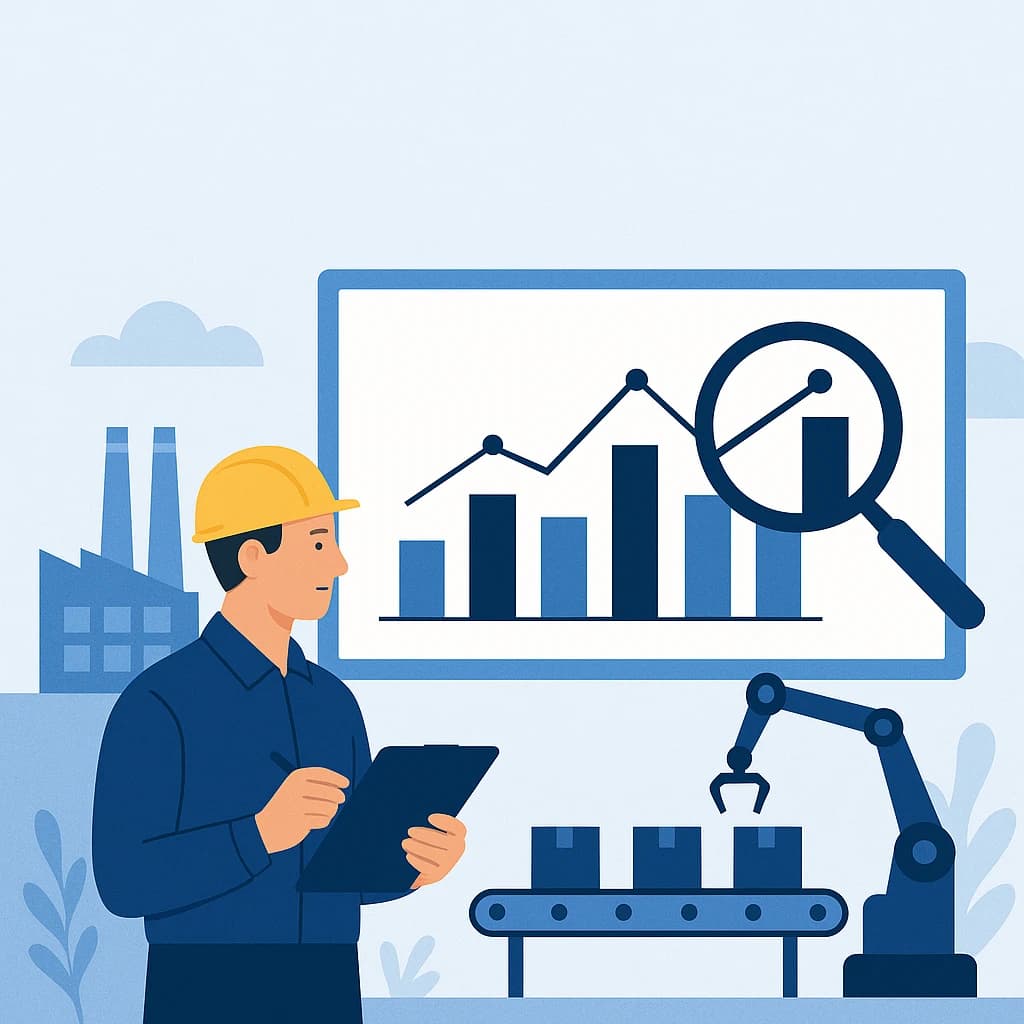
Today, data is key to working better. With it, you can find out where time is being lost, which machines are performing below expectations, or when a process needs adjustments. The MES is the bridge between what is happening in the factory and the decisions you make: it turns data into useful information that helps improve production.
When we talk about productivity on the plant floor, we often think about working faster or manufacturing more parts. But productivity is also about getting it right the first time, avoiding rework, reducing waste, and making better use of resources. Data shows you where those losses of time and money are—losses that often go unnoticed.
Data capture: the foundation of everything
To analyze information, you first need to collect it properly. This is where the MES plays an important role: it stores data about everything that happens in the plant, such as how long machines are running, production speed, quality rejects, and equipment performance.
For example, think of a machine that stops for five minutes several times a day. No one may think much of it because “it starts up quickly,” but by the end of the week those stoppages add up to several hours of lost time. The MES collects these details and makes them visible.
The clearer and more complete the data, the easier it is to understand what is happening. If information is missing or not collected properly, the conclusions can lead to mistakes. Having reliable data is like having a properly calibrated scale: without it, any decision can go awry.
Each data point is like a piece of a puzzle: when they come together, you see the full picture of production.
From information to action
Collecting data is good, but what matters is what you do with it. An MES doesn’t just display figures; it also helps detect patterns, anticipate problems, and suggest solutions.
For example, if a machine starts taking longer than usual to complete each cycle, the system detects it and alerts you before a breakdown occurs. Or if one shift produces more defects than another, this becomes clear in the report, and you can investigate the causes.
As well as looking at what has already happened, it lets you simulate what would happen if you changed a process or if demand increased. And all of this is presented in easy-to-read reports and dashboards, so you don’t have to wrestle with complicated tables or endless calculations.
That way, you not only know how the factory is doing today, but can also anticipate bottlenecks, plan production better, and organize staff work with less improvisation.
The real productivity benefits of an MES
When an MES is implemented well, the results are noticeable quickly. Here are some examples of what it can bring:
- More fine-tuned processes: identifies weak points and helps correct them.
- Continuous improvement: every adjustment is based on facts, not assumptions.
- Fast, confident decisions: real-time data lets you respond without wasting time.
- Predictive maintenance: alerts you when a machine could fail, before it does.
- Production flexibility: makes it easier to adapt to changing orders without stopping the line.
- Energy and resource savings: shows where too much is being used and how to reduce it.
- Regulatory compliance: simplifies quality checks and audits.
Each of these benefits is an advantage on its own. Together, however, they help the plant run in a much more orderly way. In the end, that means less stress for the supervisor, fewer problems for operators, and greater confidence for customers.
An MES lets you make clear decisions based on facts, not intuition.
Bold Factory: support for day-to-day operations
At Bold Factory, we know that every plant is different. A factory with 20 workers is not the same as one with 200, nor is mass production the same as more customized production. That is why our MES is modular and adapts to each company’s needs, regardless of its size or complexity.
Our goal is not to fill your day with more reports, but to give you the tools to have real control of your factory, without spending hours reviewing paperwork or asking every supervisor what happened during their shift.
Our goal is to help you use data to make your work easier, reduce problems, and increase productivity.
If you want to take the next step in managing your factory, find out how Bold Factory can help. Let’s talk and take a look together.