Planning & Purchasing (MRP)
Knowing how much stock to hold at any given moment and what purchases to make is fundamental to serving your customers when they need you.
Purchasing & Manufacturing Assistants
Bold tells you what to buy and when to launch each Work Order, cross-referencing your forecasts, current stock, supplier lead times and the rules you define (minimum stock, optimal batch size, coverage).
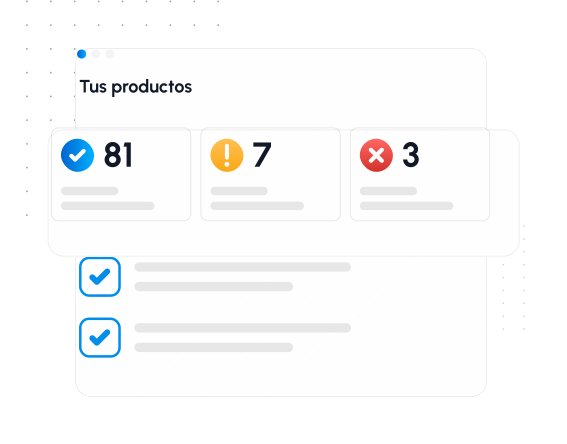
Each morning you open Bold, review the list of recommended actions and confirm with a single click. Say goodbye to parallel spreadsheets and gut-feel decisions.

Dynamic Order Allocation
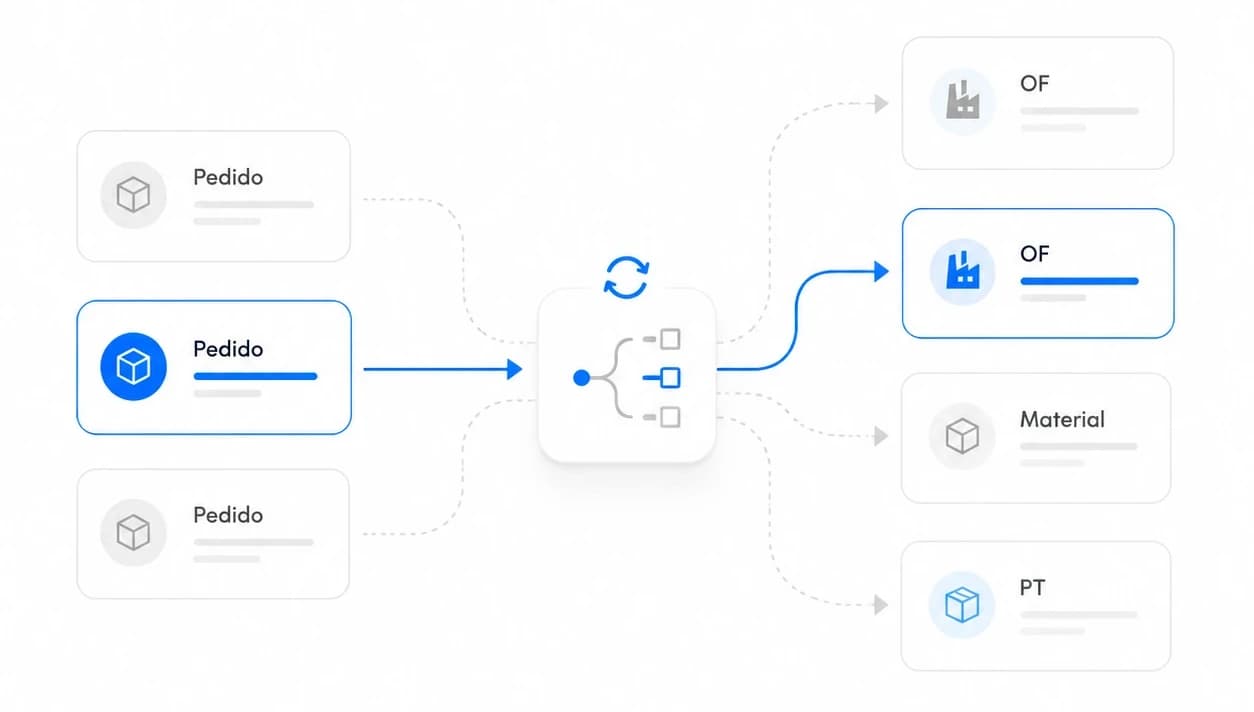
Bold recalculates in real time which materials go to each Work Order and which finished stock is allocated to each sales order. You instantly know what you can launch, what you can ship and what is on hold.
Unlike traditional MRP systems — which recalculate in overnight batches — simply changing the target date of a Work Order or a sales order updates the allocation immediately.
Demand Forecasting
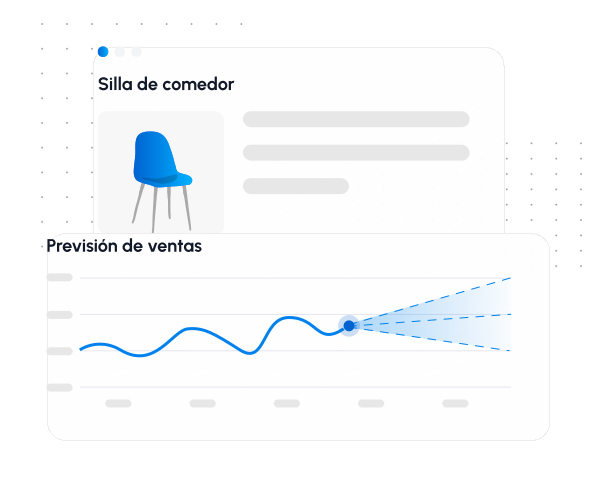
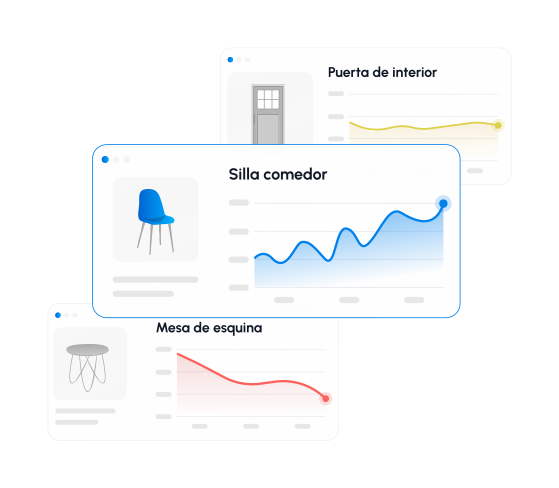
With Bold you get automatic sales forecasts based on advanced mathematical models.
From those forecasts and your bills of materials, we calculate when and how much you need to buy and what you need to manufacture. These manufacturing requests go straight to the production module so the production manager can take control from there.
Frequently asked questions
What is an MRP system (Material Requirements Planning)?
An MRP (Material Requirements Planning) system is software that calculates what materials need to be purchased and what products need to be manufactured — in what quantities and when — in order to meet demand. It does this by cross-referencing sales forecasts, confirmed orders, available stock, bills of materials (BOMs), and supplier lead times. Its goal is to avoid both stockouts and overstocking, giving your team a clear action list to execute.
What is the difference between an MRP and an ERP?
The ERP manages the administrative, financial, commercial, and logistical information of the business in a cross-functional way, while the MRP specializes in one specific question: what to buy and what to manufacture to meet demand. In practice, MRP is one of the key modules of an industrial ERP, but many SMEs need it without having a full ERP in place. Bold lets you start with MRP and connect it to your existing ERP through a public API.
What is the difference between an MRP and a MES?
MRP plans: it decides what will be purchased and manufactured over the coming weeks or months. MES (Manufacturing Execution System) executes: it controls what is happening on the shop floor in real time (orders, times, downtime, quality). They are two complementary layers: MRP sets the plan, MES puts it into practice. Bold integrates both modules in a single cloud platform so that planning and execution do not live in separate systems.
How does purchasing planning work with an MRP?
An MRP plans purchases by combining your sales forecasts, available stock, open orders, the bills of materials for each product, and each supplier's lead time. From this it calculates how much material is missing and when it needs to be ordered to arrive on time. In Bold, this is handled by a purchasing assistant that delivers a filtered list of proposals every morning, already sorted by your rules (minimum stock, optimal lot size, coverage).
How does an MRP calculate material requirements?
An MRP decomposes each finished product into its components using the bill of materials (BOM) and, for each component, subtracts available stock and purchase orders already in progress. What remains is the net requirement. That requirement is placed on a calendar according to the supplier lead time or manufacturing time, so each material is available exactly when it is needed. This is the classic MRP logic — today enhanced with automatic forecasting and real-time reallocation.
What types of companies need an MRP system?
Any manufacturer with multiple materials per product, varying supplier lead times, and fluctuating demand: industrial SMEs with series or project-based production, workshops with critical purchasing requirements, and companies that repeatedly experience stockouts or excess inventory. If you plan by instinct or in Excel and rush orders and delays slip through every week, an MRP system will bring order and reduce errors from the very first month.
How are demand forecasts generated in a modern MRP?
Demand forecasts in a modern MRP are calculated automatically from sales history, using mathematical models that detect trends, seasonality, and growth or decline patterns. The result is a per-SKU sales projection that feeds directly into purchasing and manufacturing planning — no parallel Excel files needed. In Bold, the forecast updates itself and can be adjusted manually when you have additional information (campaigns, contracts, product launches).
What are the advantages of an MRP integrated with the rest of the factory?
An MRP integrated with the ERP, the warehouse (WMS), and shop-floor execution (MES) always works with up-to-date data: actual stock consumed on each work order, purchase receipts registered in the warehouse, and orders confirmed by sales. This allows material and finished-goods allocation to be recalculated in real time rather than in an overnight batch process. In Bold it comes integrated out of the box — no connection projects between systems required.
How much does an MRP system cost and how long does implementation take?
With a cloud MRP like Bold, implementation is phased: within days you can be planning purchases and manufacturing requirements for your first products, then expand to the full catalog at your team's pace — without interrupting operations. On the cost side, you avoid upfront investment: it is billed as a monthly SaaS subscription from €300/month (Lite plan), including license, support, and updates.