FIFO in a warehouse: how to apply and control it in your plant

2026-10-28
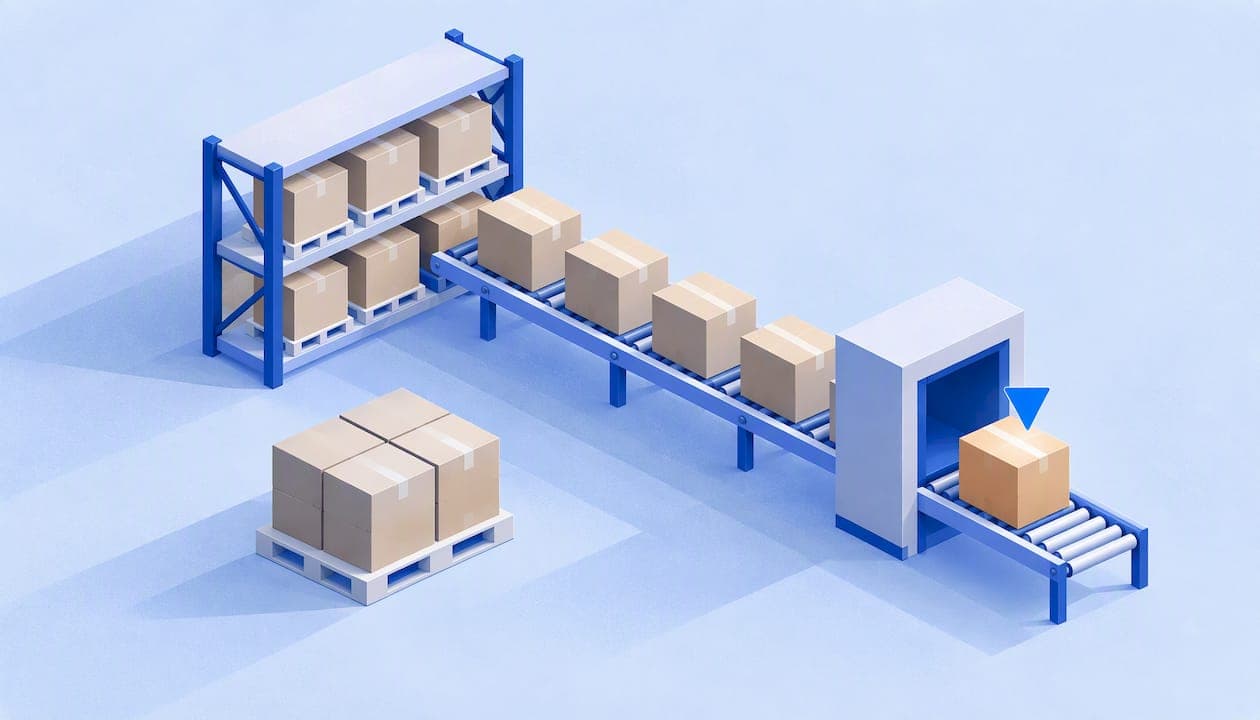
FIFO (First In, First Out) means issuing first what entered the warehouse first. It seems trivial, but in a small or medium-sized factory it can easily break down: a new pallet arrives, it is placed in front of the old one because that is more convenient, and a few weeks later there is forgotten material at the back of the rack. In this article, we explain what FIFO is, how to apply it to receipts, locations, and outbound movements, how to calculate valuation with an example, and what it takes to make it work consistently—not just on the day the warehouse is designed.
In brief
-
FIFO means that the oldest goods are the first to leave, helping maintain consistent stock rotation and prevent obsolescence and loss of value.
-
To apply it, identify each unit by its receipt date or lot, organize locations so older stock is accessible, and prioritize age when picking orders.
-
FIFO often fails during replenishment, when new stock is placed in front of older stock, and because of incorrect date records. Team training is decisive.
-
If your product expires, FEFO is usually a better criterion; otherwise, FIFO is the most natural choice for raw materials and components.
-
A warehouse management system (WMS) with real-time stock turns the rule into a specific instruction for the operator: which location, which lot, now.
Table of contents
-
How FIFO is applied to receipts, locations, and outbound movements
-
FIFO in the factory: raw materials, semi-finished goods, and production
What FIFO is in a warehouse and what it is for
FIFO is an inventory management method that prioritizes the dispatch of the oldest products to prevent obsolescence and the loss of value of goods. Its literal meaning, “first in, first out,” applies to inventory that was purchased first.
Its practical purpose is twofold. On the one hand, it improves stock rotation and reduces the accumulation of obsolete or expired goods and losses due to deterioration—something especially visible in food, pharmaceuticals, cosmetics, fashion, and electronics. On the other, it brings order: when everyone knows what goes out first, picking errors are reduced and lot control and traceability are made easier.
In a small or medium-sized industrial business, the problem is usually not expiration, but other forms of aging: sheet metal that rusts, adhesives with a shelf life, fabrics that change dye lots, components whose supplier has changed the specification, packaging that becomes misshapen. Even when material has no printed date, mixing old and new lots without control creates variability in production and disagreements when a quality issue arises: which delivery did this part come from?
How FIFO is applied to receipts, locations, and outbound movements
FIFO is not an option you switch on; it is a discipline that runs through the entire physical flow. These are the steps that work in practice.
-
Identify every receipt. Each product must be identified by its receipt date, lot, or expiration date. Without that information, FIFO is impossible; you are relying on intuition. Ideally, do this at receiving, with the delivery note in front of you and after checking quantities and condition.
-
Assign locations that respect the order. Organize the warehouse so that the oldest units are accessible. Depending on the type of racking, this means loading from one side and unloading from the other, or having separate locations for each lot so that you do not rely on someone remembering what is behind the other stock.
-
Replenish without blocking older stock. For FIFO to work, replenishment must not block access to older stock. This is where things most often go wrong.
-
Always pick by age. Order picking and supplying production lines must prioritize the oldest receipt.
-
Put returns back using the same criterion. Returns must be put back into stock using the same rotation system to avoid creating disorder. A manufacturing surplus that returns to the warehouse without a label is the source of many “orphaned” lots.
-
Review and reconcile. A cycle count comparing what the system says with what is in the location detects discrepancies sooner than an annual inventory.
A plant example
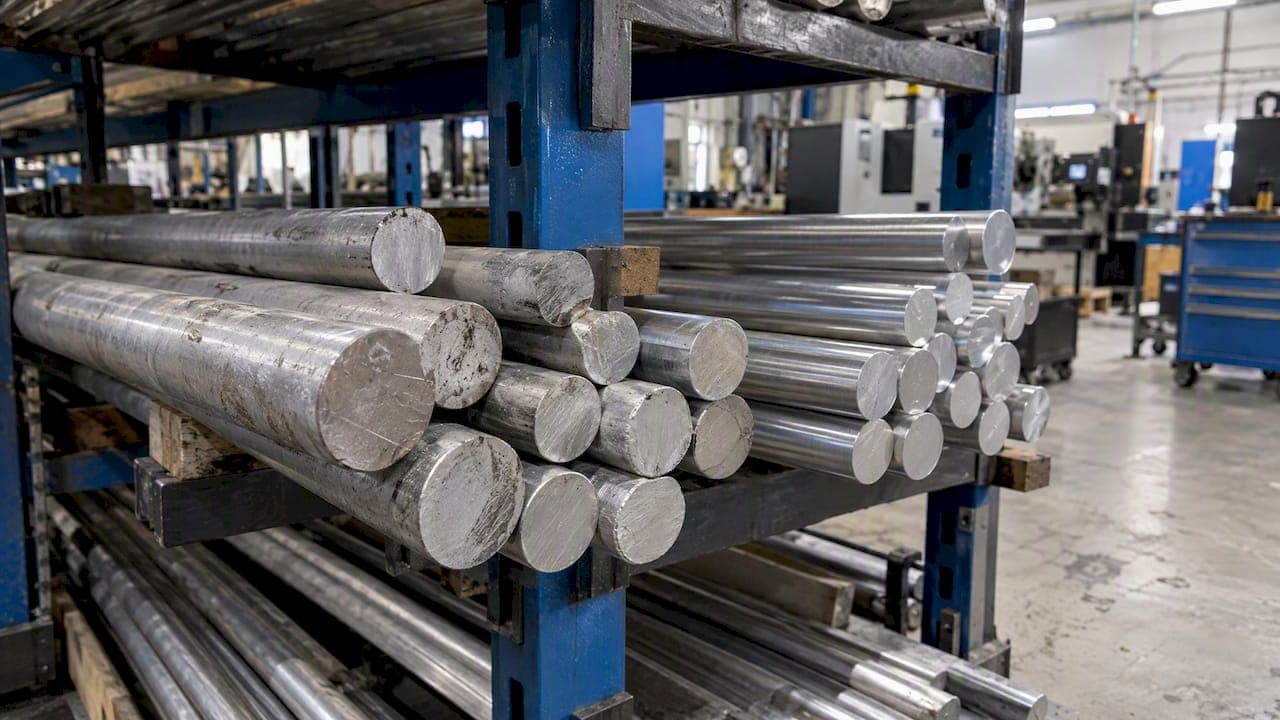
Imagine a machining plant that receives aluminum bar from two different melts three weeks apart. If both are stored in the same rack without identification, the operator takes whichever is easiest to reach. When a part with hardness outside the tolerance appears, no one can say for sure which melt it came from. With FIFO and a recorded lot, you know what was consumed first, in which manufacturing order, and which parts are affected. This is an illustrative example, but it reflects the logic of any plant handling materials from multiple lots.
Where FIFO breaks down in practice
The theory is simple. Failures are almost always human or process-related:
-
“Convenient” replenishment. FIFO often breaks down during replenishment when new stock is placed in front of older stock. If there is no visible rule and clear location, that is what will happen during a rushed shift.
-
Lack of manual rotation and overloaded racks. When space is tight, material is placed wherever it fits, and FIFO remains on paper.
-
Incorrect date records. A wrongly entered date turns the system into a source of errors because the operator trusts what they see on screen. These failures are cited as common causes, and training is the main remedy.
-
Untracked exceptions. Urgent requests, material verbally “reserved,” removals for a test. Every exception that is not recorded undermines stock reliability.
Our conclusion at Bold Factory, based on seeing how plants work, is that FIFO is not maintained with an internal memo, but by making the right thing also the easiest thing for the operator to do.
FIFO, FEFO, LIFO, and WAC: which one is right for each case
The stock rotation strategy is defined when designing or updating the warehouse according to the type of product, especially its expiration date. This table summarizes the decision criteria.
| Criterion | What it prioritizes | When it fits |
|---|---|---|
| FIFO | What entered first | Raw materials, components, and finished products without strict expiration dates but at risk of obsolescence |
| FEFO | What expires first | Perishable goods or goods with an expiration date, where FEFO is the most commonly used rotation method |
| LIFO | What entered last | Non-perishable products that do not lose value, to avoid moving goods |
| WAC (weighted average cost) | Average cost of inventory | An accounting valuation method, not a physical movement method |
The important distinction is this: FIFO, FEFO, and LIFO are physical movement rules, while FIFO and WAC are also cost calculation methods for valuation purposes. They may or may not coincide. A warehouse can physically move goods according to FEFO and value them in its accounts at the average price. To find out which valuation method is permissible and appropriate for your company, consult your tax or accounting adviser.
If you manufacture using materials that do not expire, FIFO is usually the safest choice. If you have products with a use-by date, such as glues, resins, paints, or certain packaging materials with a shelf life, the sensible approach is FEFO for those items and FIFO for the rest. A good system lets you define the rule by item, rather than applying a single rule to the entire warehouse.
How FIFO is calculated: a valuation example
FIFO valuation is calculated in three steps: entries are sorted by date and cost, outbound movements are assigned first to the oldest lot and, if that is not enough, to the next lots, and the ending inventory consists of the most recent units, valued at their acquisition cost.
Here is an example using the same approach as the one given by Ilerna: 200 units arrive at €50 and then 300 units at €60. An issue of 400 units takes place.
| Item | Calculation | Amount |
|---|---|---|
| Consumption from lot 1 | 200 × €50 | €10,000 |
| Consumption from lot 2 (partial) | 200 × €60 | €12,000 |
| Cost of issue (400 units) | €22,000 | |
| Ending inventory | 100 × €60 | €6,000 |
The practical result: when prices are rising, FIFO leaves the more expensive units in inventory and assigns an older, lower cost to production. That is why it is important for the system to retain the cost of each receipt, not just the quantity. If your ERP already calculates valuation, the operational warehouse must feed it exact receipts and issues.
FIFO in the factory: raw materials, semi-finished goods, and production
Most articles about FIFO focus on a distribution center. In a plant, the warehouse is connected to production, and that brings its own requirements.
Receiving as the starting point
FIFO quality is decided at the door. If receiving inspection does not record the lot, quantity, and condition, everything that comes afterward inherits the error. At Bold Factory, we have documented how to configure and complete receiving inspections, so that material enters the system already identified and ready to be rotated.
Consumption linked to manufacturing orders
In discrete manufacturing (metal, machining, furniture, textiles, packaging), material is consumed for a manufacturing order, not a customer order. If planning and the warehouse are separate systems, material is consumed without anyone recording the lot, and FIFO disappears exactly where it matters most. When production planning and the warehouse share data, each production plan can rely on actual inventory and the order in which materials should be consumed.
Semi-finished goods and finished products
FIFO also applies to what you manufacture. A lot of finished parts waiting for dispatch with packaging that deteriorates, or semi-finished goods waiting for external processing, need the same age-based criterion. Surplus material, remnants, and reusable offcuts also need their own location and label.
Real-time stock and inventory: what makes FIFO possible
Paper and Excel can support FIFO while the warehouse is small and the person running it knows it by heart. They stop working when there are multiple shifts, more SKUs, or staff turnover. The reason is that both are always one step behind reality: something is recorded later, updated at the end of the day, and by the time someone checks the stock, it has already changed.
A warehouse management system (WMS) closes that gap. A WMS identifies the location of the oldest product, guides operators, records movements with traceability, and alerts them to approaching expiration dates or a lack of rotation. In addition, a WMS configured for the rotation method controls inventory, transactions, and their physical orders, and provides traceability for the flow of goods.
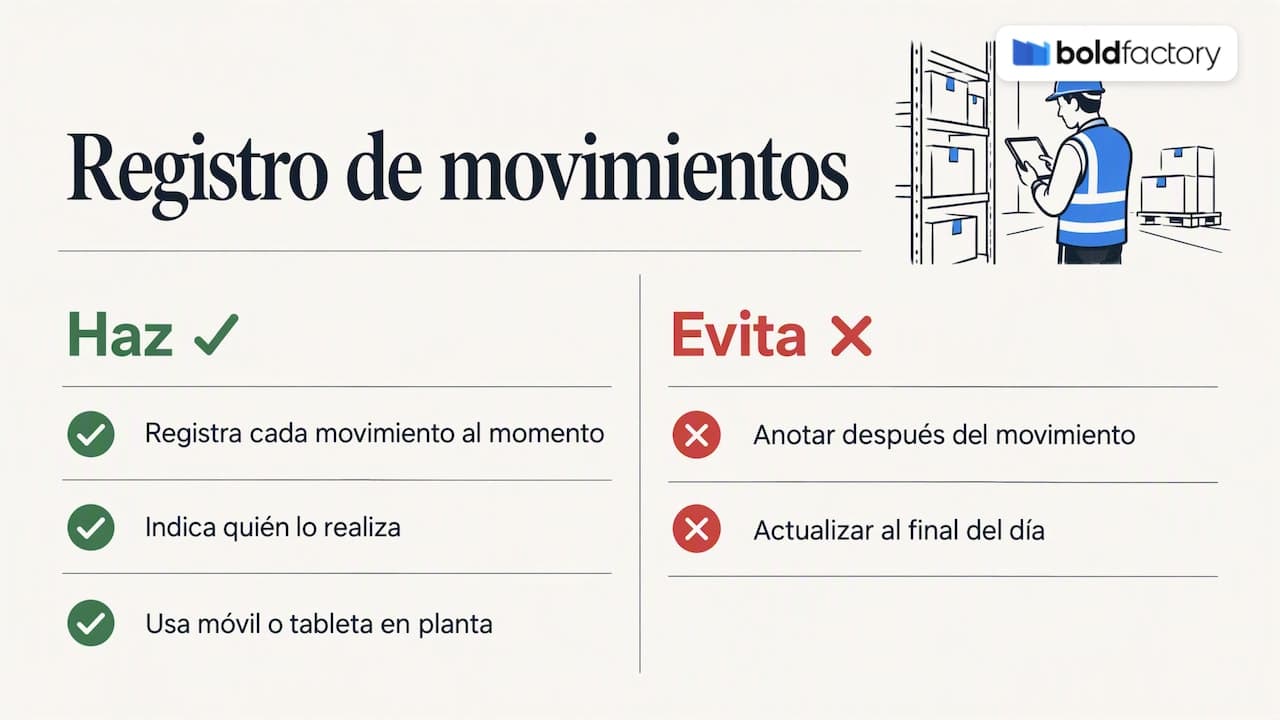
“Real-time stock” is not a technological luxury, but the condition for the data on screen to match what is on the rack. Every movement (receipt, transfer, consumption, return) must be recorded at the time it happens and by the person carrying it out, ideally from a mobile phone or tablet on the plant floor. If recording takes more effort than not recording, the system is left without data.
What to look for in a WMS to support FIFO
-
Mandatory lot and receipt-date recording at receiving.
-
Automatic suggestion of the location and lot that should be issued first.
-
The ability to define the rule (FIFO or FEFO) by item.
-
Forward and backward traceability: which lot a part came from and which orders it went to.
-
An interface that an operator without computer training can use easily.
-
Integration with the ERP so that valuation and movements do not contradict each other.
Automating rotation also protects your inventory
Automation brings precision to stock management, makes traceability easier, speeds up rotation, and optimizes space. That precision has a useful side effect: you know what you have, where it is, and what it is worth. This is the basis for any serious conversation about coverage. If your stock is a significant balance-sheet asset, it is worth checking with a broker that the insured amount reflects its real, up-to-date value; business inventory insurance is calibrated using reliable inventory data, exactly what well-managed FIFO produces.
How we solve it at Bold Factory
At Bold Factory, we have designed a platform for industrial SMEs with 5 to 100 operators that want to leave paper and Excel behind without taking on a costly project. It brings production (MES), planning and purchasing (MRP), warehousing (WMS), and maintenance (CMMS) together in a single system, so the warehouse is not an island: what is received, consumed, and manufactured is all in one place. Operators work from tablets on the plant floor, and AI agents automate repetitive tasks based on natural-language instructions. It is implemented in days and has no long-term commitment.
If you already have an ERP, you do not need to replace it: we offer API integration so both systems can share data. To start exploring the platform, the getting started guide explains how to configure it.
You can view the details of each plan on the pricing page and request a demo to see your receiving, putaway, and dispatch flow using your own data.
Getting started: FIFO in 30 days
You do not need to transform the entire plant all at once. Here is a realistic sequence:
-
Week 1: choose the scope. Start with the 20 items with the highest value or greatest risk of obsolescence, not the entire catalog.
-
Weeks 1–2: define the rule for each item. FIFO, FEFO, or no rule. Record it and make it visible at the location.
-
Week 2: organize and label. Locations with codes, and a lot label and date on every pallet or container.
-
Week 3: record movements as they happen. Receipts and consumption are recorded where they occur, not at the end of the shift. Train the person doing replenishment, because that is where FIFO is won or lost.
-
Week 4: audit. Cycle-count the items in scope and analyze discrepancies: where was the rule skipped, and why?
Once the initial scope is working, expand by product family. The most useful metric to track is simple: how many issues were made using a lot that was not the oldest available, and why.
Frequently asked questions
What is FIFO in a warehouse?
It is the stock rotation criterion under which the goods that enter first are the first to leave. It is applied by identifying each receipt by its date or lot and organizing locations and picking so that the oldest stock is used first. Its goal is to prevent obsolescence, deterioration, and loss of value.
What is the difference between FIFO and FEFO?
FIFO prioritizes the receipt date, while FEFO prioritizes the expiration date. If all your products expire after the same amount of time from their receipt, the two coincide; otherwise, FEFO is the safest criterion for perishables. Both can be used in the same plant, with a rule assigned to each item.
How is FIFO calculated?
Entries are sorted by date and cost, issues are deducted starting with the oldest lot, and ending inventory is valued using the costs of the most recent lots. With 200 units at €50 and 300 at €60, an issue of 400 units costs €22,000, and the remaining 100 units are valued at €6,000.
Do I need a WMS to apply FIFO?
In a small warehouse with few items, organization, labels, and discipline may be enough. As soon as you have multiple shifts, mixed lots, or traceability requirements, a WMS reduces errors because it indicates which location and lot should be issued and records every movement in real time.