Warehouse locations: when dividing the building pays off

2026-10-22
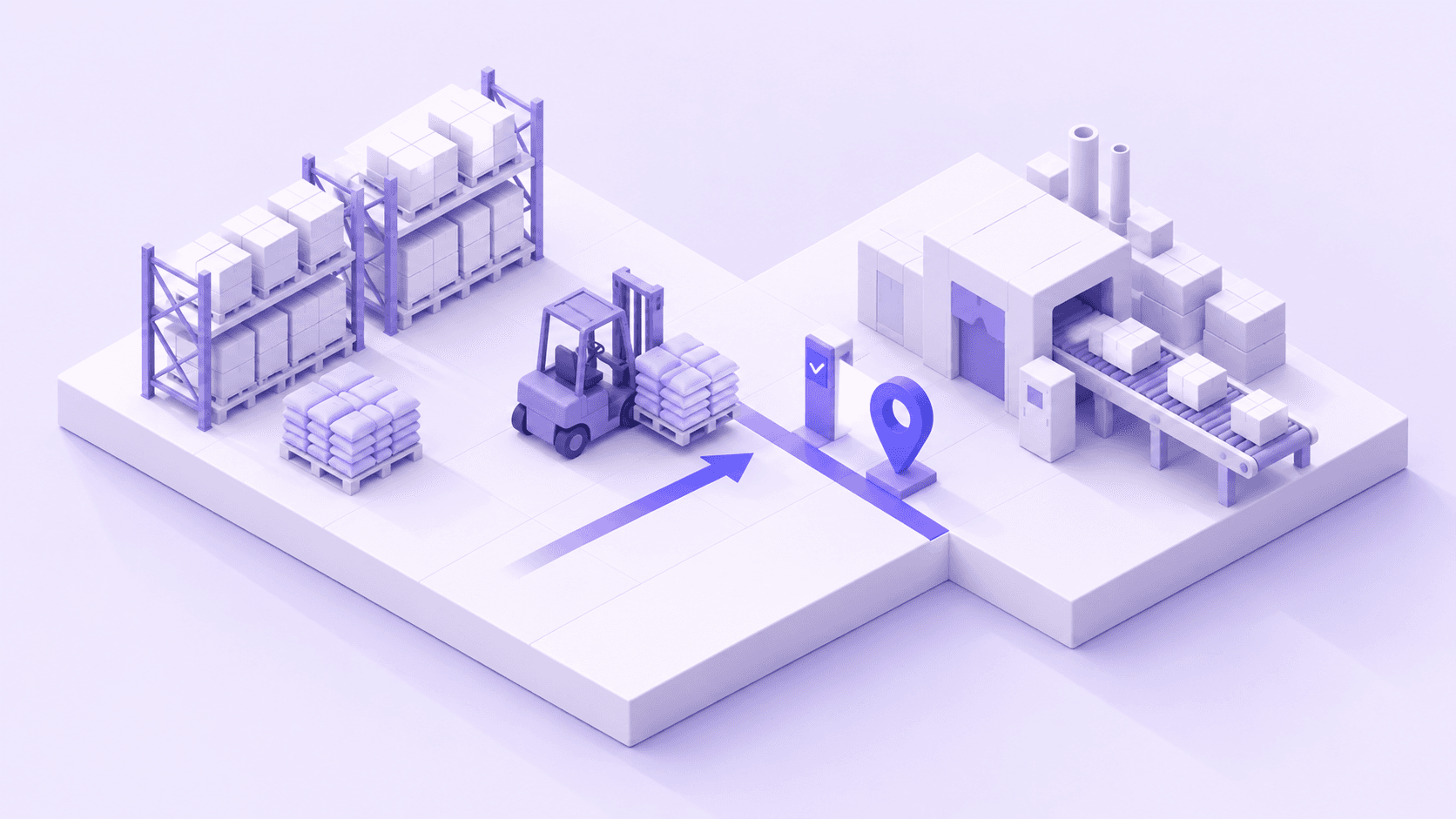
— Where is the pallet of resin from Resina S.A.?
— I saw Manolo moving it on Friday.
Manolo has the day off today. The pallet is in the warehouse, 40 meters from the person asking, and for 20 minutes three people are looking for it. It turns up behind some coils, where Manolo left it because another forklift driver was coming toward him and the aisle had to be cleared. Nobody recorded it. Everyone remembered.
The following Monday someone says the words: we’re going to map the warehouse. And the conversation that follows is always the same—do we go down to zone, rack, or bin?—as if it were a decision about the level of detail.
It isn’t. A location isn’t a place: it’s a boundary, and every boundary you draw is a record someone has to make every time they cross it for the next 10 years. The useful question isn’t how granular to get. It’s how many records per day your plant can handle, and whether what you get in return is worth what they cost.
In summary
- A location isn’t a place; it’s a boundary that requires you to declare a movement every time it’s crossed. You don’t pay the cost on the day you draw it: you pay it every day.
- A location pays off when it prevents one search for every twenty-four movements it requires you to record. Do that calculation zone by zone, never for the entire warehouse.
- The test for deciding how granular a zone should be isn’t how many SKUs it has: it’s whether someone who didn’t put it away can find it by looking.
- “It’s in the warehouse” is never a lie. “It’s in B-04-12” sometimes is, and the wrong location that makes an occupied bin look empty doesn’t make you search: it makes you buy what you already have.
- The most valuable boundary isn’t in the warehouse; it’s at the line-side edge. It’s the only one that reconciles stock with what’s been produced, and it’s the one almost nobody draws.
- A location map only survives if the three people who move the material—receiving, production, and shipping—write to it in the same place where it’s consulted.
What you’ll find here
- A location isn’t a place, it’s a boundary
- What a location costs and what it gives you in return
- Precision you can’t sustain costs more than having none
- The four boundaries in a factory, and the one almost nobody draws
- A map only survives if the three people who move the material write to it
- The right order for dividing up a warehouse
- Sources
A location isn’t a place, it’s a boundary
Let’s start with what a location is inside a system, because almost everyone pictures it incorrectly.
The usual mental image is a floor plan: the warehouse divided into grids, each grid with a name, and the software showing where everything is. That’s what you sometimes see in a demo. It’s not what happens in the data model.
In the model the industry uses to describe material—the ISA-95 series, published as a standard in IEC 62264-2—a location isn’t a standalone entity: it’s an attribute attached to the lot, alongside its quantity and status. A material lot has a location in the same way it has 340 kilos and is pending inspection. There is no map. There are lots that say where they are.
And that completely changes what the decision is about. If the location is an attribute of the lot, then changing location is a transaction: at some point, someone has to declare that the lot is no longer in A and is now in B. There’s no other way for the data to move. There is no warehouse that updates itself.
That leads to the definition worth keeping in mind for the rest of this article:
A location isn’t a place in the warehouse. It’s a line that requires you to declare a movement every time someone crosses it carrying material.
Drawing five lines means five types of declaration. Drawing three hundred means three hundred. And you don’t pay the cost on the day of the project, when there’s energy and budget: you pay it on the afternoon shift on a Tuesday in November, when there are two hours of orders left and the terminal is at the other end of the warehouse.
What a location costs and what it gives you in return
The good thing about looking at it this way is that you can do the math. Not with accounting precision, but well enough to make a decision.
A location costs records. Declaring a movement with a terminal at the end of an aisle—selecting the lot, scanning the bin label, confirming—takes around 15 seconds when everything goes well.
A location returns searches that don’t happen. A failed search—walking around, asking two people, finding it behind something else—takes about 6 minutes, and sometimes much longer.
Divide one by the other and you get the only rule you need:
A location pays off approximately when it prevents one search for every twenty-four movements it requires you to record. 360 seconds divided by 15.
Twenty-four. That’s the number. And it’s a surprisingly easy number to beat in some areas and impossible in others—which is exactly why the decision can’t be made for the whole warehouse at once.
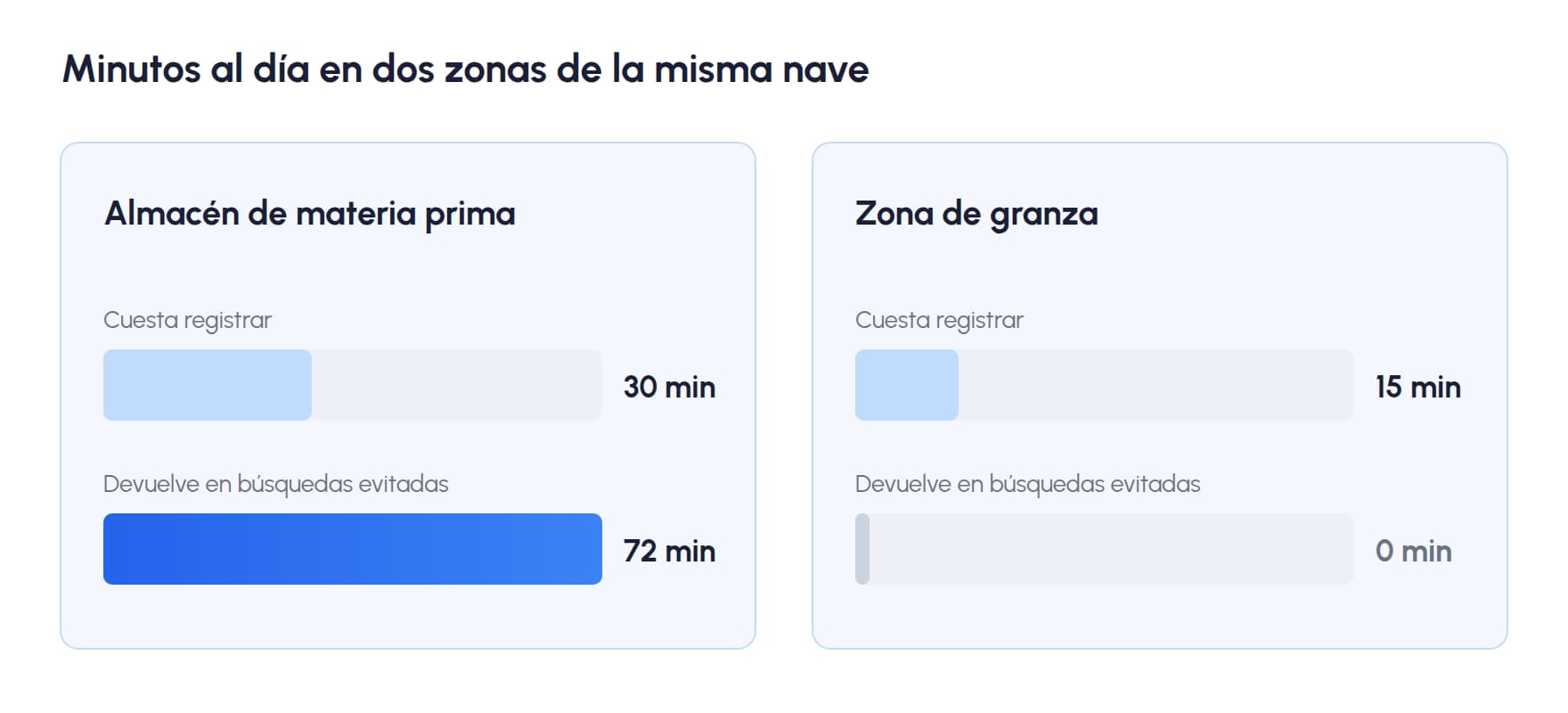
Look at the two areas in the same factory (illustrative example, using the times above):
- Raw material warehouse, 90 SKUs on racks. Around 120 boxes and pallets are moved per day. Recording them: 120 × 15 s = 30 minutes per day. Of those 120 movements, about 12 involve material that nobody would find without help: one search for every 10 movements, well below the threshold of 24. You avoid 12 × 6 min = 72 minutes. Net result: 42 minutes per day saved, about three and a half hours per week.
- Granules area, three silos and a pallet of bags. Around 60 consumptions are recorded per day: 60 × 15 s = 15 minutes per day. Searches avoided: none. The granules are in plain sight and there’s only one type. Those 15 minutes a day, over 220 working days, add up to 55 hours a year of recording that answers no question anyone has asked.
Neither conclusion is “more locations are better” or “fewer are better.” It’s that the zone is the unit of decision, and a typical factory needs different levels of granularity in different places in the same warehouse.
And the question that decides what to do in each zone isn’t how many SKUs it has or how many meters long it is. It’s simpler and more reliable:
Could someone who didn’t put it away find it by looking?
If the answer is yes—a three-meter coil, a silo, a drum that looks different from every other one—a location doesn’t buy you anything. If the answer is no—forty identical bags of additives that can only be distinguished by their labels, fasteners, spare parts—it’s the only thing that will work.
Levels of granularity aren’t a scale from “better” to “worse.” Each one answers a different question and comes at a different cost:
| Level | What question it answers | What records it adds |
|---|---|---|
| One location | Do we have it or not? | Warehouse receipts and issues |
| Zone by status (raw material, work in process, quality, finished goods) | Can I use it? | Plus each status change |
| Rack or aisle | Where should I start looking? | Plus each relocation between zones |
| Bin or map | Exactly where is it? | Plus every internal movement, including the forklift driver’s movement to clear an aisle |
Almost every factory considering “adding locations” is thinking about the last row. And almost all of them would get most of the benefit from the second.
Precision you can’t sustain costs more than having none
So far, we’ve assumed the records get made. Now let’s look at what happens when they don’t.
This is where intuition can mislead you, because it seems as though a poorly maintained location is simply a location that delivers less. That’s half the truth, not the whole truth. It doesn’t work that way, because the two possible errors don’t cost the same.
- A bin the system says is full but is actually empty costs you a search. Annoying but recoverable: the operator looks, it’s not there, they ask, it turns up.
- A bin the system says is empty but is actually full costs you a purchase. The material exists, has been paid for, and is in your warehouse, but as far as the system is concerned it doesn’t exist, so it’s included in the requirements calculation as if it were missing. And at that point nothing can stop it: an MRP amplifies whatever you give it, and it does so very quickly and with great confidence.
That second error is what turns a poorly maintained map into something worse than having no map at all. A warehouse with one location tells you “we have it” and is always right. A warehouse with three hundred bins tells you “it’s in B-04-12” and, when it’s wrong, it doesn’t fail by expressing doubt: it fails by making a specific, incorrect assertion that a planning system takes seriously.
And there’s a second effect, slower and more expensive to reverse. An operator who twice in a row finds the material where the system said it wasn’t stops looking at the system. From that day on, you keep paying the 15 seconds for every record, but get nothing in return, because nobody consults the data those records produce. It’s the same dynamic that causes a plant to end up depending on people’s memory to manufacture: the system isn’t abandoned all at once; it’s abandoned through accumulated distrust.
That leads to the uncomfortable rule, which is often what decides the project:
The level of granularity you can sustain isn’t the one your best shift can manage. It’s the one your worst-recording shift can manage.
If the night shift isn’t going to scan the bin, your warehouse doesn’t have bins: it has bins for eight hours a day and a lying map for the other sixteen.
The four boundaries in a factory, and the one almost nobody draws
If you’re going to draw lines, it helps to know where they are. In a factory, material changes hands only four times, and each of those four boundaries delivers something different.
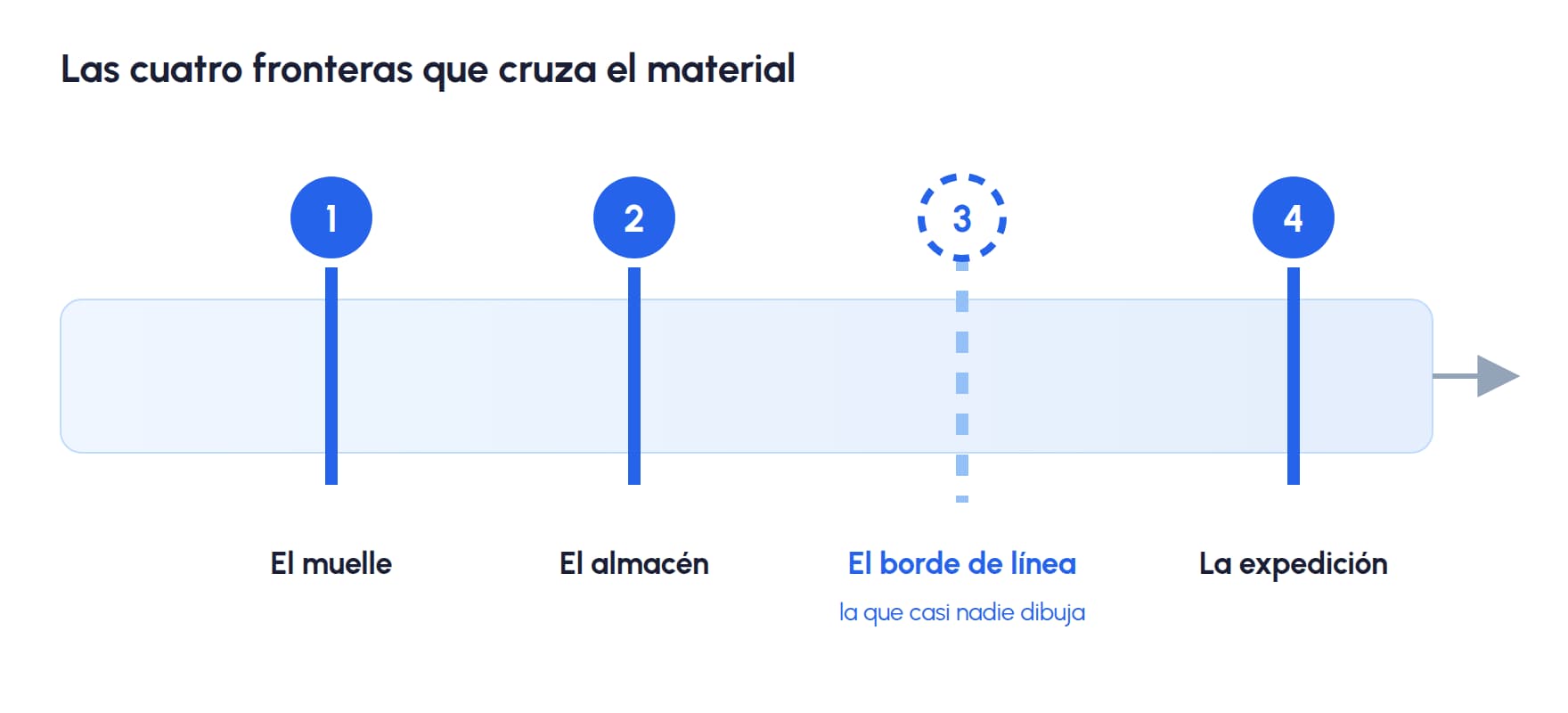
1. The loading dock: the boundary you already have
When a truck arrives, someone signs a delivery note. That’s the first boundary, and practically every factory has it recorded, even if only on paper: what arrived, from whom, and when.
What it delivers is the starting point for everything else. Without it there’s no stock, no traceability, and nothing to locate. It’s also the cheapest of the four, because the material arrives already grouped into pallets and large quantities: few records, lots of information.
2. The warehouse: the boundary everyone debates
Once the receipt has been recorded, the second boundary is the one that takes up 90 percent of meetings: how to subdivide the warehouse internally.
It’s the one that answers the visual test from the previous section, and the one that varies most from one factory to another. In a warehouse of fasteners and spare parts, bins win hands down. In one storing steel coils, they almost never do. The important thing is that this is the boundary where each zone can have a different answer, and the only one of the four where you really need to do the math on the twenty-four movements.
3. The line-side edge: the boundary almost nobody draws
And here is the real gap in almost every factory.
When a pallet leaves the warehouse for the line, in the vast majority of systems it disappears. It moves to a generic location called “plant” or “production,” or is deducted from stock as soon as it leaves. From that moment on, there is physical material in the factory that the system can no longer locate or count: it’s on the cart next to the extruder, half-consumed, and it’ll stay there for three days.
That boundary—the point of use, the line-side edge—is the only one that does something none of the other three do: reconcile what’s been consumed with what’s been produced. It’s the moment when material stops being stock and becomes product, and it’s the only record that lets you say which lot went into a specific manufacturing order. Without it, what you have isn’t data: it’s a theoretical calculation based on the bill of materials, which is exactly where the traceability chain breaks.
And it’s a cheap boundary. Just one record the operator should already be logging at their workstation. I did this = I consumed this.
4. Shipping: the boundary that determines what you can promise
The last boundary is the outbound one. What was shipped, to whom, and from which lot.
Very little granularity is usually enough—a finished-goods zone, sometimes two by customer or route—unless you ship by lots with expiration dates, in which case the location has to be as granular as the level at which you reserve stock. What it delivers is simple, and it’s what the sales team looks at: what’s really available to promise a date.
Look at all four together and the imbalance most people have becomes obvious: two hundred bins drawn at boundary 2 and a single location called “plant” at boundary 3. Precision where a mistake costs a search, and vagueness right where data turns into money.
A map only survives if the three people who move the material write to it
There’s one more part, which isn’t about design but architecture, and it’s what determines whether the map is still alive two years from now.
Three different groups cross the four boundaries. Receiving records the receipt. Production records consumption and the return of anything left over. Shipping records the outbound movement. None of the three records anything beyond its own part, and the correct stock is the exact sum of all three.
If those three parts are recorded in three different places—a delivery note in the ERP, a paper work order, a shipping spreadsheet—the map isn’t badly designed: it’s dead from day one. Not because nobody records anything, but because the three records don’t connect, and location is precisely the kind of data that only makes sense if all three update it on the same row.
It’s worth looking at how the identification standard used across the supply chain handles this. The GS1 General Specifications define a universal identifier for physical locations, the GLN, as well as an extension component for internal sublocations—a rack bin, a loading dock, a line. What’s interesting is the condition they attach to it: that internal identifier is restricted to use by mutual agreement only. In other words, even the organization that standardizes this recognizes that a sublocation means nothing outside the group that has committed to maintaining it. Nobody outside your organization cares about your map. Its only value is the value of the internal agreement to keep it up to date.
That’s why the warehouse isn’t a separate application. In the industry operations model, developed in IEC 62264-3 as the activity models for the plant level, inventory management is one of the four operations areas, at the same level as production, quality, and maintenance. They share a level because they share data: there’s no way for the warehouse to know where the material is if it doesn’t know what production is doing. That full scope is what defines a MOM.
In Bold, the location travels with the lot, not in a separate module: the operator who clocks into an order at the workstation records consumption with the same action they use to start working, and that movement updates the stock the warehouse sees and feeds into purchasing plans. The four boundaries are recorded on the same row, each zone has the level of granularity it needs, and a bin nobody maintains can be removed without changing anything else.
The right order for dividing up a warehouse
If you have to start tomorrow, the order matters more than the ambition. Four steps, and none of them requires a project.
- Start by dividing by status, not by place. Raw material, work in process, pending quality inspection, blocked, finished goods. That’s five locations; they require a record only when the material changes status—which is already a moment when someone is paying attention—and they answer most of the questions that are answered today by asking someone.
- Draw the line-side boundary before the map. It’s the cheapest of the four boundaries and the only one that reconciles stock with production. If you’re only going to add one boundary this year, make it this one.
- Increase the level one zone at a time, and only if it fails the visual test. Take the zone where people search the most, ask yourself whether someone who didn’t put something away could find it by looking, and if the answer is no, subdivide that zone and only that one. Then measure for a month whether searches have gone down before touching the next one.
- Set the level of granularity to what the worst-recording shift can manage. If your chosen level can’t be maintained on the worst shift, you don’t have it: you have a map that lies for part of the day. Move up a level and keep data you can trust.
Once you’ve done that, the question that started the article—when to use multiple locations—answers itself, zone by zone, which is the only way it can be answered.
Sources
- IEC 62264-2:2026, Enterprise-control system integration — Part 2: Objects and attributes — object models for the exchange between plant and enterprise systems, third edition published in March 2026, where the material location is described as an attribute of the lot rather than a separate record.
- IEC 62264-3:2016, Enterprise-control system integration — Part 3: Activity models of manufacturing operations management — activity models for Level 3 manufacturing operations, where inventory management is one of the areas, alongside production, quality, and maintenance.
- IEC 62264-1:2013, Enterprise-control system integration — Part 1: Models and terminology — models and terminology for the hierarchy of levels between the plant and enterprise systems, and the framework on which the two previous parts depend.
- GS1 General Specifications, Release 26.0 — definition of the GLN for physical locations and the extension component for internal sublocations, restricted to use by mutual agreement between the parties.
- ISA-95, International Society of Automation — committee and structure of the model’s parts from which the standards above are derived.
Conclusion
Dividing up a warehouse isn’t a problem of detail; it’s a problem of maintenance. Every line you draw on the plan is a commitment to record a movement every time someone crosses it, every day, including in August and at eleven at night. The most useful map isn’t the most detailed one: it’s the most detailed one your plant can sustain without losing faith in it.
And if you’re only going to draw one new boundary this year, don’t put it in the warehouse. Put it where material stops being stock and becomes product, because it’s the only one that will give you a number you can base a purchase on.
Discover how Bold keeps stock in sync with what happens on the line, without duplicating records: request a demo 👇 and check it with your own warehouse.