SGA vs WMS: The Same Technology, Two Different Names

2026-10-13
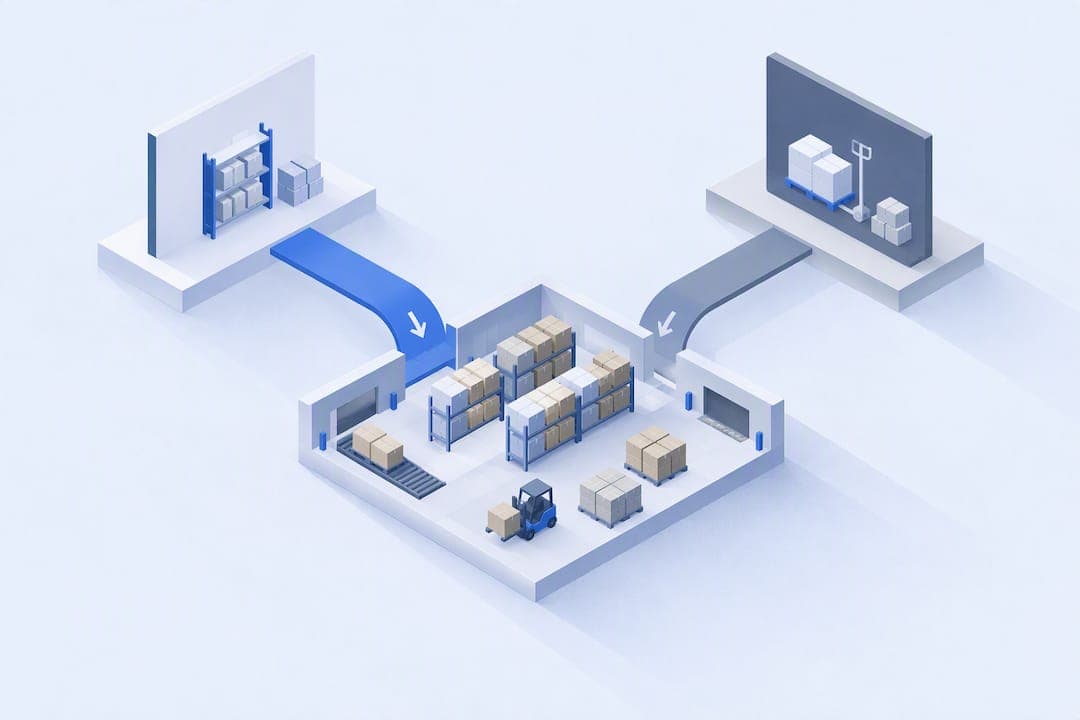
SGA and WMS are the same type of software: the former is the Spanish abbreviation for “warehouse management system” and the latter is its English equivalent, Warehouse Management System. The real decision is not about the name, but about which features your warehouse needs and how quickly you can put them in place. Platforms such as Bold Factory can address these operational needs for industrial SMEs without requiring a complex project.
In brief:
- Prioritize receiving and order picking, where manual errors accumulate; traceability should record the location, lot, and expiry date of each unit.
- Sync the system with the ERP and use GS1 labels to bring together the product reference, lot, and expiry date; the plant needs scanners, printers, and stable Wi-Fi.
- Before digitizing, document processes, test the system in one area, and train operators; compare inventory, order picking, and space utilization before and after.
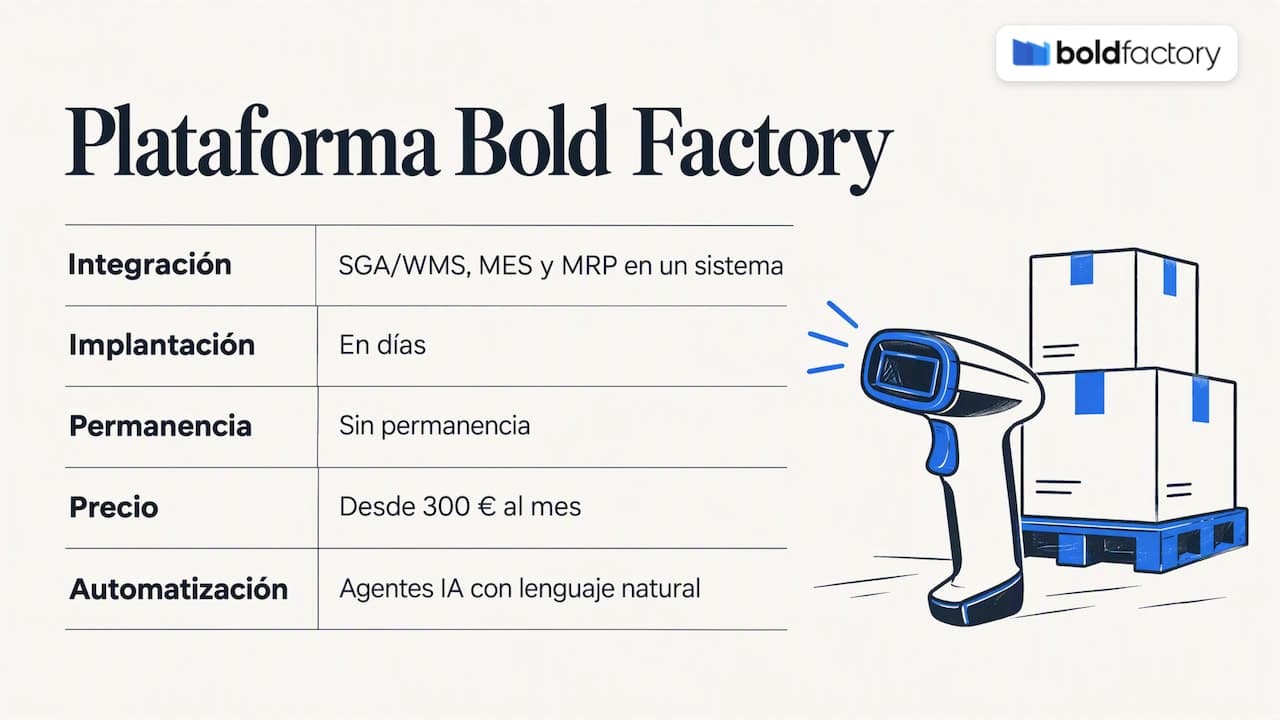
- Bold Factory connects warehousing, production, and purchasing, and offers plans from €300 per month with implementation in days; check compatibility with your ERP.
Table of Contents
- What the terms mean and why they are used interchangeably
- Key features an SGA/WMS should offer in daily operations
- Technical integrations and requirements: ERP, GS1, and hardware
- How to choose and implement an SGA/WMS in an industrial SME: a practical checklist
- Why consider Bold Factory to cover SGA/WMS needs in an industrial SME
- Frequently asked questions
- Sources
What the terms mean and why they are used interchangeably
The source of the confusion is purely linguistic. SGA originated as a direct translation of WMS in the Spanish-speaking logistics sector, and today both acronyms appear in manuals, supplier specifications, and technical conversations without any functional distinction between them, as Mundo Logística confirms. If a supplier presents its SGA as something different from a WMS, they are probably talking about scope or level of sophistication, not a different product category.
The real differences have to do with how this functionality is deployed within the company:
- An SGA can exist as a module within an ERP, sharing a database and screens with purchasing or finance.
- It can also be a dedicated solution, designed exclusively for warehousing and then connected to the ERP through integration.
- And within either format, complexity can range from basic (locations and stock) to advanced, with predictive analytics and automation, as described in the Wikipedia entry on warehouse management systems.
For an industrial SME, this distinction matters more than the acronym: an ERP module is often more rigid for day-to-day warehouse operations, while a dedicated solution or one natively integrated with production tends to adapt better to actual plant workflows.
Key features an SGA/WMS should offer in daily operations
The usefulness of an SGA or WMS is measured by day-to-day warehouse operations, not by its technical specifications. These are the capabilities that make the difference between a system that saves time and one that simply digitizes paperwork:
- Receiving and data capture: record inbound goods with lot, expiry date, and quantity from the very first scan, ideally using GS1 labels that combine several data points in a single code.
- Location management and putaway: automatically decide where to place each product reference based on turnover, volume, or picking zone, to make better use of available space.
- Picking strategies: organize work in waves, batches, or even with pick-to-light in higher-volume warehouses, a common capability in advanced WMS systems.
- Replenishment and traceability: maintain real-time visibility of stock and apply FEFO or FIFO rules according to the type of product.
- Returns and shipping: close the loop with clear outbound preparation and returns management processes without losing traceability.
Professional tip: start by digitizing receiving and picking before any other function: these are the points where the most manual errors accumulate and where you will see a return first.
Traceability deserves special mention. A well-configured SGA/WMS does not just tell you how much stock there is, but where each unit is, which lot it comes from, and when it expires—essential information in sectors such as food, pharmaceuticals, and regulated packaging.
Technical integrations and requirements: ERP, GS1, and hardware
An SGA/WMS does not work in isolation. Its value depends on how well it syncs with the rest of the factory’s digital ecosystem:
- ERP connection: the warehouse needs to exchange master data (product references, customers, orders) continuously; poor synchronization creates stock discrepancies that lead to shipping errors.
- GS1 standards: GS1 labels can represent several data elements (GTIN, lot, expiry date) in a single code, and make it possible to scan multiple values in one operation when the system is configured to do so, as explained in Microsoft Learn’s documentation on GS1 barcodes. GS1-128 is the most widely used symbology in logistics for grouping this information on pallet labels, according to GS1 Spain.
- Minimum hardware: mobile terminals, handheld or fixed scanners, label printers, and stable Wi-Fi connectivity throughout the plant are practical requirements, not optional extras.
- Physical automation: when there are conveyor belts, robots, or automated picking systems, a control system (WCS/SCA) is usually involved to execute the commands issued by the SGA/WMS; designing this integration from the outset avoids bottlenecks.
The dividing line between ERP and WMS is usually the level of granularity: the ERP manages stock at warehouse or plant level, while the WMS manages it at the level of specific locations and movements, as detailed by Información Logística.
How to choose and implement an SGA/WMS in an industrial SME: a practical checklist
Choosing a system is the easy part; implementing it well is where a project succeeds or fails. This sequence works for most industrial SMEs:
- Process assessment: document how your warehouse works today without digitizing anything yet.
- Criteria definition: prioritize ease of use for operators, API availability, implementation time, total cost, and support quality.
- Limited pilot: test the system in one area or with a specific product family before deploying it throughout the plant.
- Configuration: adjust locations, picking rules, and stock alerts to match actual processes, not the default template.
- Training and deployment: train the operators who will use the system every day before going live.
SMEs get better results when they prioritize SGA/WMS solutions that combine ease of use, rapid implementation, and APIs for integrating their existing ERP, according to Toyota Forklifts’ analysis of WMS systems.
To check whether implementation is working, measure inventory accuracy, average picking time per order, and warehouse occupancy before and after the change. And a reminder worth repeating: an SGA/WMS improves efficiency, but its value depends on data quality, integration, and prior training, as Logística Eficiente warns. Digitizing a poorly designed process simply produces a faster version of the same problem.
Why consider Bold Factory to cover SGA/WMS needs in an industrial SME
At Bold Factory, we designed our platform so warehouse management does not operate in isolation from the rest of the factory. We integrate SGA/WMS with production (MES) and purchasing planning (MRP) in a single system, so lot traceability and stock accuracy draw on the same data the plant uses to manufacture—without duplicating information or relying on parallel Excel spreadsheets. You can find out how production plans fit with the warehouse in our technical documentation.
Unlike custom-built developments, we implement in days and require no long-term commitment, with an interface designed for any operator to use from a mobile phone, not just from a fixed office workstation. Our AI agents automate repetitive tasks using natural-language instructions, reducing the learning curve for SMEs without a dedicated IT team.
If you want to review features and costs, you can check our Lite and Pro plans from €300 per month, or see how we connect to your current ERP on our integrations page. To get started without complications, the getting started guide explains the implementation process.
Frequently asked questions
Is an SGA the same as a WMS?
Yes, they are the same type of software: SGA is the Spanish abbreviation and WMS the English abbreviation for Warehouse Management System, as Mundo Logística confirms. There is no technical difference between the two terms.
What minimum features should an SGA/WMS have for an SME?
At a minimum, it should cover receiving with lot capture, location management, organized picking, and real-time stock control. FEFO or FIFO traceability is essential in sectors with expiry dates or strict quality control.
What hardware requirements does an SGA/WMS have?
It needs mobile terminals or scanners, label printers compatible with GS1 standards, and stable connectivity throughout the plant. When physical automation is involved, it also requires integration with the equipment’s control system.
How much does it cost to implement an SGA/WMS in an industrial SME?
Bold Factory, for example, offers plans from €300 per month on its Lite plan, with implementation in days rather than months.
How do I know if my SGA/WMS implementation has worked?
Compare inventory accuracy, average picking time, and warehouse occupancy before and after deployment. If these indicators do not improve within the first few weeks, this is usually a sign that processes were poorly defined before digitization, not that the software itself has failed.