What Is a CMMS, and Should You Measure by Time or Usage?

2026-10-08
Today, the extruder is making a noise it wasn’t making yesterday.
The maintenance supervisor walks over, listens for a while with a hand resting on the frame, and notices that the casing is hotter than he’d like. He knows exactly what it is. What he doesn’t know is when it was last greased, because the last time was done by a colleague who no longer works at the company, and who knows whether he wrote it down in some notebook lost in a drawer.
So he makes the decision people always make: looks at the clock, works out how much of the order is left, and keeps it running until Monday.
What that person is missing isn’t a program. It’s a number—how many hours that machine has been running since its last greasing—and the remarkable thing is that that number exists. It’s in the production reports from the last six weeks, in another system, two desks away. That, in a nutshell, is what this post is about: what a CMMS does, what it doesn’t do, and why the data it depends on almost never lives where the CMMS can see it.
In a nutshell
- A CMMS doesn’t prevent breakdowns: it prevents you from forgetting the inspections you had already decided to do. What to inspect and how often is still your decision.
- The standard that defines preventive maintenance gives you two clocks—time intervals or units of use—and almost every factory schedules maintenance using only the first.
- The calendar measures time, but what wears a machine down is use. Scheduling by date means doing unnecessary inspections in slow months and arriving late in peak months, when breakdowns are costly.
- Production is already tracking the counter maintenance needs: run hours, cycles, meters, strokes. It’s almost always in another system.
- A preventive work order closed with a �0�done�� and nothing else never lets you adjust the interval: after two years, you have three hundred inspections and zero information about whether any of them were necessary.
- Without run hours, MTBF is calculated using calendar time, and two machines with very different reliability look identical in the report.
What you’ll find here
- What a CMMS is, and what it doesn’t do for you
- The three decisions hidden behind “every 30 days”
- The history is the product, not the work order
- Why maintenance and production can’t be two separate systems
- Where to start without buying anything
- Sources
What a CMMS is, and what it doesn’t do for you
CMMS stands for Computerized Maintenance Management System, and it’s the system where everything your factory knows about its machines lives. In practice, it covers five things:
- Assets: the plant hierarchy—buildings, lines, machines, components—with the complete history at every level.
- Work orders: corrective work orders opened when something breaks, showing who handled it, how long it took, and what they did.
- Preventive maintenance: recurring inspections that the system generates automatically, without anyone having to remember.
- Spare parts: which replacement part was used for each intervention and what’s left on the shelf.
- Costs and causes: how much has been spent on each machine and why it fails.
So far, that’s what anyone will tell you. Now for the uncomfortable part.
A CMMS doesn’t prevent any breakdowns. What it prevents is you forgetting the inspections you had already decided to do. It’s a memory and an alarm clock, and both are incredibly valuable—half of the breakdowns at an industrial SME happen because nobody remembered, not because nobody knew—but it’s worth not confusing them with the other thing. The decision about what to inspect and how often isn’t made by the software. You make it, usually in the first month, usually in a hurry, and then it stays there for years.
And that decision, which is what really determines whether preventive maintenance works, is almost always made badly for one very specific reason.
Three decisions that are made too casually
Open the maintenance plan of any industrial SME and you’ll find lines like this: grease the extruder every 30 days. It looks like one decision. It’s three, and all three were made without much thought.
1. The clock: the calendar measures time, not wear
The first decision is what to count with.
The European standard that defines maintenance terminology, UNE-EN 13306, divides preventive maintenance into two branches: predetermined maintenance, performed according to a plan set in advance, and condition-based maintenance, performed when a measurement indicates it’s needed. When defining predetermined maintenance, it gives two possible clocks, not one: time intervals or a number of units of use.
Almost everyone implements only the first. Not out of conviction: because the calendar is the only counter a CMMS comes with by default. It knows the date on its own. Someone has to give it the machine hours.
The problem is that time isn’t what breaks a machine. What breaks a machine is use, and use isn’t constant. Take an extruder whose manufacturer specifies greasing every 250 operating hours, scheduled in the CMMS every 30 days:
- August, a slow month: the machine runs for 60 hours. You grease it after using just 24% of the interval. You’ve used up an entire intervention, with its downtime and technician, for nothing.
- October, a peak month: the machine runs for 300 hours. You grease it 50 hours late, 20% past the interval. And it’s the month when downtime costs you the most.
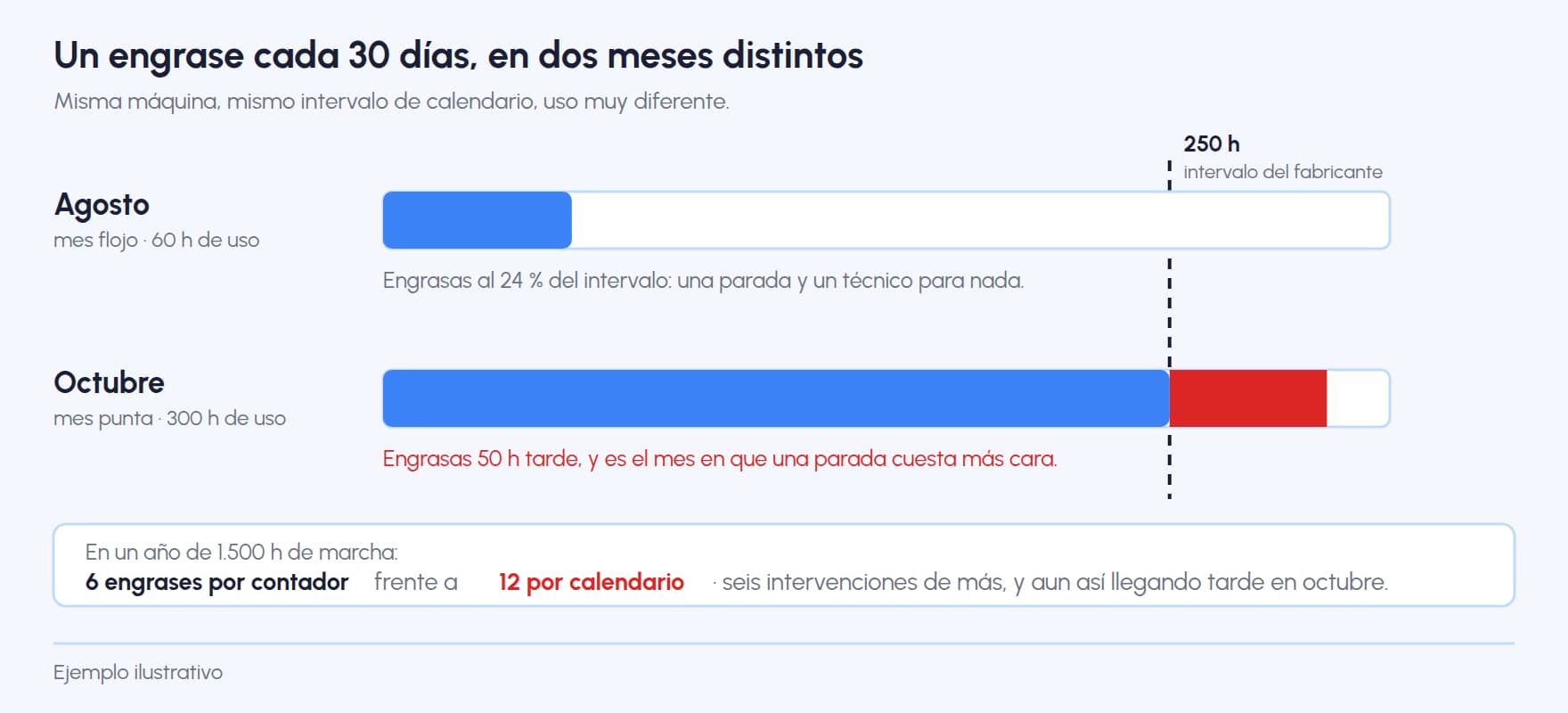
Over the full year, with a machine that runs for 1,500 hours: by the counter, you’d need six greasings (1,500 ÷ 250); by the calendar, you do twelve. Six unnecessary interventions, and you still arrive late in the months that matter. You pay on both sides.
This doesn’t mean throwing the calendar out. Some preventive maintenance should absolutely be scheduled by date: the regulatory inspection of a pressure vessel, the calibration of an instrument, or oil that oxidizes whether the machine is running or not. The decision to make—once, line by line in the plan—is which preventive tasks are based on time and which on use. Almost no factory has made that decision, because nobody has ever put the question to them.
2. The source: production has the right counter
Once you’ve decided you want to count hours, the second question is where they come from.
This is where the conversation fills up with sensors, IoT, and predictive maintenance. And, honestly, for a Spanish industrial SME, that almost never applies: there’s no network of accelerometers on the bearings, no connected PLC sending temperatures every second. Selling a CMMS on that promise is selling a project that will never happen.
But the counter already exists, and you don’t need to buy anything to have it. Every time an operator clocks a manufacturing order on a machine and closes it, they’re declaring exactly how many hours that machine has been running. Every time they report the quantity produced, they’re declaring cycles, strokes, or meters. That’s a usage counter, it’s the one the standard calls for, and it’s been accumulating in production reports for years.
The sensor you need is already installed in your factory. It’s the operator, and they’re already recording the data.
The reason you don’t use it is purely architectural: production enters that data, while the maintenance plan lives somewhere else. It’s exactly the same kind of gap that breaks lot traceability or warehouse inventory: every step is recorded correctly, but the connection is left in no-man’s-land.
3. The number: you can only adjust an interval if the work order says what you found
The third decision is the number itself. Why 250 hours and not 400?
On day one, the answer is easy and it’s the only honest one: whatever the manufacturer’s manual says. It’s the only data you have, and the manufacturer calculated it assuming nominal conditions that probably aren’t yours—your facility may be dustier, your product more abrasive, or your shift shorter.
What should happen next is that the number changes. If three consecutive greasings show the point is in perfect condition, you can extend the interval. If it shows signs of degradation ahead of schedule, you need to shorten it. It’s a closed loop, and it’s what separates a living maintenance plan from a list someone copied from a manual in 2019.
That loop almost never closes, and the reason is frustratingly simple: the vast majority of preventive work orders are closed with a “done” and nothing else. “Done” tells you the task was carried out. It doesn’t tell you whether it was needed. After two years, you have three hundred completed preventive tasks and exactly zero information about whether any of your intervals are right.
The fix costs one field. For each preventive action, have the technician mark a result—OK, early wear, or out of tolerance—and, where it makes sense, enter a numerical value or take a photo. Three taps at the workstation. That’s what turns a task list into a plan that learns.
The history is the product, not the work order
This brings us to the fundamental misunderstanding about CMMSs, and it’s worth saying plainly: the work order isn’t the product. It’s the residue. What you’re buying when you digitize maintenance is the history that accumulates underneath.
That history is only useful if two things are set up correctly.
The first is the cause, and it needs to be coded, not written out. If one technician types “the belt broke,” another types “belt failure,” and a third types “replaced belt, motor side,” you have three texts and no data: nobody will ever be able to count how many belt failures that machine has had. A short, closed list—leak, wear, electrical failure, blockage, operating error—bores the person filling it out and saves the person who has to decide a year later whether to repair or replace that machine.
The second is the denominator, and here we come back to the counter from another angle.
The indicator everyone uses to measure reliability is MTBF, mean time between failures. Maintenance indicator standards—UNE-EN 15341 and ISO 22400-2 for the operations level—define it based on operating time, not elapsed time. If you don’t have run hours, the calculation uses the only thing available: the calendar. And then this happens:
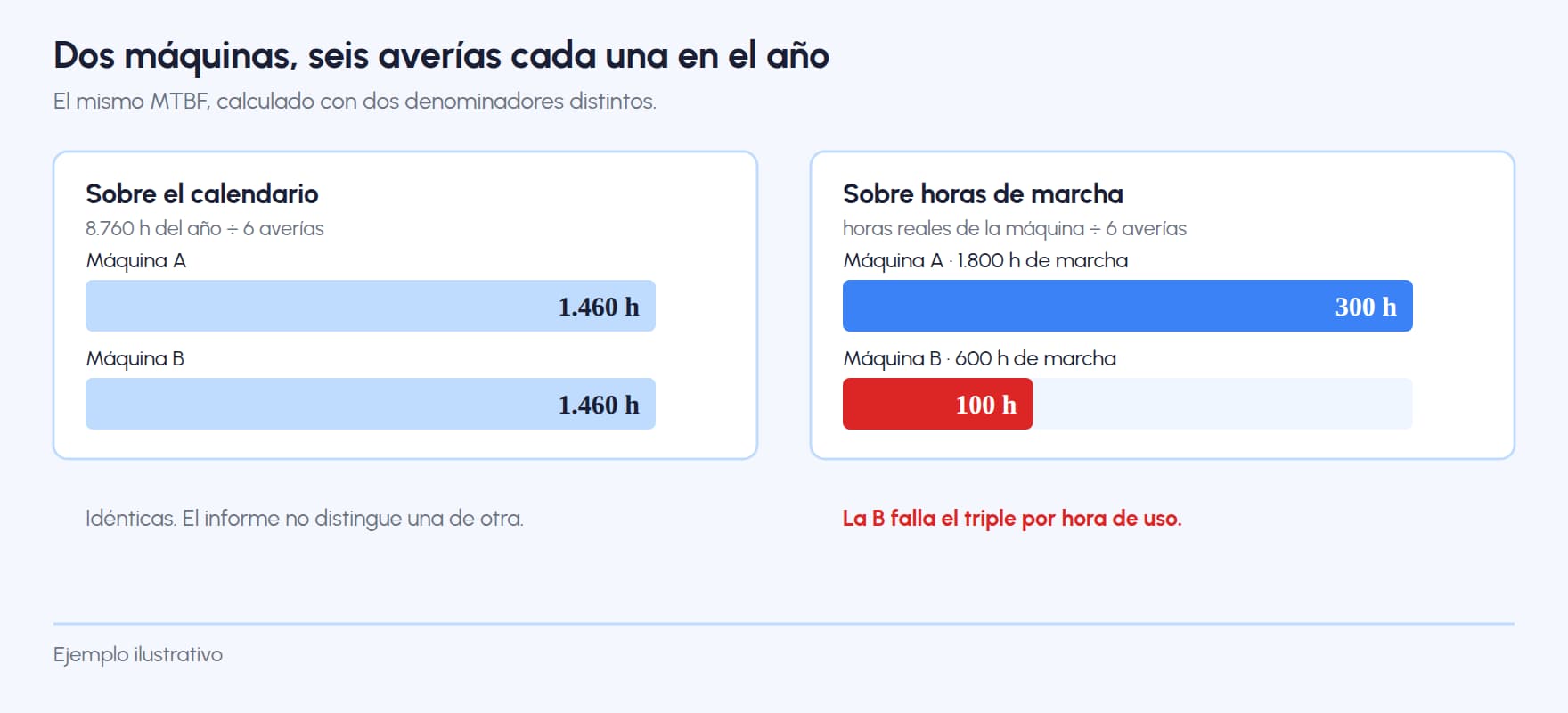
Two machines, six breakdowns each in a year. By calendar time, they have the same MTBF: 8,760 ÷ 6 = 1,460 hours. Identical. Based on run hours, the first has worked 1,800 hours and the second 600: 300 hours versus 100. The second fails three times as often per hour of use, and it’s the one you need to look at.
In other words, the same counter that tells you when an inspection is due also tells you which machine needs fixing. Without it, the maintenance report isn’t measuring your machines. It’s measuring the passage of months. It’s the same denominator problem that so often leads to OEE being misinterpreted.
Why maintenance and production can’t be two separate systems
At this point, everything points to the same place, so it’s worth looking at it directly. A CMMS needs two things from production—run hours and spare-part consumption—and it gives production one thing in return: preventive maintenance is work that occupies the machine.
That last point is what almost nobody takes into account when comparing tools. Two hours of greasing on Tuesday isn’t just a maintenance task: it’s a two-hour slot someone has to take away from manufacturing orders. If that slot doesn’t appear in the same calendar used to plan production, it doesn’t exist. And when it doesn’t exist, the outcome is already decided: production always wins, and preventive maintenance gets postponed. It gets postponed in September, it gets postponed in October, and in November the machine stops on its own.
That’s why the useful question isn’t which CMMS has more features, but where each piece of data comes from:
| Standalone CMMS | ERP module | Maintenance within an MOM | |
|---|---|---|---|
| Where run hours come from | Whatever someone enters manually | Nowhere: the ERP doesn’t have them | From production records, as they happen |
| When it finds out that the machine is stopped | When someone opens a notification | In the data transfer the following day | In real time |
| What happens to the spare part consumed | Deducted from its own warehouse | Deducted in the ERP | It’s the same stock production sees |
| Where preventive maintenance competes for the machine | Nowhere: it can’t see the plan | Nowhere | In the same calendar as the orders |
None of this is about software quality. A specialized CMMS does things a general-purpose module doesn’t, and an ERP module works well in companies where spare-parts inventory is genuinely managed in the ERP—those companies do exist. And it’s not about size either: an ERP’s manufacturing module handles the plant poorly because of how it was conceived, not because it lacks resources.
It’s about where the data is entered. In the model the industry uses to organize this—the ISA-95 series, published as a standard in IEC 62264—maintenance isn’t a separate program: it’s one of the four operations areas at the plant level, alongside production, quality, and warehousing. The four share a level because they share data. That’s exactly the scope of an MOM.
In Bold, a machine’s run hours aren’t typed in: they’re the same hours the operator reports when clocking in a manufacturing order at the workstation. A counter-based preventive task is generated when the machine crosses the usage threshold, not when a month passes. The spare part the technician uses comes from the same stock the warehouse team sees. And the preventive task appears in the production calendar for what it is: a reserved slot on that machine, on that day.
Where to start without buying anything
Four things, all of which you can do this month.
- Split your plan into two columns: time and use. Take your current maintenance plan and mark each line with the clock that applies to it. It takes an afternoon with the supervisor and doesn’t cost a cent. Most plants discover here that half their plan is scheduled using the wrong clock.
- Start tracking the counter for your five critical machines. You don’t need to instrument the entire plant. Five machines, run hours reported at the workstation, and you’ll have what you need to reschedule the preventive tasks that matter most.
- Add a result to the preventive work order. OK, early wear, or out of tolerance. Without that field, your maintenance plan can never improve, no matter how many years go by.
- Close the list of causes. Five or six options, defined by the supervisor and required when closing a corrective work order. It’s the only requirement for being able to count the history instead of reading through it.
Once you’ve done this, a CMMS will give you a maintenance plan that adjusts itself. If you don’t, it’ll give you the same list from the 2019 manual, but with reminders.
Sources
- UNE-EN 13306:2018, Maintenance. Maintenance terminology — European standard defining preventive maintenance and its division into predetermined and condition-based maintenance, and specifying the two clocks for predetermined maintenance: time intervals or a number of units of use.
- UNE-EN 15341, Maintenance. Key performance indicators for maintenance — standardized catalog of maintenance indicators and a reference for calculating reliability based on operating time.
- ISO 22400-2:2014, KPIs for manufacturing operations management — definitions of operations-level indicators, including availability and breakdown indicators, calculated based on equipment operating time rather than calendar time.
- IEC 62264-1:2013, Enterprise-control system integration — model and terminology for Level 3 manufacturing operations, of which maintenance is one of the four areas alongside production, quality, and warehousing.
- ISA-95, International Society of Automation — the original committee and model from which the standard above is derived, and the source of the hierarchy between plant-level and enterprise systems.
Conclusion
A CMMS is an excellent tool for making sure nothing gets forgotten. What it can’t do is decide for you when an inspection is due, and that’s precisely the decision that determines whether preventive maintenance saves you money or just moves it somewhere else.
The good news is that you don’t need to buy or install the data you need to make that decision well. Your plant has been recording it all along, every time someone clocks in an order on a machine. It’s just in the wrong system.
Find out how Bold schedules maintenance using your machines’ actual run hours: request a demo 👇 and check it against your own preventive maintenance plan.