Cloud MES: What It Is and How to Choose One for Your Industrial Plant

2026-03-31
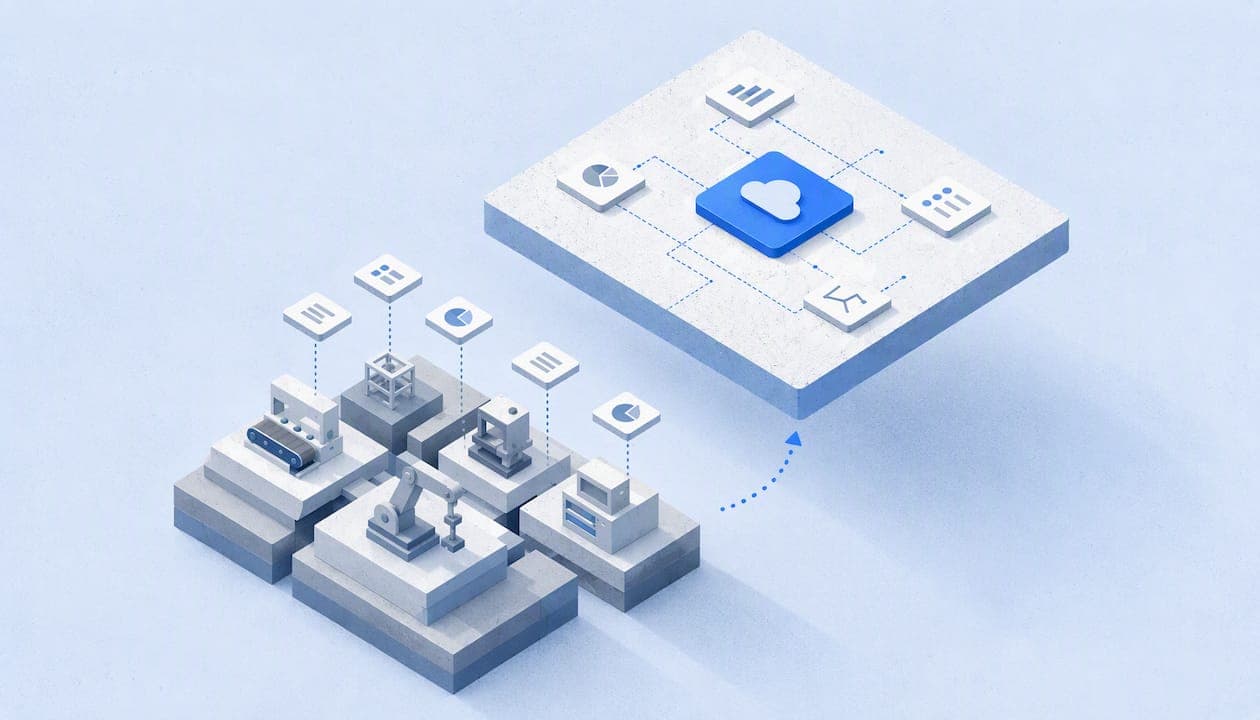
A cloud MES is a SaaS system that controls production execution from a browser or mobile device, without any in-house servers to maintain. It offers remote plant visibility, pay-as-you-go pricing instead of an upfront investment, and implementation in days, not months. For a small or medium-sized industrial company that wants to move on from paper and Excel without taking on a complex IT project, it is the most sensible option compared with a traditional on-premise MES.
In summary:
A cloud MES offers key functions similar to traditional systems, such as order management, digital instructions, traceability, and quality control, with access from any device connected to the Internet.
The main advantage is lower costs through a monthly payment model, eliminating investment in servers and enabling deployments in days instead of months.
For most small and medium-sized businesses, cloud management is usually sufficient, except for processes with extreme latency requirements or strict regulations.
Integration with ERP and SCADA systems and machines requires APIs, edge gateways, or OPC UA adapters, with clear rules of responsibility to avoid duplicate data or discrepancies.
Migration to a cloud MES can be completed in short phases, starting with a pilot on one line or cell, and should focus on changing operators’ mindsets to overcome resistance to change.
Table of Contents
-
Advantages of choosing a cloud MES over the traditional model
-
Cloud MES vs. on-premise: the differences that really matter
-
Which technical features to prioritize when evaluating a cloud MES
-
How to connect your cloud MES to your ERP, SCADA, and machines
-
Security and shared responsibility: what each party is responsible for
-
Why we recommend a cloud MES for small and medium-sized industrial businesses
-
Bold Factory: implementation in days for production, warehousing, and maintenance
What a cloud MES is and what core functions it should offer
A cloud MES (Manufacturing Execution System) is manufacturing execution software delivered as a service: the provider hosts the application, data, and updates, and the plant accesses it via the web or a mobile app without installing anything on local servers. Technically speaking, it is a SaaS within the general classification of cloud services, which distinguishes three layers: IaaS (infrastructure), PaaS (platform), and SaaS (ready-to-use software). A cloud MES belongs to that third layer: the operator opens the application and gets to work, without worrying about what lies beneath it.
Delivering the software over the Internet does not change what an MES needs to do in the plant. Its core functions remain the same as those of a traditional system, but are accessible from any device with a connection:
-
Production order management: creation, sequencing, and real-time tracking of every manufacturing order.
-
Digital work instructions: operators see the exact steps for each operation on their screen, without relying on paper drawings.
-
Batch and component traceability: a record of which materials, machines, and operators were involved in each unit produced.
-
Integrated quality control: recording nonconformities and inspection points, and blocking defective parts before they move further through the process.
-
Capturing machine and operator data at the point of use, replacing paper work sheets.
Advantages of choosing a cloud MES over the traditional model
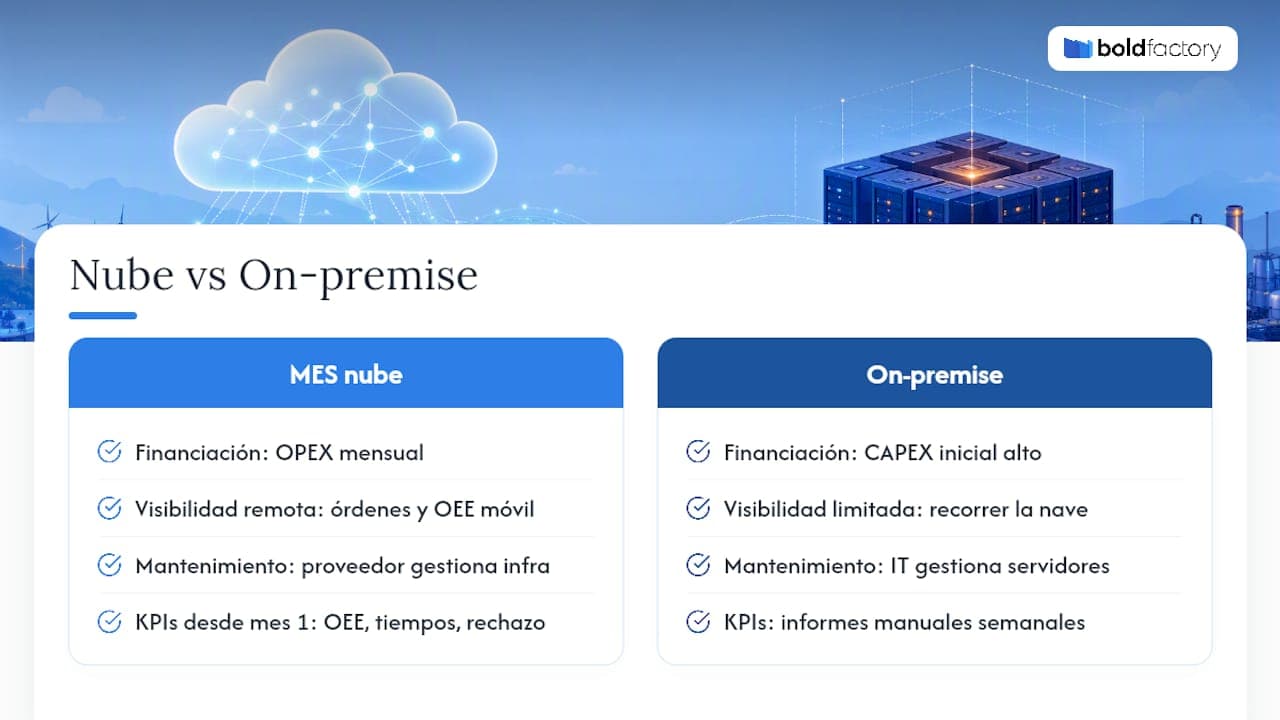
The most frequently cited advantage is economic: moving from a capital investment (CAPEX) to a monthly operating expense (OPEX). This makes a cloud MES especially accessible for plants with 5 to 100 operators, where an on-premise project costing several hundred thousand euros simply does not make financial sense.
The second advantage is visibility. The operations director can see the status of production orders, OEE (overall equipment effectiveness), or quality alerts from a mobile phone, whether or not they are at the plant. This changes how the plant is managed: instead of walking around the factory to find out which machine is stopped, information arrives before the problem turns into a crisis.
The third advantage, less visible but decisive in day-to-day operations, is maintenance. The provider manages updates, security patches, and infrastructure availability, so a small or medium-sized company’s IT team (if it has one) no longer has to worry about its own servers.
Professional tip: Before signing, ask the provider for a breakdown of which KPIs the system delivers from the first month. An MES that only promises “visibility” without specific figures for OEE, cycle times, or rejection rates is not delivering the value it should.
Analytics and artificial intelligence services built into many cloud platforms make it possible to go a step further: turn data captured on the shop floor into predictive alerts and automated reports, instead of reports that someone has to put together by hand every week.
Cloud MES vs. on-premise: the differences that really matter
The discussion about “cloud versus your own server” often gets bogged down in generalities. In practice, three differences determine whether pure cloud is right for your plant or whether you need a hybrid layer.
Deployment speed and cost model. An on-premise installation involves servers, perpetual licenses, and weeks or months to get up and running. A cloud MES is implemented in days, with a monthly subscription and no need to purchase hardware.
For most discrete manufacturing workshops (machining, metal, furniture, textiles, packaging), cloud management is sufficient. Only processes with extreme latency requirements or very strict data residency regulations need a more complex hybrid architecture, with some processing at the edge and some in the cloud. Hybrid storage, combining public cloud and local resources, is the usual solution when this happens.
Which technical features to prioritize when evaluating a cloud MES
Not all cloud MES systems meet the same needs to the same degree. Before comparing prices, it is worth reviewing these capabilities:
-
Work instructions with version control: when a drawing or procedure changes, the operator should always see the current version, with an auditable change history.
-
Batch traceability linked to quality: the ability to link each nonconformity to a specific batch, machine, and shift, with support for statistical process control (SPC) and corrective actions (CAPA).
-
Open APIs and industrial connectivity: support for protocols such as OPC UA and adapters for PLCs, so machines can feed data into the system without manual intervention.
-
Offline operation with automatic synchronization, already mentioned as a requirement for operational continuity.
-
Reporting and AI-powered automation: dashboards that generate KPIs without exporting to spreadsheets, and agents that perform repetitive tasks (generating work sheets, delay alerts) based on instructions in plain language.
The industrial production control offered by the most comprehensive platforms integrates these layers into a single workflow, avoiding the need for operators to switch between different applications to record a part, report a quality incident, and check the current drawing.
Professional tip: Always ask for a demo using real data from your plant, not the provider’s generic example. An MES that looks impeccable with sample data can become confusing as soon as you enter your own product references and manufacturing routes.
How to connect your cloud MES to your ERP, SCADA, and machines
Integration is often the point that determines whether a cloud MES project succeeds or remains incomplete. Three patterns cover most cases:
-
API-first integration: the MES and ERP exchange orders, materials, and production results through programmatic interfaces, so no one has to enter the same data twice. Industry documentation published by major cloud providers, such as Microsoft Cloud for Manufacturing, details precisely these types of integration patterns for the industrial sector.
-
Edge gateway: a local device collects signals from PLCs and SCADA systems, normalizes them, and sends them to the cloud MES, solving the latency problem without giving up remote management.
-
OPC UA adapters: the most widely used standard for enabling machines from different manufacturers to speak a common language with plant software, without custom development for each model.
The most common risk is not technical, but one of data governance: if the ERP and MES each generate their own version of a production order, duplicates and discrepancies arise that no one knows how to resolve. The way to prevent this is to define from the outset which system is the single source of truth for each data item (usually the ERP for orders and the MES for execution) and maintain that rule without exceptions. A technical analysis of the differences between SCADA and MES is useful to avoid confusing the layers when designing this architecture. Before connecting any PLC or SCADA system in production, it is also advisable to test in an isolated environment: a poorly managed communication failure can stop an entire line.
Security and shared responsibility: what each party is responsible for
The security of a cloud MES is governed by what is known as the shared responsibility model: the provider manages the infrastructure, patches, and server availability, while the plant retains responsibility for local connectivity, user management, and the quality of the master data it enters into the system. This division of responsibilities is well documented in the cloud shared responsibility guides published by major technology providers.
In practice, this translates into a few specific obligations for each party:
-
The provider must guarantee encryption of production data in transit and at rest, regular security audits, and automatic backups.
-
The plant must control who has access to which functions (an operator does not need administrator permissions), review those access rights regularly, and keep product and route master data up to date.
-
Both parties must agree in advance on where the data is stored and how frequently backups are made, especially if the factory operates in a sector with strict regulatory traceability requirements.
A common failure in cloud MES implementations is not an external attack, but an ambiguous definition of this division of responsibility: when no one knows whether a startup delay is due to the platform or the plant’s own connectivity, the project gets bogged down in support disputes that could have been avoided with a clear agreement from day one. The cloud storage that underpins these systems offers the scalability and durability needed to store years of production history, but that technical guarantee does not replace internal discipline around access and master data.
How to migrate your plant to a cloud MES step by step
Migrating a workshop or small or medium-sized industrial company to a cloud MES should not be a project that takes months. A realistic plan has four phases:
-
Assessment and scope. Before touching any software, define which specific process you want to control first (one line, one cell, one shift) and which KPI you will use to measure success: OEE, cycle time, rejection rate, or on-time delivery.
-
Pilot on one line or cell. Implement the system in a limited area, validate the critical integrations (ERP, a key machine), and train the team that will use it every day. A well-chosen pilot generates real data to convince the rest of the plant.
-
Phased rollout. Extend the system line by line or workshop by workshop, rather than with a “big bang” that forces all production to stop on the same day. Each phase should be completed with clean master data before the next one begins.
-
Governance and post-launch support. Define who handles day-to-day questions, who updates work instructions, and how often the target KPIs are reviewed against actual results.
Professional tip: Choose your pilot for its visible impact, not its technical ease. A line with known traceability problems will convince the rest of the factory more than a flawless line where the MES barely makes any noticeable difference.
The biggest risk in these migrations is usually not technological. It is resistance to change from operators used to paper, who see the new system as excessive monitoring rather than as a tool that saves them administrative work. Explaining from day one what operators gain (fewer forms to fill in by hand, instructions always in view) usually carries more weight than any technical argument.
Why we recommend a cloud MES for small and medium-sized industrial businesses
Resistance to migrating to a cloud MES rarely comes from the technology. Today’s cloud platforms handle latency and security reasonably well. It comes from a simpler fear: that the project will drag on, become complicated, and end up resembling those custom developments that never quite fit the reality of the plant.
That is where the real value of a unified system lies, compared with adding separate modules from different providers. When production, purchasing, warehousing, and maintenance all run on the same platform, a small team (the kind a business with 5 to 100 operators has, without a dedicated IT department) does not need to manage five contracts or five different integrations to gain complete visibility. Real operational improvement arrives in weeks, not as a promise of long-term “transformation” that so many industrial software projects never deliver.
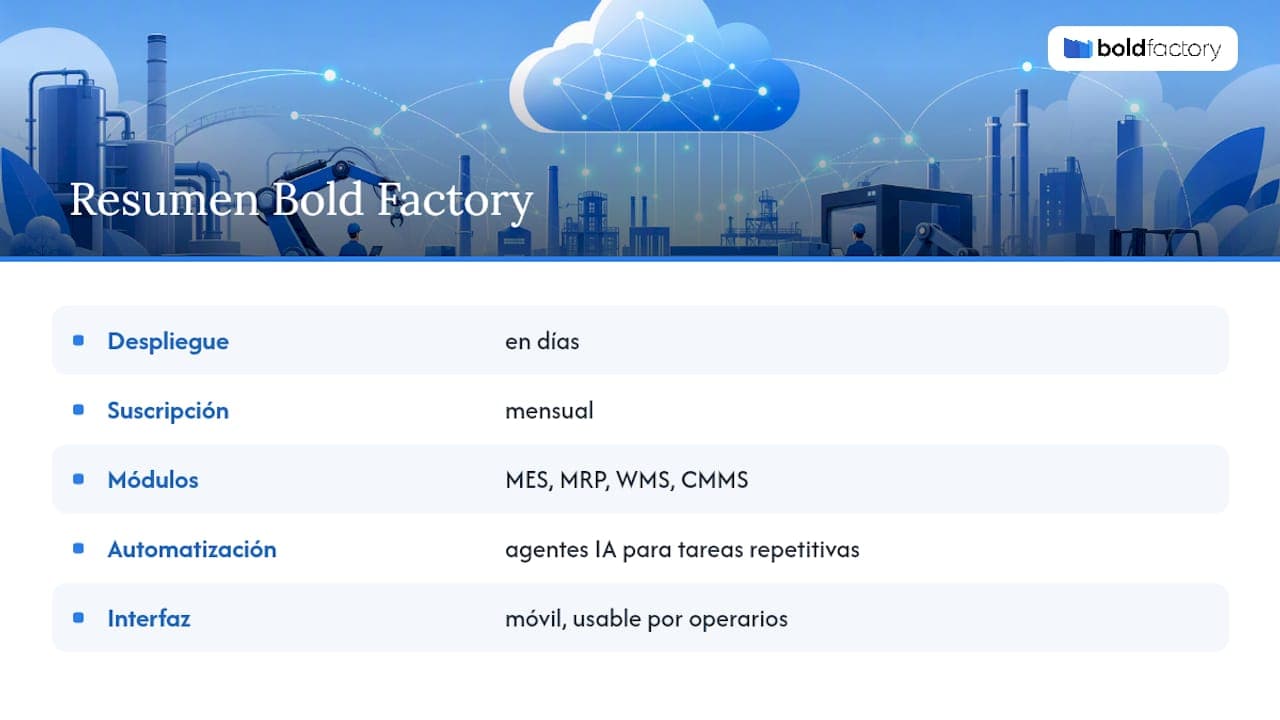
Bold Factory is a direct alternative to custom developments and MES projects that drag on for months: the platform brings together production (MES), planning and purchasing (MRP), warehousing (WMS/SGS), and maintenance (CMMS/CMMS) in a single system, with artificial intelligence agents that automate repetitive tasks through instructions in plain language.
The subscription is monthly, and implementation is measured in days. This addresses precisely the fear that holds many small and medium-sized industrial businesses back: there is no need to commit to a long project to start seeing results. The interface is designed so any operator can use it from a mobile phone, making it easier to manage the plant day to day and see what is happening in the factory from anywhere.
If you manage a plant with between 5 and 100 operators and want to leave paper and Excel behind without taking on an expensive project, the natural next step is to review Bold Factory’s MES system and request a demo using data from your own factory.
Frequently asked questions
What is the difference between a cloud MES and an on-premise one?
A cloud MES is paid for by subscription and accessed via the web or mobile devices without your own servers; the provider manages updates and infrastructure. An on-premise system requires you to buy servers and licenses, with deployments that take months instead of days.
Which cloud services are most widely used in manufacturing?
The most widely used are SaaS (software such as an MES, ready to use), cloud storage for production data, and analytics and artificial intelligence services that process that data in real time, according to the general classification of cloud services.
What are the four types of cloud storage?
The usual distinction is between public, private, hybrid, and multicloud storage. For critical production data, many plants choose hybrid storage to balance local latency with the scalability of the public cloud.
How long does it take to implement a cloud MES such as Bold Factory?
Unlike traditional systems that require you to configure everything all at once, Bold is designed for a gradual start: someone from our team supports you throughout the implementation and adapts the scope to your specific goals. For example, many factories start with the most urgent need—replacing paper work sheets so they can see the status of orders on a single assembly line—and later, once the team is comfortable, continue by expanding to more lines, defining bills of materials, enabling warehouse control, and finally, planning. You decide the pace with our support, step by step and without stopping production for even a single minute.
Sources
To explore the technical concepts behind a cloud MES in greater depth, it is worth consulting cloud providers’ documentation directly. The classification of cloud services into IaaS, PaaS, and SaaS explains exactly where an MES fits within the broader technology ecosystem. The guides on shared responsibility are essential reading before signing any industrial cloud software contract, because they clearly define which security responsibilities belong to the provider and which belong to the plant. For a general understanding of the fundamentals of cloud computing, the cloud computing entry provides a solid foundation without unnecessary technical jargon.