How ERPs Conquered the World (and Why You Don’t Need a “Manufacturing ERP”)

2026-08-27
Your factory probably has an ERP. Administration opens it every morning, invoices, does the accounting, and closes the month without a hitch (most months). The thing is, it works. It works well. But go down to the shop floor and it’s a different story: work orders on paper, a planning spreadsheet only the supervisor understands, and the usual question: how’s this or that order going? Let me ask... (in other words, they haven’t a clue).
If you were sharp enough to realize there was a problem, you may also use your ERP in the factory. Specifically, your ERP’s manufacturing module. But let’s be honest: the only thing it’s good for is printing work orders faster. You still don’t trust your inventory records, and you spend hours every day entering what’s been done into the system from the paperwork. At least you can close orders and generate a delivery note. That’s about the only thing you can count on.
Here’s my question: if the ERP manages accounting, invoicing, and finance so well, why doesn’t it manage the most important part of your factory—the manufacturing—well? The answer isn’t in your ERP. It’s in how the ERP got here.
The ERP was born in a factory and left it behind
The story begins in the 1960s with MRP, a system for calculating material requirements that IBM developed together with an agricultural machinery manufacturer. In the 1980s came MRP II, which added capacity, shop-floor operations, and demand forecasting. Software made by manufacturers, for manufacturers.
The turning point came in 1990, when the consultancy Gartner, after spotting a new trend in this market, coined the term ERP (for those who speak both languages, Enterprise Resource Planning). Technology companies realized that to sell the same product to an insurance company, a supermarket, and a metalworking shop, that product had to be built around something identical across all industries. And the only thing that’s truly identical is accounting: an accounting entry is the same in every industry. Manufacturing, on the other hand, looks completely different from one factory to the next.
So the center of gravity shifted. ERPs became widespread by moving away from the factory.
In Spain, it came in through the administration department
Here, the story is even clearer. Since things tend to arrive in Spain a little later than elsewhere, ERP didn’t reach Spanish SMEs from the shop floor; it arrived through the administrator’s office.
ContaPlus launched in 1985, was sold at newsstands alongside magazines, and had more than 600,000 licenses by 2000. Then came FacturaPlus, A3 at accounting firms, and its subsequent acquisition by Sage. In short, accounting and invoicing programs that kept adding modules until they were called ERPs. And often they were recommended by the accounting firm, not the production manager.
It worked extraordinarily well, although the real takeoff is much more recent than it might seem.
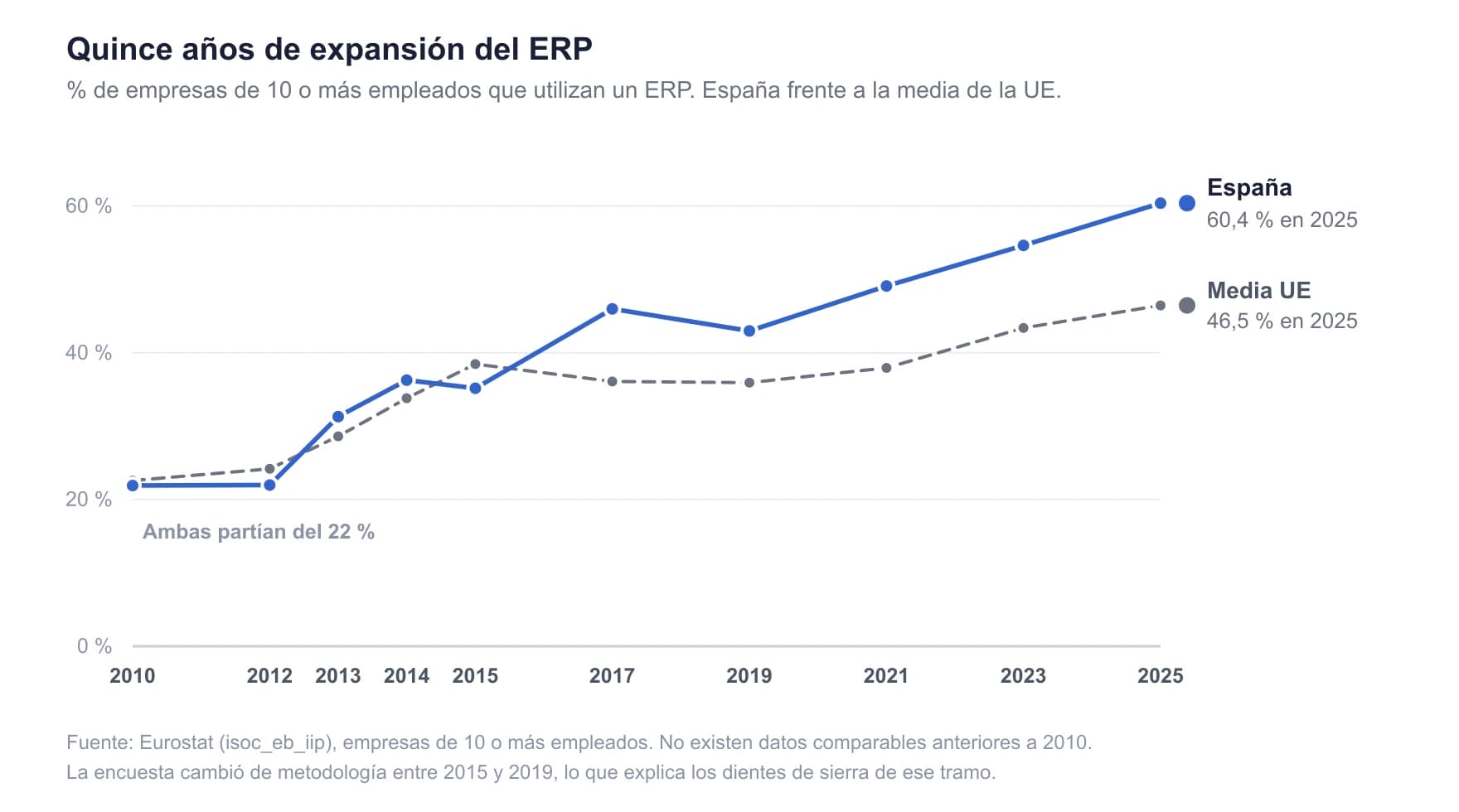
In 2010, just over two out of every ten Spanish companies used an ERP, exactly the same as the European average. Today, it’s six out of ten, and Spain is the third-ranked country in the EU for adoption, behind only Denmark and Belgium. In fifteen years, ERP has gone from being used by a select few to becoming the default system for Spanish companies.
Nothing that follows is meant to dispute that achievement: when it comes to accounting, invoicing, and administration, ERPs are excellent. The problem starts when that same product is stretched onto the shop floor.
Why a manufacturing module isn’t manufacturing software
The expansion made sense. If I already have your financial data, why not also sell you HR, inventory, and production? The result is modules that share a brand, sales team, and invoice, but do a poor job of solving problems they weren’t designed for. There are three underlying reasons:
- They operate at different speeds: the ERP thinks in days, weeks, and month-end closings, because that’s the rhythm of accounting entries and invoices. The factory operates in minutes: a machine stops, a material isn’t there, two orders overlap. A system designed to record the past is of little use for managing the present.
- They’re built for a different user: the module inherits an interface designed for a computer, for someone sitting in an office with a keyboard and time to spare. Your operator is wearing gloves, standing up, and has ten seconds. And if the operator doesn’t record it, the data simply doesn’t exist. The user experience on the shop floor isn’t an aesthetic detail; it’s the difference between having data and not having it.
- The modules don’t talk to each other as much as the brochure promises: the ERP pitch is “everything integrated into a single system.” The reality is that many modules are different products, bought from third parties at some point and grouped under the same brand. They share a database on paper and operate as silos day to day.
And then customization comes along
This is where the final nail goes into the coffin. Since the generic module doesn’t look anything like your factory, it gets customized. One development for your product costing, another for quality control, another for the shop-floor report. Every custom layer takes you a little further from the standard product.
The cost doesn’t show up on day one; it shows up later: updates that break things, a consultant needed for every change, and a version of the tool that’s no longer anyone else’s and is impossible to test in its entirety after each update. It’s the same mechanism we explained in the burden of legacy versions, applied to manufacturing.
The numbers back this up: more than half of ERP projects go over budget, and between 60% and 70% fail to meet the objectives they were approved for, according to Gartner and Panorama. Over-customization appears time and again among the main causes.
You end up paying to maintain one-of-a-kind software, but without any of the benefits of software built to measure.
Keep your ERP and give the factory what it needs
The conclusion isn’t that you need to throw anything away. Your ERP does what it was designed to do well, and replacing it would be an expensive, pointless project.
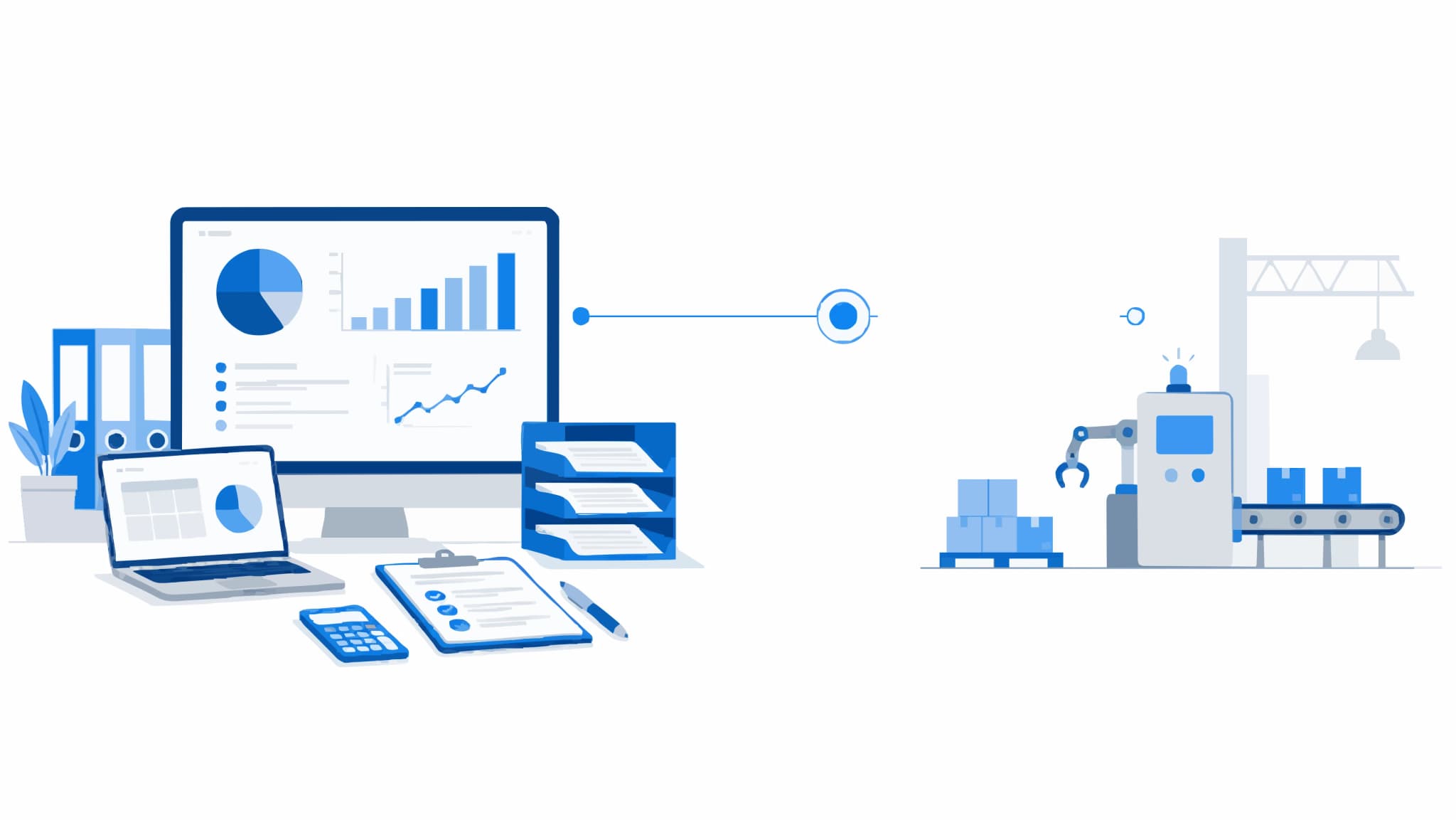
The conclusion is to specialize. Administration lives in the ERP. Production lives in software born on the shop floor, with its own data model, its own pace, and an interface designed for the people who make things. And the two share information—something that now takes days, not months.
What this division achieves is easy to explain: decisions are made on the shop floor, in the moment, using real data about what’s happening; then that same data flows into the ERP as costs, consumption, and allocated hours. Each system doing what it was designed to do.
Conclusion
ERPs conquered the world because they found the one process common to every company and turned it into a product. It’s a great business story, and it explains why they now offer you a manufacturing module: not because it’s what they know how to do best, but because they were already inside your company.
That’s why the useful question isn’t which manufacturing ERP you need. It’s what your shop floor needs that your ERP will never provide.
Discover how Bold brings your factory under control without touching your ERP: request a demo 👇 and see for yourself on your own shop floor.