Decide in 30 Days Whether Your Industrial SME Needs MRP or ERP

2026-09-01

MRP plans materials; ERP is a business management platform that almost always includes an MRP engine. If your only problem is calculating what to buy and when to manufacture it, MRP will solve it. If you’re also dealing with a lack of coordination between production, accounting, sales, or multiple plants, you need ERP. The logical next step is to audit where your operations are really failing before signing anything.
In short:
- If you manage multiple plants or legal entities and need a consolidated view, a full ERP system is essential.
- If you only need to address materials planning and purchasing, without coordination between departments, a standalone MRP system may be enough and faster to implement.
- When plant production generates real-time data and you need to reduce manual processes, integrating a MES system with your ERP or MRP improves synchronization and efficiency.
- Implementing an ERP can take months and require consulting, while platforms like Bold Factory offer integration in days and mobile access.
- It’s a good idea to analyze operational symptoms before deciding: stockouts, slow closings, or disconnects between production and accounting indicate that you need a full ERP.
Table of contents
- What Is MRP (and MRP II): Key Functions, Logic, and Limitations
- What Is ERP: Functional Scope and Benefits Over MRP
- Key Differences Between MRP and ERP by Operational Dimension
- When to Choose Standalone MRP and When to Migrate to ERP
- How MES Fits In and Why It May Be Needed Alongside MRP or ERP
- Case Study: How Bold Factory Integrates MRP, MES, and Warehouse Management in One Platform
- What to Do Now: A Checklist Before You Decide
- What Often Goes Wrong in These Implementations
- Integrate MRP, MES, and Warehouse Management Without a Months-Long Project
- Sources
What Is MRP (and MRP II): Key Functions, Logic, and Limitations
MRP (material requirements planning) starts with a product’s bill of materials, breaks it down piece by piece, and calculates how much needs to be purchased or manufactured and by what date. This process is called a bill of materials (BOM) explosion. It’s combined with netting (subtracting what you already have in stock) and offsetting for each component’s lead time, as described by Supply Chain Research.
A typical MRP system covers these functions:
- Calculating material requirements based on demand or the master production schedule.
- Automatically generating purchase and manufacturing orders.
- Managing safety stock and reorder points.
- Tracking lead times by supplier and component.
Professional tip: Always check the lead times entered in the system before trusting its purchase recommendations: a poorly calibrated MRP system can generate perfectly timed orders using data that’s no longer accurate.
The fundamental limitation is that MRP assumes infinite production capacity and fixed lead times, which rarely holds true in a real workshop with shared machines and breakdowns. By design, it doesn’t check whether you have machine hours available that week; it only tells you what materials you need and when. For an SME that manufactures to order with a limited product range, this limitation is usually acceptable, and MRP can make an immediate difference in stockouts.
What Is ERP: Functional Scope and Benefits Over MRP
ERP (enterprise resource planning) is built around a single database shared across the entire company. On top of it, the system provides modules for finance, purchasing, sales, human resources, and almost always an integrated MRP engine. The fundamental difference isn’t that ERP replaces MRP, but that it wraps it in a much broader management system, as explained by ERP Research.
Typical modules in a manufacturing ERP include:
- Accounting and finance integrated with purchasing and sales.
- Customer and order management with real-time margin visibility.
- Human resources and payroll.
- The MRP engine itself for material planning.
- Consolidated reporting across departments and, if there are multiple sites, across plants.
The real benefit over standalone MRP is cross-functional visibility: management can see the impact of a purchasing decision on the income statement without asking each department for a report. Repetitive reconciliation tasks between systems disappear because they all feed into the same database, according to Forbes Advisor. The cost of that broader scope is predictable: more modules, more users to train, and an implementation that takes months rather than weeks.
Key Differences Between MRP and ERP by Operational Dimension
The quickest way to decide is to compare them by dimension, not by marketing label. MRP and ERP aren’t competing for the same role: one solves a specific problem, while the other manages the entire business.
- Scope: MRP covers material planning and purchasing; ERP also covers finance, sales, and HR, and includes MRP itself.
- Typical users: Planners and purchasing teams use MRP; the entire organization uses ERP, from administration to management.
- Database: MRP usually works with inventory and production data; ERP centralizes all company data in a single source.
- Implementation time: A focused MRP system is usually deployed in 2 to 6 months, compared with ERP projects that can take months or even years, according to ERP Research.
- Cost and scalability: MRP scales well as long as the problem is still about materials; ERP scales better when the problem is coordination between departments or sites.
In practice, MRP is almost never an exclusive alternative to ERP: it’s usually included in it. The real question isn’t “MRP or ERP,” but whether you need just that planning engine or the whole platform around it.
When to Choose Standalone MRP and When to Migrate to ERP
Before comparing software prices, measure these symptoms in your own operation. They’re the indicators that show whether you should stick with MRP or move up to ERP.
- Count how many manual integrations you maintain today. If reconciling production with accounting takes you more than a day a month, that’s a sign you need ERP.
- Measure your monthly accounting close time. If closing takes longer because production data isn’t available in real time, that points to ERP.
- Check whether you operate more than one legal entity or plant. Consolidation across multiple sites is the domain of ERP, not MRP.
- Check whether your problem is only about materials. Stockouts or poorly calculated purchases, without accounting friction, are reason to stick with MRP.
Small companies with processes concentrated in a single plant often don’t need a full ERP from day one, as MYOB points out. Many companies migrate from MRP to ERP gradually, when accounting friction outweighs the cost of integrating separate systems, according to ERP Research.
Professional tip: If your real limitation is machine capacity, neither MRP nor ERP will solve it well: that’s where an APS finite-capacity planning system comes in, as Supply Chain Research notes.
How MES Fits In and Why It May Be Needed Alongside MRP or ERP
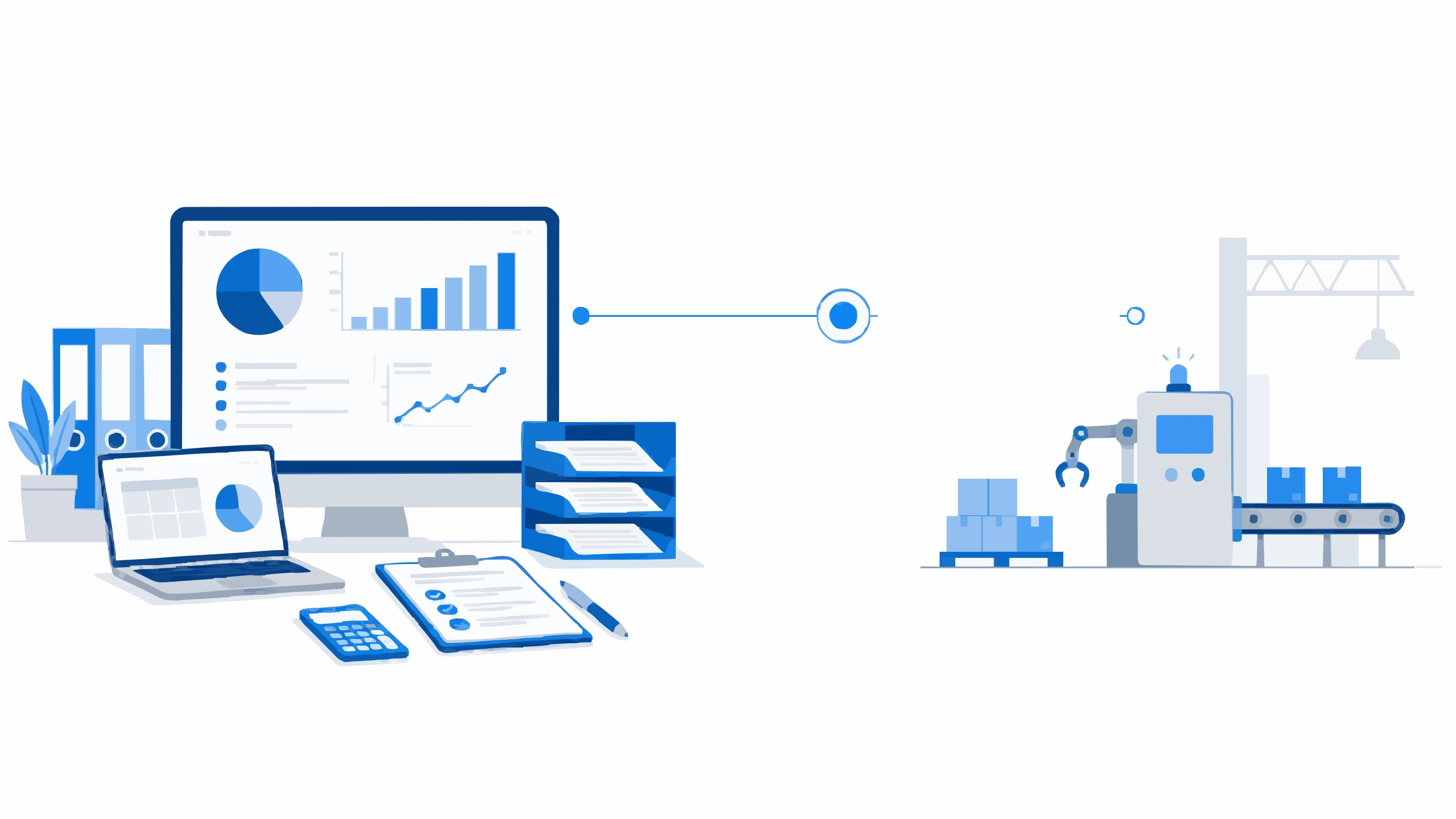
MRP plans, ERP records and coordinates, and MES (manufacturing execution system) does the work in between: capturing what’s happening on the plant floor in real time. Without this layer, your materials plan is still based on estimates while the production line moves ahead independently.
The typical workflow works like this:
- MRP generates the manufacturing order with dates and quantities.
- MES records actual progress: which operator, which machine, how much time, how many good parts, and how many rejects.
- ERP receives the consolidated data to update costs, inventory, and invoicing without anyone having to enter anything manually.
This link between execution and planning is where the operational difference really shows, because without MES integration, the factory and the office remain out of sync even when ERP has been implemented.
Case Study: How Bold Factory Integrates MRP, MES, and Warehouse Management in One Platform
A machining SME that manufactures to order doesn’t need to launch three separate projects to connect planning, execution, and warehouse management. Bold Factory brings together the MRP planning engine, plant-floor production control (MES), warehouse management and traceability (SGA), and machinery maintenance (GMAO) in one system, with artificial intelligence agents that automate repetitive tasks through simple-language instructions.
When an operator records an order’s progress on a mobile phone and that data feeds directly into purchasing plans without anyone having to transcribe it, the delay between what happens on the plant floor and what the production manager sees disappears.
Professional tip: During a demo, always ask to see how a change on the plant floor is reflected in the material plan without manual intervention: that’s how you can tell whether the integration is real or just an exported report.
What to Do Now: A Checklist Before You Decide
Before asking anyone for a quote, organize your decision with these three steps.
- Audit your real bottlenecks: Are materials, accounting, or coordination between plants failing?
- Ask for this in the demo: bill of materials (BOM) management, accounting integration, open API availability, and consolidated reports.
- Run a 30-day pilot with a measurable success criterion, such as cutting manual reconciliations in half.
| Symptom identified | Recommended system |
|---|---|
| Stockouts and uncoordinated purchasing | Standalone MRP |
| Slow accounting closes and silos between departments | Full ERP |
| Lack of real-time data from the plant floor | Add MES to MRP/ERP |
| Machine capacity is the bottleneck | Complementary APS system |
What Often Goes Wrong in These Implementations
The most common mistake isn’t choosing the wrong option between MRP and ERP, but starting the project without a defined scope: someone asks to “manage the whole factory,” and nobody prioritizes which process to solve first. The second mistake is launching the system with poor master data, outdated bills of materials, or duplicate references; no software will fix that on its own. The early sign that a project is going well isn’t the go-live date, but whether operators are already entering real data in the first two weeks without someone having to chase them.
— Alex Ponce
Integrate MRP, MES, and Warehouse Management Without a Months-Long Project
A traditional ERP takes months to implement and usually requires outside consultants to adapt it to a small workshop. Bold Factory offers the opposite approach: production, planning and purchasing, warehouse management, and maintenance on a single platform, designed so an operator can use it from a mobile phone without prior training.
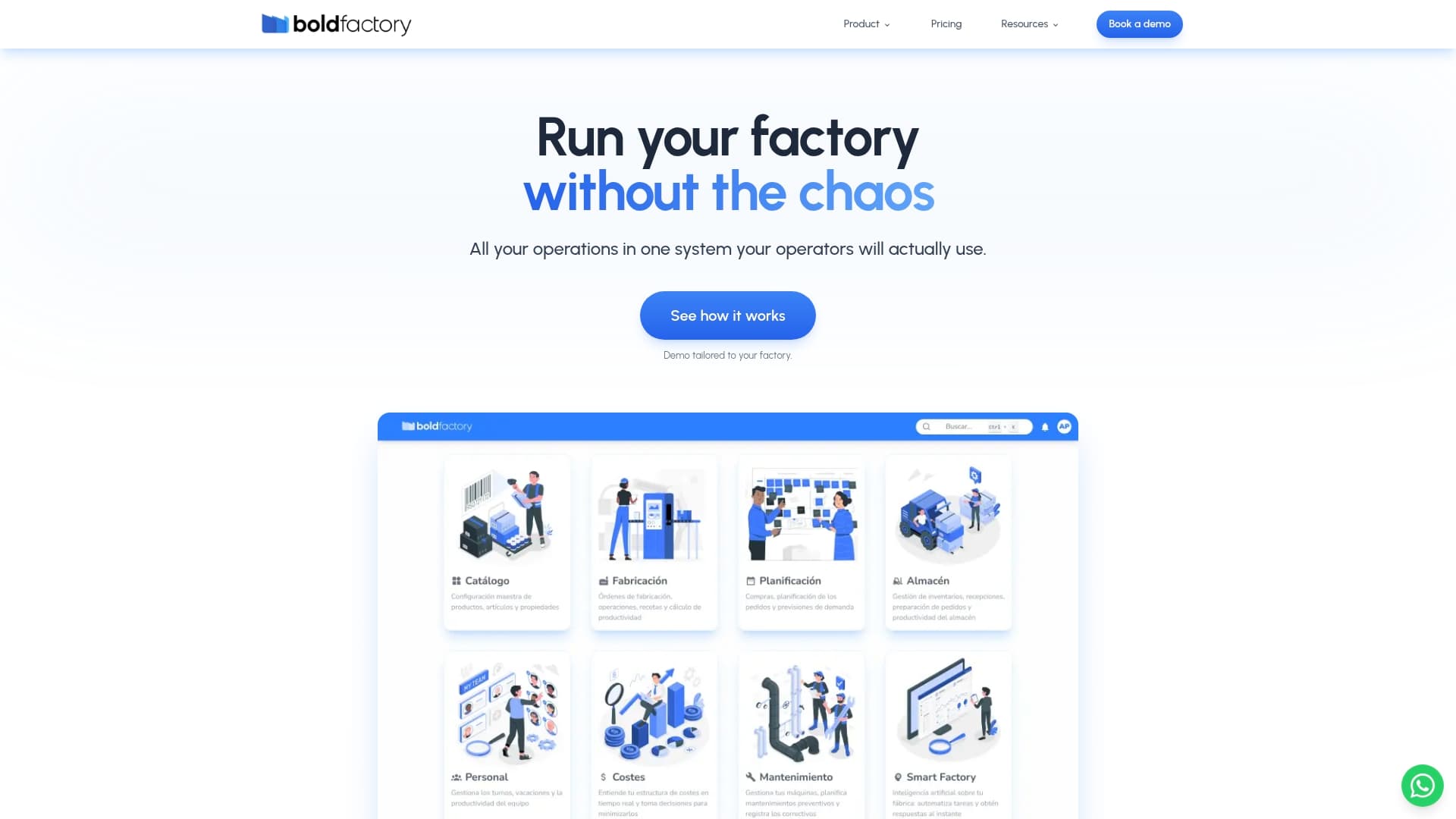
It’s implemented in days, not months, with no mandatory commitment. During the demo, see how it works with your own bill of materials and how it connects with your existing ERP, if you need to keep it for accounting. Request a trial of the industrial production control software and assess in a real pilot how much time your team stops wasting on manual data reconciliation.
Sources
For more historical and technical context on this comparison, it’s worth reviewing how SAP describes the evolution from MRP to ERP and what distinguishes an APS finite-capacity planning system. If you’re interested in plant-floor execution, the page about production control integrated with your ERP explains how to connect both layers without duplicating work.
- MRP vs ERP: Key Differences (2026 Guide) | ERP Research
- MRP vs ERP vs APS | Supply Chain Research
- ERP vs MRP | Forbes Advisor