Lot Traceability: Why Complying with the Law Isn’t Enough to Recall a Product

2026-09-10
It’s nine-thirty in the morning, and your supplier calls to tell you that the raw material lot they delivered six weeks ago was defective.
The question that comes next is always the same, and always uncomfortable: where did that lot end up? How many production orders it went into, what finished product came out of them, and which customers it was sent to.
In most factories, you don’t look up the answer. You piece it together. Someone goes down to the archives to find the incoming delivery notes, someone else reviews six weeks of production reports, and together they try to remember which machine that pallet was opened on. Two days later, you have an answer you don’t entirely trust—and you still have to make a decision worth tens or hundreds of thousands of euros based on it.
The striking thing is that, in the meantime, you’re probably complying with the law. To the letter.
In brief
- The law only requires you to know who you buy from and who you sell to. The link in between—which incoming lot ended up in which outgoing lot—is up to you.
- That’s why you can pass a paperwork audit and still be unable to narrow down a recall: one checks that you have records; the other checks that they’re linked.
- Of the four moments when traceability is recorded, the one that’s almost always missing is consumption: the only one that happens at the machine.
- Lot size determines the size of the recall. You determine it, it costs nothing, and it multiplies or divides what you have to hold when something goes wrong.
- A traceability detail that isn’t captured at the moment it happens isn’t a fact; it’s an estimate.
- Traceability only exists end to end: if warehousing, production, quality, and shipping are separate systems, the chain breaks at the seams.
What you’ll find here
- What the law requires you to know, and what it leaves up to you
- The four moments when traceability is recorded
- Three decisions that determine whether your traceability is useful
- Where to start without launching a six-month project
- Sources
What the law requires you to know, and what it leaves up to you
Traceability in European industry has a founding article: Article 18 of Regulation (EC) No 178/2002, which has been mandatory since January 1, 2005. Its requirement fits in one sentence: you must be able to identify who supplied each product to you and who you supplied it to.
This is the principle known as one step back, one step forward, and in practice it translates into three stages that should not be confused:
- Upstream traceability: what came in, from whom, and when. Your incoming delivery notes and invoices.
- Internal or process traceability: what happened to it inside your factory. Which incoming lot ended up in which outgoing lot.
- Downstream traceability: what went out, to whom, and when. Your outgoing delivery notes.
Article 18 requires the first and third stages. Not the one in the middle. Official implementation guidance is explicit on this: the Regulation does not impose any specific internal traceability system and leaves each operator to decide how precisely to track it.
That’s the whole story. A routine audit checks that you have records. A recall checks that those records are linked. And those are two different things: you can have an immaculate archive of everything that comes in and everything that goes out and still be unable to connect one end to the other.
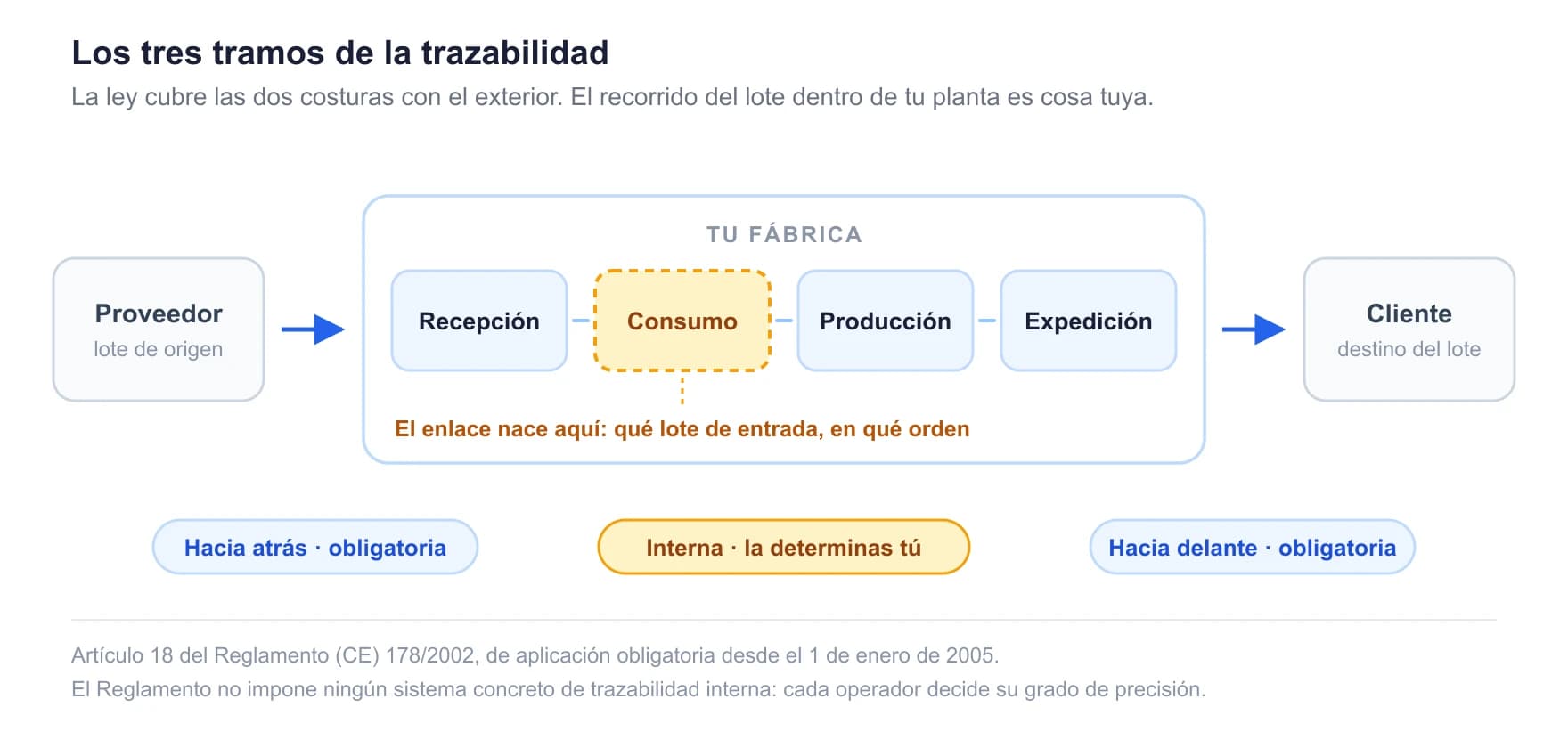
The law asks you for the two ends of the chain. A recall always asks about the link in the middle.
What each sector will ask you for
If you manufacture in any of these sectors, lot traceability isn’t a good practice; it’s a condition of doing business.
| Sector | Reference regulatory framework | What you’ll be asked for during an inspection |
|---|---|---|
| Food and beverages | Regulation (EC) No 178/2002, HACCP, Regulation (EU) No 1169/2011 (allergens), ISO 22000 / IFS / BRCGS | Reconstruct the destination of a lot and the origin of its ingredients within hours |
| Cosmetics | Regulation (EC) No 1223/2009, ISO 22716 (good manufacturing practices) | Product information file and traceability of the manufacturing lot |
| Chemicals and paints | REACH, CLP, safety data sheets | Exact composition of the lot and who it was supplied to |
| Pharmaceuticals and supplements | Good Manufacturing Practice (EudraLex Vol. 4), Commission Delegated Regulation (EU) 2016/161 | Complete batch record, reviewed and signed before release |
| Automotive and metalworking | IATF 16949 and customer requirements | Trace the component back to the vehicle and define the scope of containment |
And if you’re not in any of these sectors, you’re not entirely off the hook either: as soon as your customer is a large manufacturer, traceability will be required by its purchasing specifications, which are usually far less forgiving than an inspector.
The four moments when traceability is recorded
Traceability isn’t a document you fill out. It’s four specific moments in the day when someone has to write something down while doing something else:
- Receiving. The material arrives, and you record the supplier’s lot, not yours: its code, the receipt date, and the expiry date if it has one.
- Consumption. That pallet is opened and taken to a production order. This is where the link is created: this incoming lot, in this order.
- Transformation. The order produces a new lot. You record the identifier you assign it, the quantity, who made it, on which machine, and any control variables that matter in your process: temperature, weight, mix, heat number.
- Shipping. That lot goes out to specific customers, in specific quantities.
Try the exercise in your own plant and you’ll see that you have stages 1, 3, and 4 reasonably well covered: there’s an incoming delivery note, there’s a production report, and there’s an outgoing delivery note. The one that’s almost always missing is stage 2.
And that’s no accident. The other three happen at administrative moments, with someone sitting in front of a computer. Consumption happens on the shop floor, with hands busy and time short. It’s the only one of the four that asks an operator to do something in the middle of their work—and it’s precisely what turns three independent lists into a chain.
Three decisions that determine whether your traceability is useful
So far, we’ve covered what traceability is. What follows is what separates traceability that works from traceability that only exists in a filing cabinet.
There are three decisions, and the interesting thing is that none of them is technological: how finely you split your lots, when the data is recorded, and where it lives. They’re made once, usually without anyone realizing it, and they shape everything that comes after.
1. Lot size determines the size of your recall
The first is the one people are least likely to make consciously and the one with the most financial impact: how large a lot is.
Directive 2011/91/EU, which regulates the indication of lot numbers on food products, defines a lot as a group of units produced or packaged under practically identical conditions, and adds something decisive: the manufacturer determines the lot. No one is going to come and tell you where to draw the line.
Look at the numbers. An eight-hour shift that turns out 4,000 units:
- If you declare one lot per shift, a deviation in the mix at 10:15 means you have to hold all 4,000.
- If you declare one lot per production order—say, eight a day—you hold 500.
The recording effort is practically the same. The recall is eight times smaller.
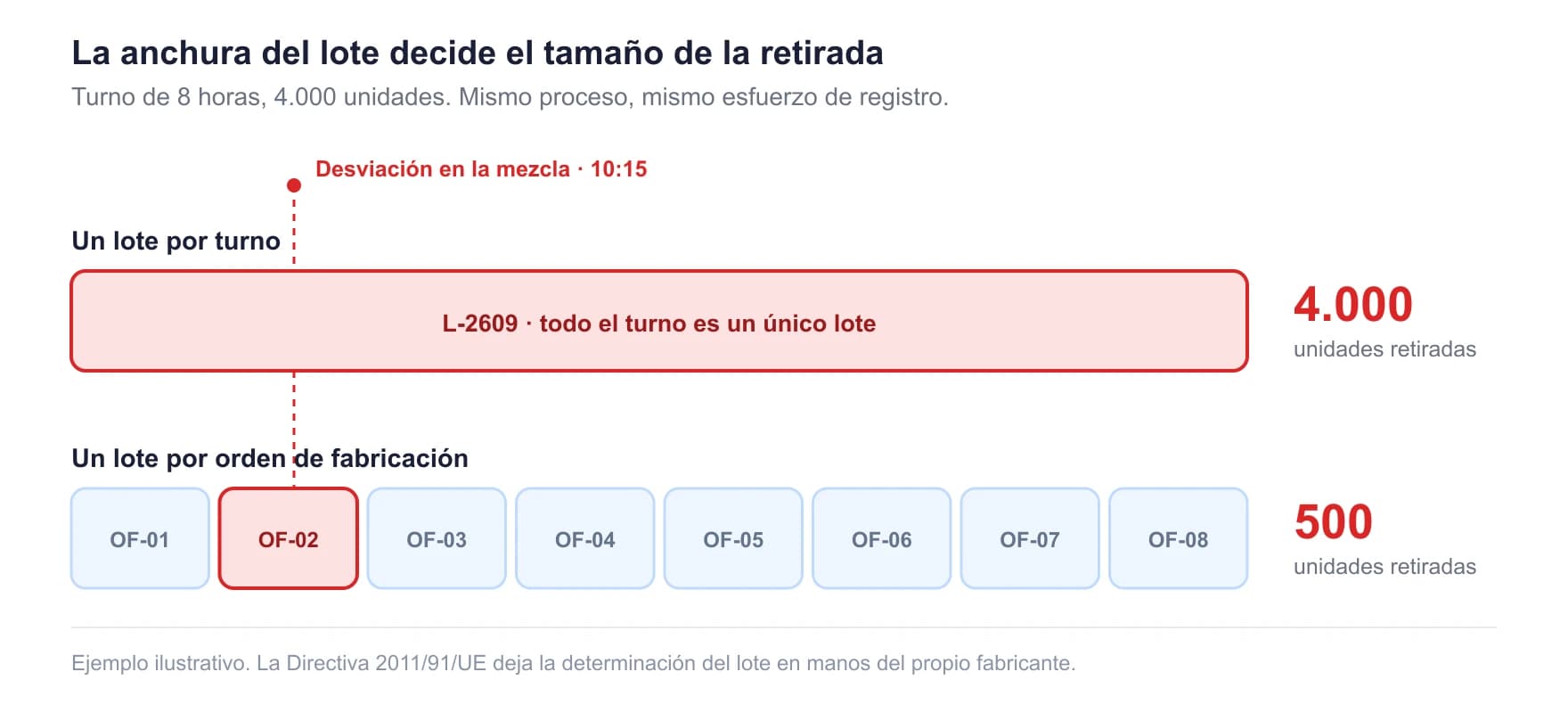
That’s why traceability is more like an insurance deductible than an administrative cost: it doesn’t prevent an incident; it determines how much you pay when one happens. And you set that figure yourself, long before anything goes wrong, on the day you decide where to split your lots.
That said, more lots also mean more records, and there is a real trade-off here that each plant has to find. The practical rule: let the process, not the calendar, determine where to split lots. A change of mix, a change of reel, a change of mold, a change of heat. Wherever something that could go wrong changes, start a new lot.
2. The problem isn’t the paper; it’s the timing
Once you’ve decided on lot size, the second decision isn’t about how much you record, but when.
And let’s be fair to paper: a record properly filled out at the machine provides perfect traceability. Paper doesn’t lie.
What fails isn’t the medium; it’s when the information is recorded. The operator has their hands full, decides to write it down “in a minute,” and by the end of the shift, the lot number on the third reel is no longer a fact; it’s a memory. The next day, someone transfers that paper to Excel, and now you have two layers of reconstruction on top of something that happened once and that nobody watched as it happened.
That leads to the only rule that really matters here:
Traceability data that isn’t captured at the moment it happens isn’t data. It’s an estimate.
That’s why digitizing production doesn’t work just because it’s digital. It works when the record is where the action happens: at the workstation, in two taps, on the same screen where the operator is already declaring what they’re making. If you ask them to go somewhere else to record it, you’ve gone back to paper with extra steps. It’s exactly the same reason user experience on the factory floor determines whether a digitization project ends up with data or not.
3. The chain breaks between systems, not within them
Even if you split your lots properly and capture data in the moment, there’s a third place where traceability can slip away. And this one isn’t on the shop floor; it’s in the architecture.
Follow the journey of a lot: it’s born in the warehouse when it’s received, lives in the production order, is validated by quality, and ends at shipping. In many factories, those are four different departments using four different systems, or three systems and a notebook.
Each stage can be perfectly recorded and you can still have no traceability, because traceability only exists end to end. A chain broken at one point isn’t a partial chain; it isn’t a chain.
It’s the same seam you find when trying to run the plant with an ERP’s manufacturing module: each part works well in its own domain, and the link is left in no-man’s-land. And it’s the underlying reason MOM systems exist: they let warehousing, production, quality, and shipping work with the same data instead of synchronizing four copies. At Bold, the lot is literally the same object from the moment it enters the door until it leaves on a delivery note.
Where to start without launching a six-month project
- Decide on lot size before anything else. It shapes everything that follows and costs nothing: just a meeting. One lot per production order is usually a reasonable starting point.
- Close the missing link first. Consumption. Even if receiving and shipping stay on paper for another month, this is the link you don’t have, and without it the other three are no use.
- Capture data where things happen. You don’t need new hardware: the tablet or phone already on the shop floor can read a code just as well as a high-end scanner. What you need is for the record to be on the same screen where the operator is already working.
- Start with the highest-risk line, not the easiest one. The goal isn’t traceability for 100% of your items; it’s traceability where a recall would really hurt.
Sources
- Regulation (EC) No 178/2002 — Article 18: the obligation to identify suppliers and customers (one step back, one step forward), applicable since January 1, 2005.
- Food Traceability Guide, Government of Aragon — explanation of the three stages of traceability and confirmation that the Regulation does not impose any specific internal traceability system.
- Directive 2011/91/EU — definition of a lot and assignment of the decision about lot identification to the producer, manufacturer, or packager.
- AESAN, Spanish Agency for Food Safety and Nutrition — the Spanish authority’s position on food traceability.
Conclusion
Lot traceability isn’t looked up; it’s built. Looking it up is the easy part—any decent system can answer in seconds if the data is there—and all the difficulty lies in making sure that data is recorded automatically, at the exact moment it happens, without anyone having to remember anything three weeks later.
Put that way, it stops being a regulatory issue and becomes what it really is: a design decision about how your plant works. Those who make it in time can answer a call like the one at the beginning in an afternoon. Those who don’t make it end up making it anyway: by default, and on the day someone calls.
Find out how Bold keeps the lot chain connected from receiving to shipping: request a demo 👇 and see for yourself with your own items.