Leave Excel Behind in 4–6 Weeks: Cloud MRP for Industrial SMEs

2026-04-16
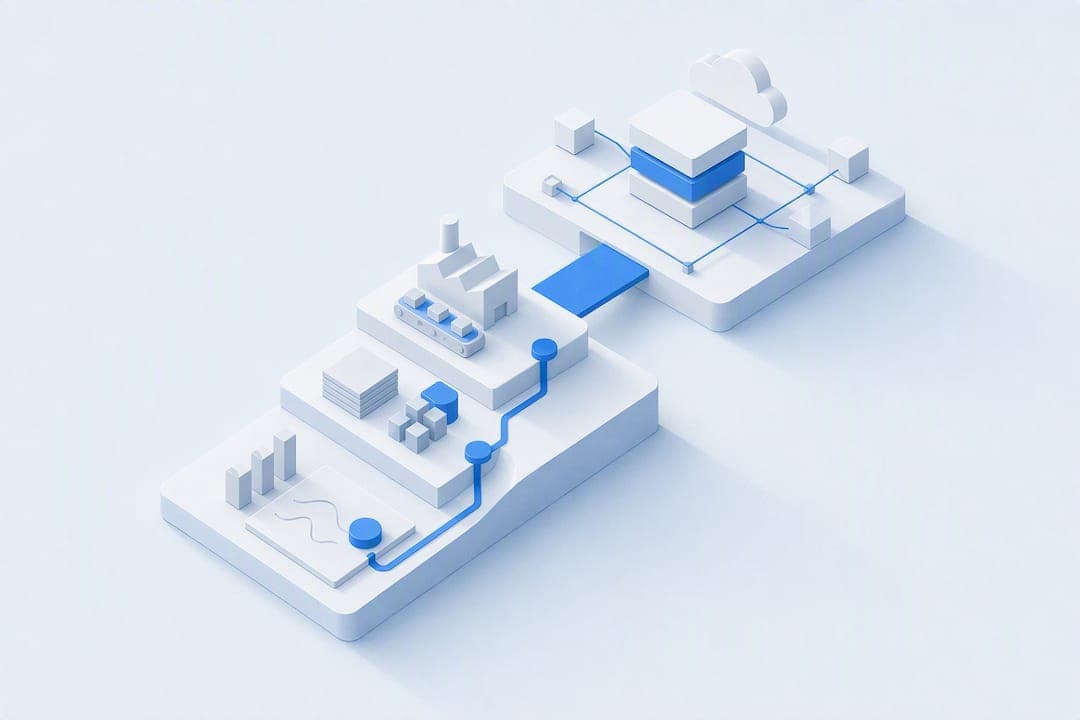
Cloud MRP is the fastest way for an industrial SME to stop planning with Excel spreadsheets and reduce stockouts and downtime caused by material shortages. It calculates what to buy and what to manufacture by combining demand, the bill of materials, and lead times, accessible from any computer or mobile device without your own servers. For a production manager who currently improvises with scattered spreadsheets, it is the operational improvement with the fastest return.
In brief:
- Implementing cloud MRP significantly reduces costs, shifting from investment in hardware to monthly subscription expenses.
- Remote access, real-time collaboration, and integration with systems such as ERP and WMS increase planning efficiency and accuracy.
- Successful implementation requires cleaning up data, defining a pilot, and measuring results at 30, 60, and 90 days, ensuring adoption and reducing manual tasks.
- Compatibility with artificial intelligence and IIoT technologies can improve production and maintenance management predictably and proactively.
- Choosing platforms with open APIs and guarantees for privacy and SLAs is key to avoiding disruptive problems in industrial management.
Table of contents
- What is MRP, and how did it move to the cloud?
- Concrete benefits of cloud MRP for an industrial SME
- How cloud MRP works in practice
- Integration with ERP, MES, and the warehouse: what data needs to be shared
- How to implement cloud MRP: realistic steps and timeline
- What an integrated platform offers compared with assembling each piece separately
- What to review regarding legal matters and data privacy
- Where cloud MRP is headed: AI, IIoT, and what to watch
- Bold Factory: the practical way to leave Excel behind in weeks, not years
- Sources
What is MRP, and how did it move to the cloud?
MRP (material requirements planning) is the system that translates what needs to be sold or manufactured into what needs to be purchased and produced, and when. SAP defines it as software that calculates the procurement plans needed to meet forecast demand and production plans. It originated in the 1960s as batch calculations on mainframes, almost always tied to large factories with dedicated IT departments.
Traditional MRP works with three inputs: demand (confirmed orders or forecasts), the bill of materials or BOM (the components in each product), and supplier lead times. Using these three data points, it calculates how much material is missing and when each order needs to be placed.
MRP II expanded the scope to include plant capacity, labor, and costs—not just materials. This led to the first steps toward what we now call ERP: a system that no longer just plans purchases, but connects finance, sales, and production in a single environment.
What has changed with the cloud is not the calculation itself, but who can afford it. In the past, setting up MRP required your own servers, expensive licenses, and IT teams. Today, a web-based MRP platform runs on a subscription, updates automatically, and is paid for according to usage, democratizing access for workshops with twenty or thirty employees that would never have considered it before.
The components every operational cloud MRP system still needs are the same as always:
- Demand forecast or confirmed order book.
- Up-to-date bill of materials (BOM) for each product.
- Real-time inventory levels.
- Actual lead times from each supplier.
Concrete benefits of cloud MRP for an industrial SME
The benefit that carries the most weight in the purchasing decision is the cost model. Traditional MRP required purchasing servers, user licenses, and annual maintenance; cloud MRP is paid for as a monthly subscription, with no upfront hardware investment. This turns a capital expense into an operating expense, something any SME's finance director appreciates when approving the project.
Cloud computing also offers scalability, remote access, a lower total cost of ownership, and analytics capabilities that an on-premises system rarely provides with the same agility. That combination explains why SMEs adopt these platforms faster than traditional systems: a pilot can be set up in days, not months, and the initial risk is minimal.
Professional tip: Before comparing prices between providers, calculate how much each stockout costs you today in hours of production downtime. That figure—not the monthly fee—is what justifies the change to management.
Other practical benefits that plant teams notice first:
- Genuine remote access: the operations director can check the production plan from a mobile phone without being at the factory.
- Collaboration between purchasing, the plant, and management using the same data, without different versions of the same spreadsheet.
- Backups and encryption managed by the provider, without relying on an unmaintained local server.
- Analytics that are beginning to incorporate AI-assisted forecasting instead of static formulas.
How cloud MRP works in practice
Cloud MRP works through an input, process, and output logic that is worth understanding before implementation, because it determines which data needs to be ready.
- Inputs. The system needs demand (confirmed orders or a sales forecast), the bill of materials for each product, inventory available in the warehouse, and the lead times agreed with each supplier.
- Requirements explosion. The MRP engine breaks down each finished product into its components, subtracts what is already in stock, and determines what needs to be purchased or manufactured.
- Batch and date calculations. It groups requirements into reasonably sized orders and schedules them according to each supplier's lead time or the internal production time.
- Synchronization with purchasing. It automatically generates purchase order proposals that the purchasing manager only needs to validate or adjust.
- Outputs and alerts. The system issues purchase orders, manufacturing orders, and alerts when it detects a risk of a stockout before it happens.
A simple example: a machine shop receives an order for 500 parts due in six weeks. The MRP checks the BOM, sees that 300 kilos of an alloy with a four-week supplier lead time are missing, and automatically generates the purchase order with a deadline. Without this automatic calculation, someone would have to manually check the product record, stock, and supplier lead time, risking late detection.
Integration with ERP, MES, and the warehouse: what data needs to be shared
Cloud MRP does not operate in isolation. Its real value comes when it shares data with the rest of the factory's systems without duplicating information or creating discrepancies between what the paperwork says and what happens on the plant floor.
With ERP, it mainly shares financial and commercial data: material costs, margins, invoicing, and the status of customer orders that trigger planning. MRP calculates what to purchase and manufacture; ERP manages the business around that production. They are distinct functions that need to communicate, not one program with two names.
With MES (manufacturing execution system), the exchange is more operational: MRP says what needs to be produced and when, and MES reports what actually happened on the machine, including the time taken and any scrap. Without that feedback, the plan becomes disconnected from plant-floor reality within a few weeks.
Integrating a WMS or SGA (warehouse management system) also provides lot traceability and the exact location of stock, which is critical in sectors such as food, metal, and pharmaceuticals, where every component must be traceable back to its origin.
- MRP needs to know actual inventory, not theoretical inventory, to calculate requirements accurately.
- MES provides actual production times, which adjust MRP's future lead times.
- WMS prevents a purchase order from being placed for something that is already physically in the warehouse, but is simply in the wrong location.
Professional tip: Before signing with any provider, ask to see its API documentation. If it does not have an open API to your current ERP, you will end up re-entering data manually—which is exactly the problem you wanted to solve.
How to implement cloud MRP: realistic steps and timeline
Most failed implementations do not fail because of the software, but because of the data and changes in habits. These are the steps that make the difference between an implementation that takes weeks and one that drags on for months.
- Clean up master data first. Review and update the bill of materials (BOM) for your best-selling products first; do not try to digitize all 400 items at once.
- Define a focused pilot. Choose a product family or production line, not the entire factory. A 4-to-6-week pilot with measurable results is more convincing than a full rollout that has not been validated.
- Set success criteria before you start. For example: cut stockouts on that line in half, or eliminate the parallel Excel spreadsheet used by purchasing.
- Train operators and purchasing staff in parallel. Resistance to change usually comes from someone who fears losing control of "their" spreadsheet, not from someone using the system on the plant floor.
- Assign a governance lead. Someone needs to decide who updates the BOM and who validates supplier lead times, or the system will become outdated within weeks.
- Measure at 30, 60, and 90 days. In the first month, measure actual daily usage; at subsequent stages, measure the reduction in stockouts and the time saved on manual planning tasks.
Professional tip: The most honest indicator of a successful implementation is not how many people use the system, but how many people have stopped opening the parallel Excel spreadsheet. If that file is still active after 60 days, some part of the process has not been properly closed out.
The typical implementation timeline depends on the scope: a focused pilot on a platform designed for SMEs can be up and running quickly, while complete integrations with ERP and several modules usually take weeks or a few months—considerably less time than very extensive custom projects.
What an integrated platform offers compared with assembling each piece separately
Many SMEs discover too late that an isolated MRP system, without a connection to production and the warehouse, ends up creating the very problem it was meant to solve: duplicate data and decisions made using outdated information. Market analyses point to a growing preference for solutions that combine MES, MRP, and WMS specifically to avoid these silos.
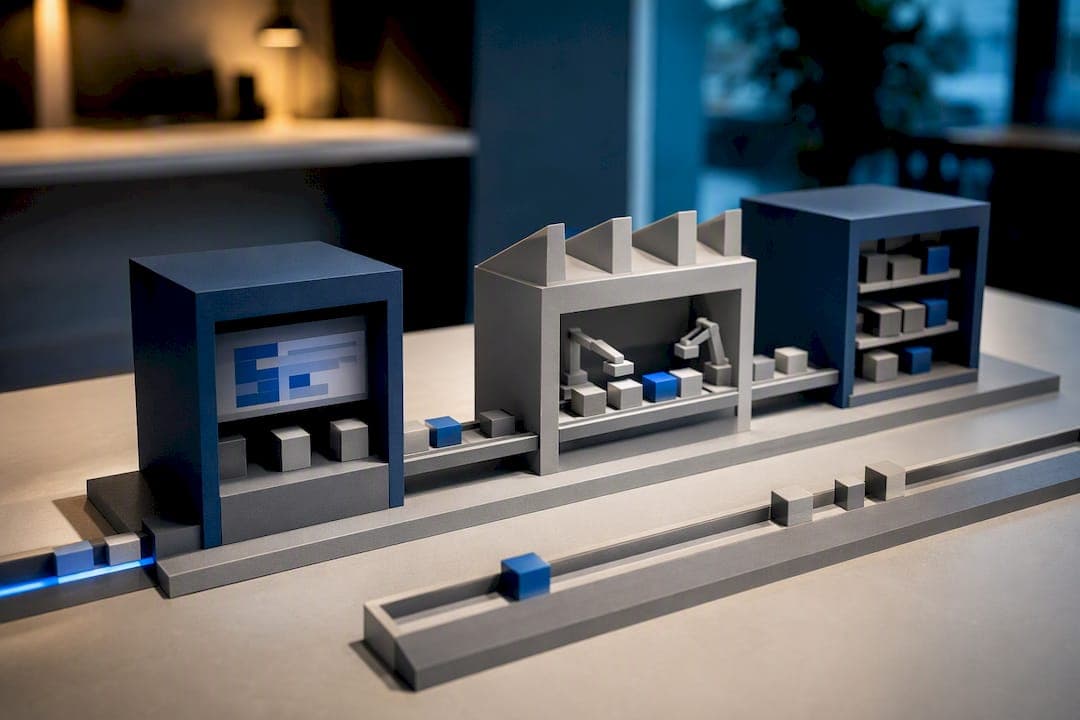
Some platforms bring planning and purchasing (MRP), production control (MES), warehouse management and traceability (WMS), and machinery maintenance (CMMS) together in a single solution, with API integration to the ERP used by the company. This coverage avoids the common scenario of having three or four programs that do not communicate with one another.
Points that often carry weight in a production manager's decision:
- Implementation measured in days, not the months or years typical of a custom development project.
- No long-term contract, reducing the risk of being tied to a system that does not meet expectations.
- An interface designed for any operator to use from a mobile phone, with no lengthy learning curve.
- AI agents that automate repetitive tasks through natural-language instructions, without the need to program complex rules.
What to review regarding legal matters and data privacy
Moving production planning to the cloud means that sensitive data (costs, suppliers, sales volumes) passes through a third party's servers. That is not inherently a problem, but there are a few things to check before signing.
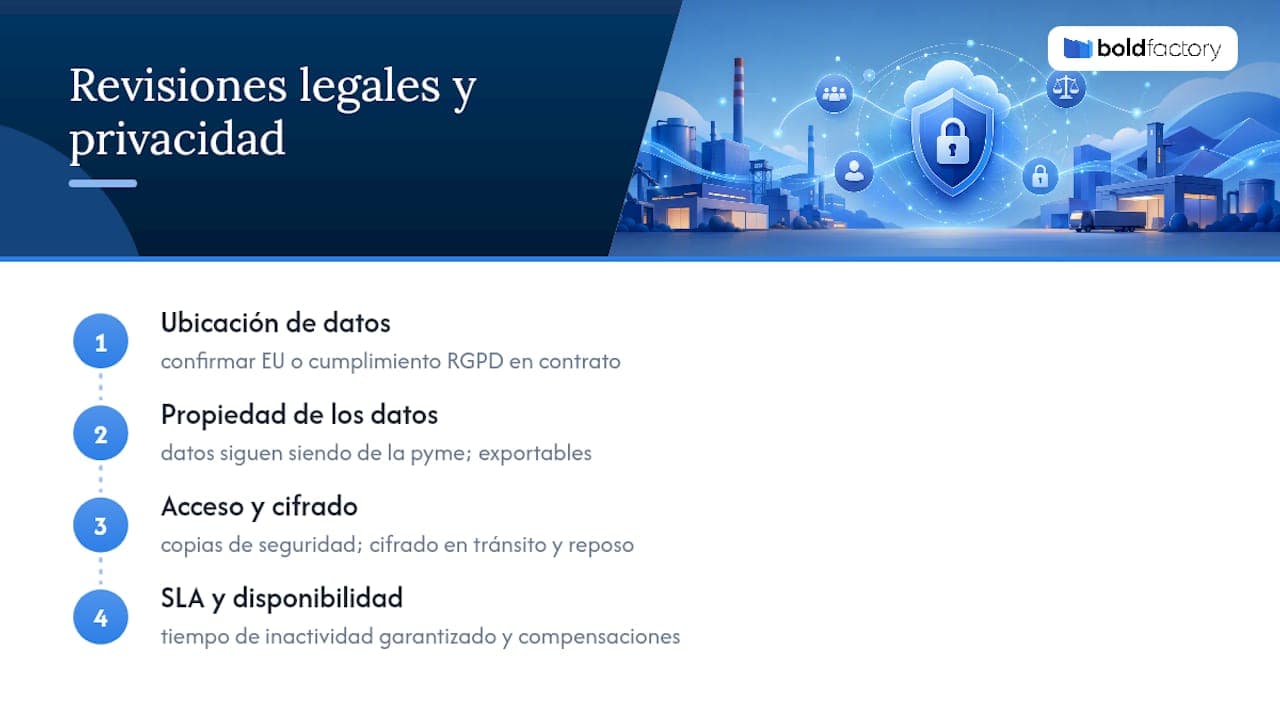
First, verify where the data is physically stored. If the provider operates in the European Union or certifies compliance with the General Data Protection Regulation (GDPR), the company retains the same legal guarantees as with any other provider that processes personal data or commercially sensitive information. Ask for this information explicitly in the contract; do not assume it.
Second, consider data ownership. A well-drafted subscription contract makes it clear that production, customer, and supplier data remains the SME's property, not the software provider's, and that it can be exported if the company decides to switch platforms.
Third, consider access and encryption. It is reasonable to ask how the provider manages backups, whether it encrypts data in transit and at rest, and what happens to the information if the company cancels its subscription. Any serious provider should answer these questions directly.
Finally, it is worth reviewing the service-level agreements (SLAs): what uptime the provider guarantees and what compensation is available if the system fails at a critical point in production. This is no minor detail when the planning of the entire factory depends on the system being available.
Where cloud MRP is headed: AI, IIoT, and what to watch
Artificial intelligence is no longer a distant promise in production planning. Industry analyses describe how AI is redefining smart manufacturing by improving demand forecasting and anticipating maintenance needs before a breakdown occurs. Combined with data from plant-floor sensors (known as IIoT), AI can adjust production plans using real machine data, not just historical estimates.
For an SME choosing technology today, the practical recommendation is simple: prioritize platforms that already include these capabilities natively, rather than promising them "soon." A system that learns from your actual plant data is worth more than one that only automates paperwork.
— Alex Ponce
Bold Factory: the practical way to leave Excel behind in weeks, not years
Compared with custom development that takes months to get started and locks you into long contracts, there are alternatives that can be implemented in days, with no long-term commitment and integrated modules from day one.
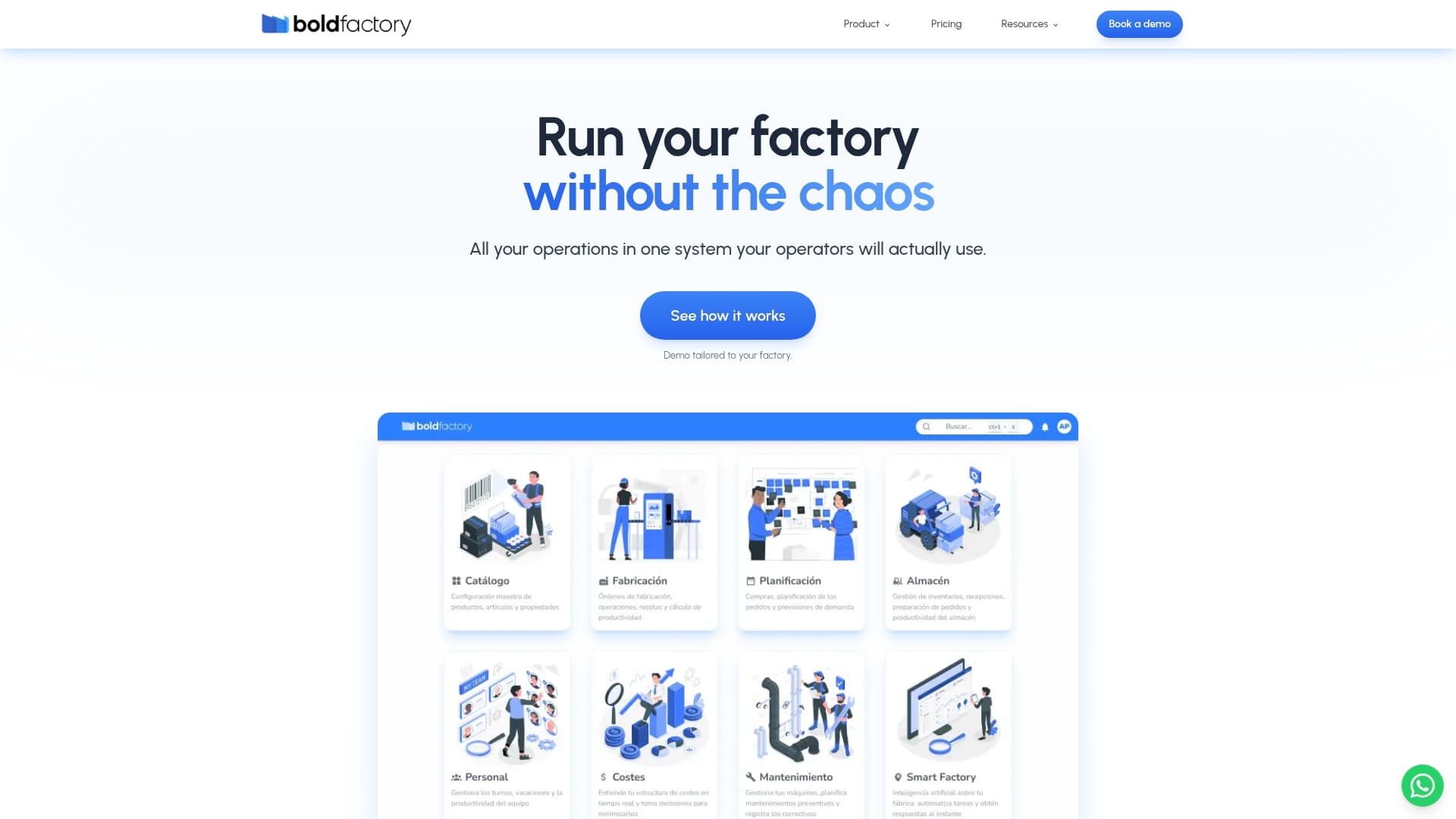
That means you do not have to choose between digitizing production and digitizing the warehouse: the MRP planning module automatically shares data with production control and machinery maintenance, so a manufacturing order delayed by a breakdown is reflected in the plan without anyone having to update three different systems by hand. API access to the existing ERP also avoids the duplicated work of entering the same data twice.
If your team is still planning with spreadsheets that become outdated every week, the next logical step is to request a demo of Bold Factory's software for industrial SMEs and see, using your own data, how much manual planning time can be eliminated in the first month.
Sources
To explore each claim in this article, it is worth reviewing SAP's technical definition of MRP directly, as well as the industry case for cloud MRP for metal service centers.
- What is material requirements planning (MRP?) | SAP
- Technological advances and MRP improvement | FasterCapital
- The future of smart manufacturing takes a new turn with AI | Forbes