MES and SCADA for SMEs: implement them in 3 phases and in days

2026-02-11
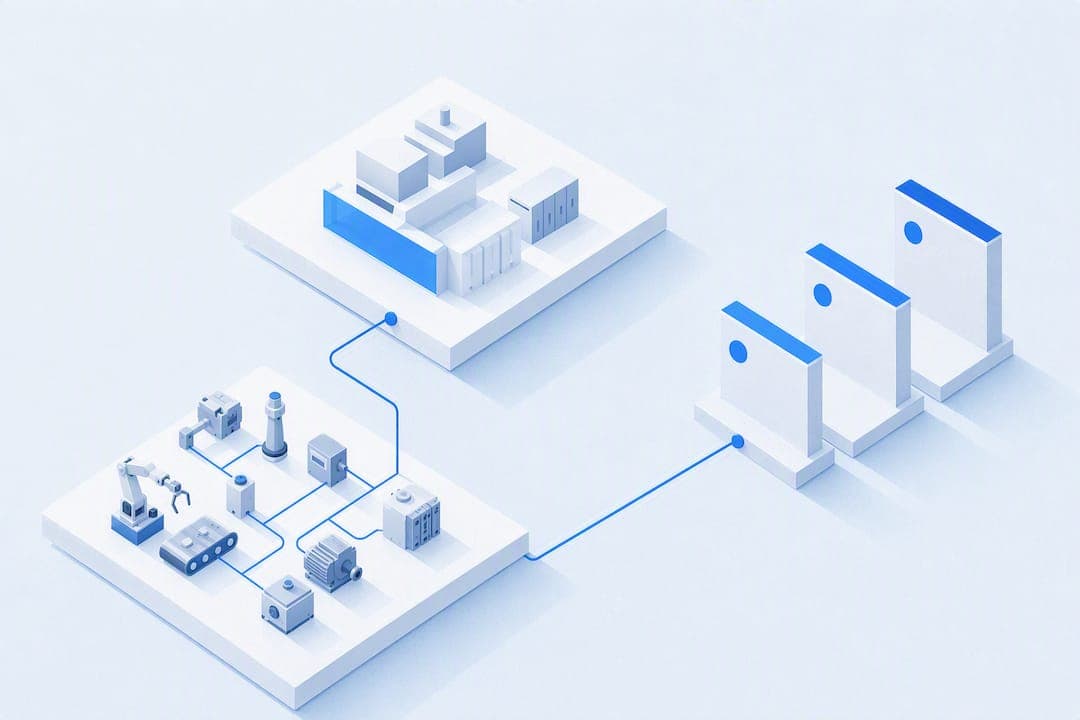
It is not a choice between one or the other: SCADA supervises and controls production in real time, while MES manages orders, traceability, and quality across shifts and days. Within the ISA-95 model, the former operates at level 2 and the latter at level 3. In most factories, both end up being necessary because they answer different questions.
In brief:
- Installing SCADA first helps provide real-time visibility into machines, but it does not replace the order and quality management offered by an MES.
- MES focuses on managing batches, traceability, and quality results over a horizon of shifts and days, not seconds.
- SCADA and MES integration should follow the ISA-95 model, using open standards such as OPC UA or MQTT to reduce costs and complexity.
- In small factories, implementation should happen in phases: SCADA first, then critical order management, followed by progressive scaling based on results.
- The right choice is to use both systems together rather than trying to make one replace the other, since they address different management and control needs.
Table of contents
- What SCADA is and what functions it covers on the plant floor
- What an MES is and what it brings to traceability and quality
- Key differences between MES and SCADA
- How SCADA and MES integrate according to ISA-95
- A practical roadmap for implementing MES and SCADA at an SME
- What experience at industrial SMEs confirms
- Why the right question is not “MES or SCADA”
- An MES designed for SMEs, without a months-long project.
- Sources
What SCADA is and what functions it covers on the plant floor
SCADA is the layer that tells you what is happening right now at each machine. It collects signals from sensors and programmable logic controllers, displays them on operator screens, and triggers alarms when something goes out of range. Its time horizon is measured in milliseconds or seconds, not shifts.
The functions it covers are specific:
- Data acquisition from sensors, PLCs, and drives.
- Human-machine interface (HMI) so the operator can see and act on the process.
- Management of alarms and critical safety or stoppage events.
- Historical recording of process variables (historian).
- Remote control of actuators and equipment start/stop.
Common protocols include OPC UA, Modbus, and EtherNet/IP, chosen for their reliability in environments with electrical noise and fast cycles. Typical users are control room operators and maintenance staff who need to see the machine's status by the second. If the plant still lacks reliable visibility into its equipment, SCADA is usually the sensible first investment, before considering any higher layer.
Professional tip: Do not install SCADA expecting it to replace paper production reports. Its purpose is to monitor the machine, not manage the manufacturing order: for that, you will need an MES.
What an MES is and what it brings to traceability and quality
An MES manages production execution: which order is being manufactured, with which batch, who made it, and what the quality result was. It works over a horizon of shifts and days, not seconds, and connects the shop floor with planning and management.
Its main functions include:
- Releasing and tracking manufacturing orders.
- Batch genealogy and traceability of materials consumed.
- Quality control with nonconformance records for each operation.
- Recording times and stoppages associated with each order, not just the machine.
- Calculating indicators such as OEE from contextualized data.
Typical users include planning, quality, and management, as well as the operators themselves, who record their work from a screen or mobile phone. Measurable benefits appear quickly: fewer reworks due to batch identification errors, complete traceability in the event of a customer complaint, and much cleaner consumption reconciliation with the ERP. Industrial production control software covers this layer precisely when an Excel spreadsheet is no longer enough.
Key differences between MES and SCADA
The quickest way to distinguish them is to ask what question each one answers. SCADA answers, “What is happening right now on this machine?” MES answers, “What is being manufactured, how, and by whom, and with what result?”—a distinction that captures the logic of both production system layers.
The criteria that set them apart:
- Objective: SCADA aims for immediate control; MES aims for order execution and traceability.
- Focus: SCADA looks at the machine; MES looks at the product, the batch, and the operator.
- Users: SCADA is for the control room and maintenance; MES involves planning, quality, and management.
- Time horizon: milliseconds and seconds versus shifts and days.
- Decisions it enables: adjusting a process parameter versus deciding whether an order is closed, repeated, or blocked for quality reasons.
Imagine a line stoppage. SCADA detects it instantly, triggers the alarm, and records its exact start and end times. MES, on the other hand, links that stoppage to the specific manufacturing order, calculates its impact on the shift's OEE, and records whether it affected a batch already committed to a customer. Without that context, the machine data provided by SCADA has no meaning for management. If your problem is not knowing what the machine is doing, start with SCADA; if your problem is not knowing what was manufactured or with what quality, you need an MES.
How SCADA and MES integrate according to ISA-95
The ISA-95 model organizes the factory into levels: levels 0 and 1 are sensors and controllers, level 2 is SCADA, level 3 is MES, and level 4 is ERP. The usual data flow moves up from the PLC to SCADA, then to MES, and ends at the ERP for costs and purchasing; in the opposite direction, MES sends manufacturing instructions and constraints down to the plant.
This relationship is complementary, not competitive: SCADA supplies MES with real-time data, and MES sends back orders and constraints that the plant must follow. Cloud platforms have made this integration considerably simpler than the custom API development of a decade ago.
Key fact: Keeping the layers separate according to ISA-95 and using open standards such as OPC UA or MQTT reduces maintenance complexity compared with forcing systems to converge, which tends to make maintenance more expensive over the medium term.
Best practices to keep things simple:
- Use OPC UA or MQTT to connect SCADA with MES instead of proprietary point-to-point connections.
- Let the ERP manage costs and purchasing; do not ask it to provide shop-floor traceability—that is what MES is for.
- Avoid having MES try to act as SCADA by reading sensors directly: it loses order and quality context.
A practical roadmap for implementing MES and SCADA at an SME
The sequence that works best in factories with fewer than one hundred operators has three phases, without skipping steps or oversizing the project from day one.
- Visibility first. Install SCADA or a lightweight OEE solution to get reliable machine data before thinking about traceability.
- MES for critical processes. Add order management, quality, and traceability where the risk of rework or complaints is greatest, not across the entire plant at once.
- Scale toward MOM. Integrate maintenance, warehousing, and comparisons between lines once the basic MES is working reliably.
This sequence is in line with the recommendations in digitalization guides for medium-sized companies: forcing SCADA and MES to converge too early tends to create fragile solutions that cost more to maintain than to implement.
Professional tip: Do not wait until the process is perfect to digitize it. Start with the line with the most rework or complaints: that is where you will see a return in weeks, not years.
What experience at industrial SMEs confirms
The implementations that go best tend to share a pattern: deployments take days, not months, and paper and Excel are quickly eliminated from the plant floor. Daily visibility improves almost immediately, even before the MES is complete.
The most repeated lesson is to start with the essentials: traceability for the critical order, not a complete map of processes. Fragile integrations, with custom connections between different systems, are the most common reason a project is abandoned after six months. Validating the return with a pilot limited to one line before scaling avoids this mistake.
Why the right question is not “MES or SCADA”
The discussion about which of the two systems is “better” starts from a mistaken premise. Neither replaces the other because they answer different questions, and trying to stretch SCADA to make it act as MES (or vice versa) is the fastest way to end up with a system that satisfies no one: neither the operator, who cannot find the information, nor management, which does not trust the data.
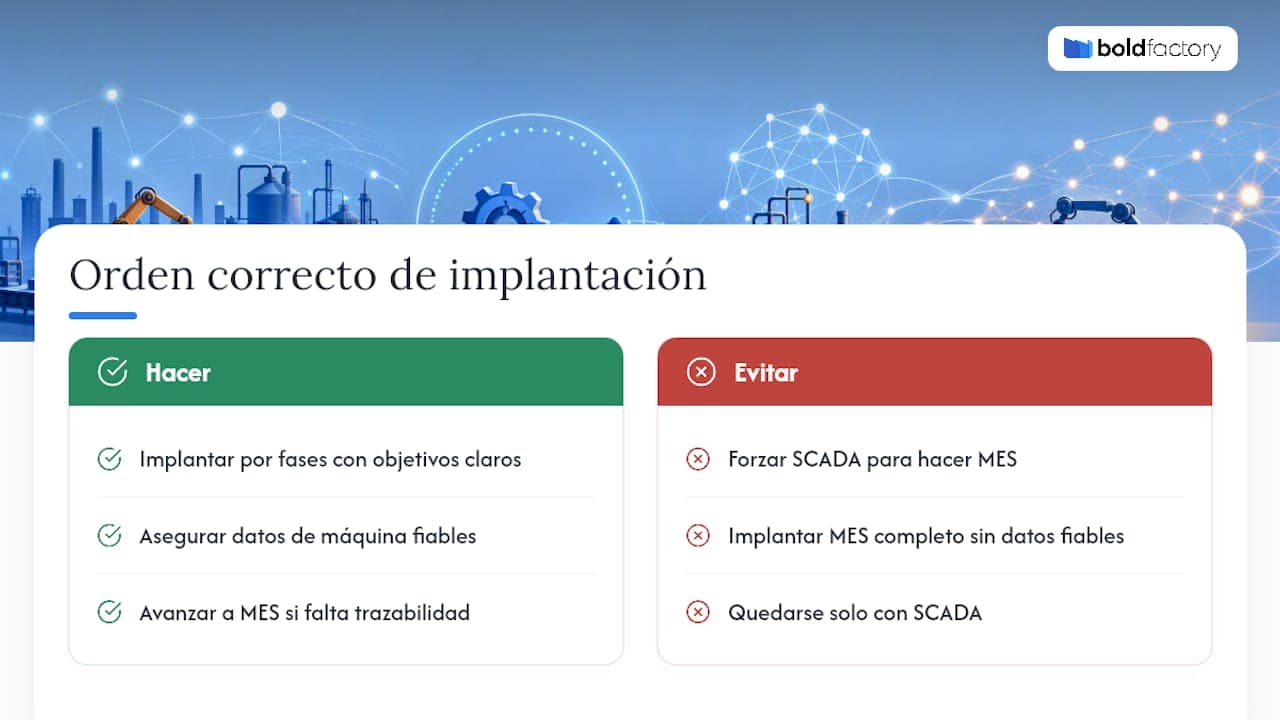
What does fail in practice is not the technical choice, but the order. Many SMEs try to implement a complete MES before they have reliable machine data, and the result is a system that records orders on a poor information base. A phased roadmap is not excessive caution: it is the difference between a project that people are using after three months and one that gets abandoned.
The opposite mistake also happens: sticking with SCADA alone for years because “we already have visibility,” while traceability remains on paper and every customer complaint is investigated manually. If your factory already knows what its machines are doing but does not know what has been manufactured or with what quality, that is exactly the sign that it needs to take the next step.
— Alex Ponce
An MES designed for SMEs, without a months-long project.
There are platforms that bring production control, planning, warehousing, and maintenance together in a single system that can be up and running in days, with no long-term commitment.
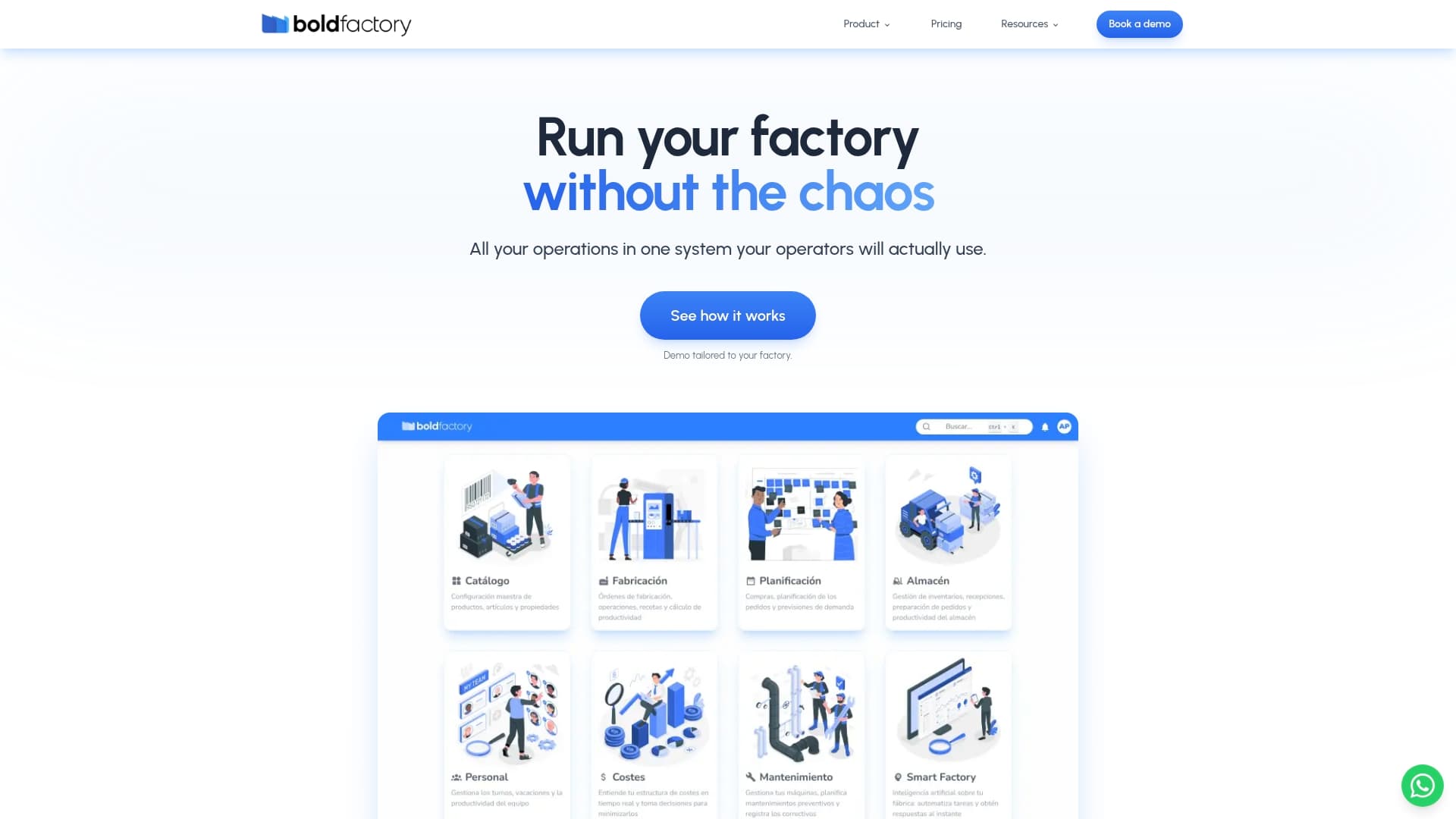
Some platforms cover MES functions such as digital orders, batch traceability, and quality records, along with planning and purchasing, warehouse management, and maintenance, with artificial intelligence agents that automate repetitive tasks through natural-language instructions. The shared goal of SME leaders is to gain real visibility into the factory without having to be physically on the plant floor, through an intuitive interface that can be used from a mobile phone.
If your factory already has SCADA or basic machine control, and the next step is order traceability, you can explore Bold Factory's industrial production control software and request a demo to see how it fits your specific process.
Sources
To understand the full architecture, it is worth reviewing the ISA-95 model, the explanation of how MES and SCADA work together, and the analysis of their future convergence published by Automation World.