Line Balancing: The Lean Technique for Eliminating Idle Time

2026-02-24
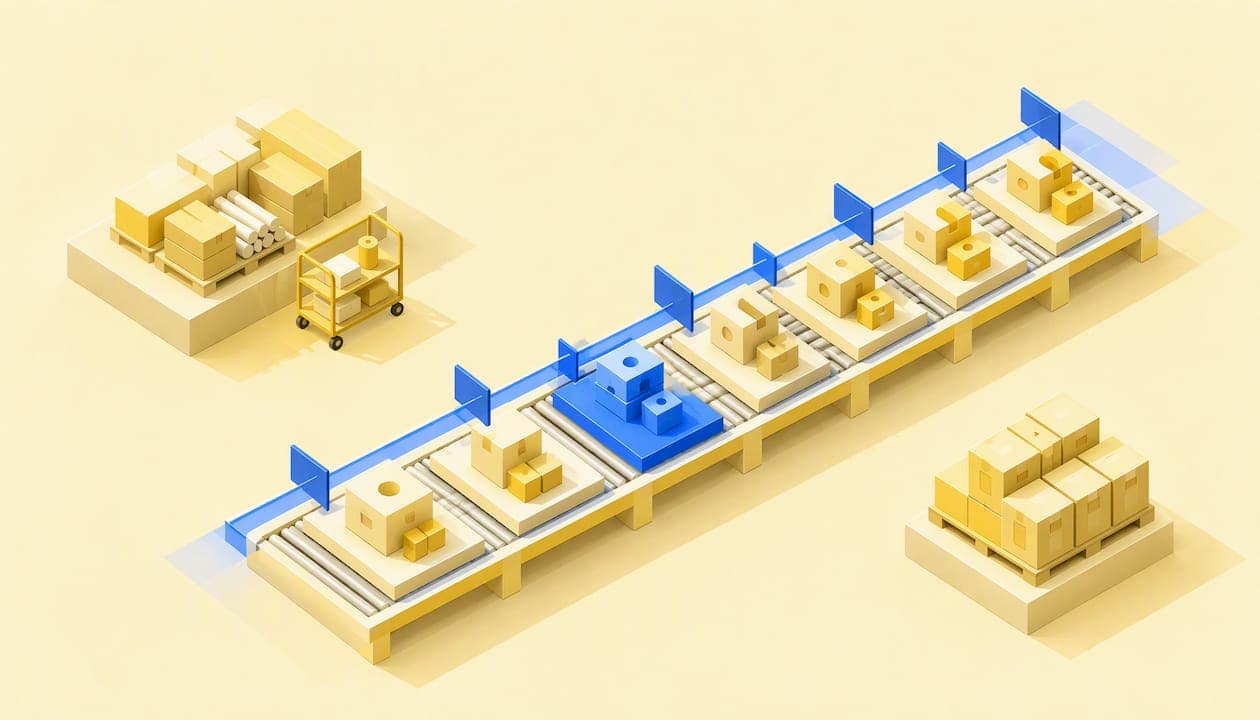
Line balancing redistributes tasks among stations to bring each one closer to the target takt time and eliminate waiting. The direct result is less idle time and more units per shift without investing in new machinery. It is measured using takt time and balancing efficiency, and the calculation must be repeated whenever the product or demand changes.
In summary:
Line balancing is recommended only for production with high volume, continuous flow, and task times measured using real data.
Optimal balancing efficiency is between 85% and 95%; below that range, there is room for improvement, while above it, idle times should be reviewed.
Simulation and digital tools make the process faster and more precise, especially on multi-model lines or those with high variability.
Frequent time measurement and periodic adjustments are key to keeping the line balanced as demand changes.
Avoid reassigning tasks without reliable data or multi-skilled operators, and never balance processes with low continuity or volume.
Table of contents
-
Key calculations: takt time, minimum stations, and efficiency
-
Common challenges when balancing a line and how to overcome them
What line balancing is and why it works
Line balancing consists of distributing the total work content among the stations on a production line so that no station takes longer than the target cycle time. This target is called takt time: the rate at which a unit must be produced to meet customer demand during the available workday.
When one station takes longer than the others, it becomes a bottleneck and forces the rest of the line to wait. Balancing moves tasks from that station to others with available capacity, reduces waiting, and increases the OEE performance factor without affecting the availability or quality factors. It is an improvement that does not require buying new machines, only reorganizing the existing work.
Three conditions must be in place for the exercise to make sense:
-
Sufficient production volume to justify a dedicated line.
-
Continuous flow, without sporadic batches that change the product mix every few hours.
-
Task times measured using real data, not rough estimates.
Practical steps for balancing a line
The process follows a fixed sequence that any production manager can apply on the plant floor without needing training in industrial engineering.
-
Calculate takt time. Divide the available workday time by demand for the period. This is the upper limit that no station can exceed.
-
Measure task times. Time the work elements with at least 5 to 10 repetitions per task to prevent an atypical data point from distorting the calculation.
-
Identify tasks and precedence relationships. Build a precedence diagram showing which operations must be performed before others; this is essential before moving anything.
-
Assign tasks to stations. Group work elements while respecting takt time and precedence relationships, prioritizing by positional weight when several tasks compete for the same station.
-
Calculate the theoretical minimum number of stations and compare it with the actual number to see the potential for improvement.
-
Iterate and document. Measure the impact after the change, make adjustments, and record the new work standard.
Professional tip: Don't time only the best operator on the shift. Measure two or three different people performing the same task: variation between operators is often greater than variation between repetitions by the same person.
Key calculations: takt time, minimum stations, and efficiency
Three formulas underpin the entire balancing exercise, and it is worth having them on hand before changing any station.
-
Takt time = available time ÷ demand for the period. If there are 480 available minutes and demand is 240 units, takt time is 2 minutes per unit.
-
Theoretical minimum number of stations = sum of task times ÷ bottleneck cycle time, rounded up.
-
Balancing efficiency = sum of task times ÷ (number of stations × bottleneck cycle time).
Key fact: A balancing efficiency range of 85% to 95% is considered solid in assembly operations. Below that range, there is real room for improvement; above it, check whether minor stops or small amounts of idle time are being overlooked.
To verify the improvement, measure actual OEE performance again after the change rather than relying only on the theoretical calculation on paper.
Tools and when to use simulation versus spreadsheets
A well-built Excel spreadsheet works for calculating takt time, the number of stations, and efficiency on a simple, single-model line. The problem arises with real-world variability and multi-model lines, where several product references share stations with different task times depending on the product passing through them at any given moment.
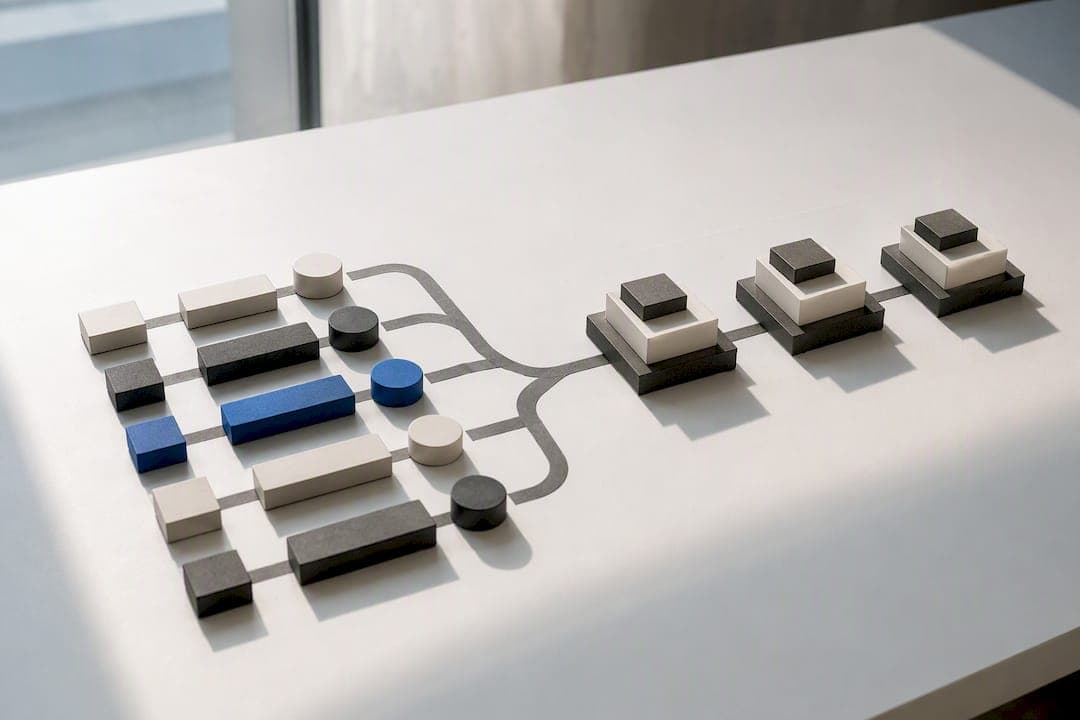
That's where Excel falls short, because it treats times as fixed values rather than distributions with variation. Simulation makes it possible to test different assignment scenarios before moving a single operator, avoiding the real risk that a poorly calculated adjustment will increase work-in-process inventory instead of reducing it.
When choosing a tool, prioritize:
-
The ability to iterate through scenarios quickly, without manually rebuilding formulas.
-
Real task-time data captured on the plant floor, not historical estimates.
-
Integration with planning and production systems so the new line balance is reflected in actual scheduling.
Professional tip: If you work with multi-model lines, first calculate the [object Object] before assigning tasks to stations; assigning tasks based on the times for just one model on a mixed line is the most common mistake.
When not to apply line balancing and the main risks
Line balancing is not universal. Without sufficient volume and continuity of flow, the effort of measuring and reassigning tasks will not pay off, because the line's configuration will change before the adjustment produces results.
The main risks are:
-
Balancing low-volume or highly variable processes, where takt time changes every few days.
-
Reassigning tasks without multi-skilled operators who can take on the new distribution of work, as explained by the importance of staff training and multi-skilling in optimizing the production line.
-
Ignoring maintenance: a machine that frequently breaks down will undo any line balance, no matter how carefully it was calculated.
-
Moving resources without simulating first, which can increase work-in-process inventory instead of reducing it.
A limited pilot, with prior simulation when variability is high, reduces these risks before the change is applied to the entire line.
A practical line-balancing example with numbers
An assembly line operates for 480 minutes per shift and must deliver 240 units per day. It has five tasks with times of 1.8, 2.1, 1.5, 1.9, and 1.7 minutes, for a total of 9 minutes of work per unit.
-
Takt time = 480 ÷ 240 = 2 minutes per unit.
-
Theoretical minimum number of stations = 9 ÷ 2 = 4.5, rounded up to 5 stations.
-
Initial configuration with 6 stations: efficiency = 9 ÷ (6 × 2) = 75%.
-
After regrouping tasks into 5 stations while respecting precedence relationships: efficiency = 9 ÷ (5 × 2) = 90%.
The next step is to measure actual times again after the change and confirm that no station exceeds the 2-minute takt time under normal shift conditions.
Common challenges when balancing a line and how to overcome them
The most common challenge is not calculating the formulas, but getting reliable time data. Many plants time a task once, with an experienced operator, and project that result as if it represented the entire shift. The result is a line balance that works on paper and fails on the plant floor at the first demand spike.
The second challenge is team resistance. Reassigning tasks among operators is often seen as a threat to their jobs if the reason isn't explained. Involving the operators themselves in measuring task times, rather than imposing the new distribution from above, reduces friction and improves data quality because no one hides or inflates their task time.
A third obstacle arises when task precedence relationships are not documented. Without a clear precedence diagram, it is easy to assign a task to a station that comes before the station it actually depends on, causing rework or defects.
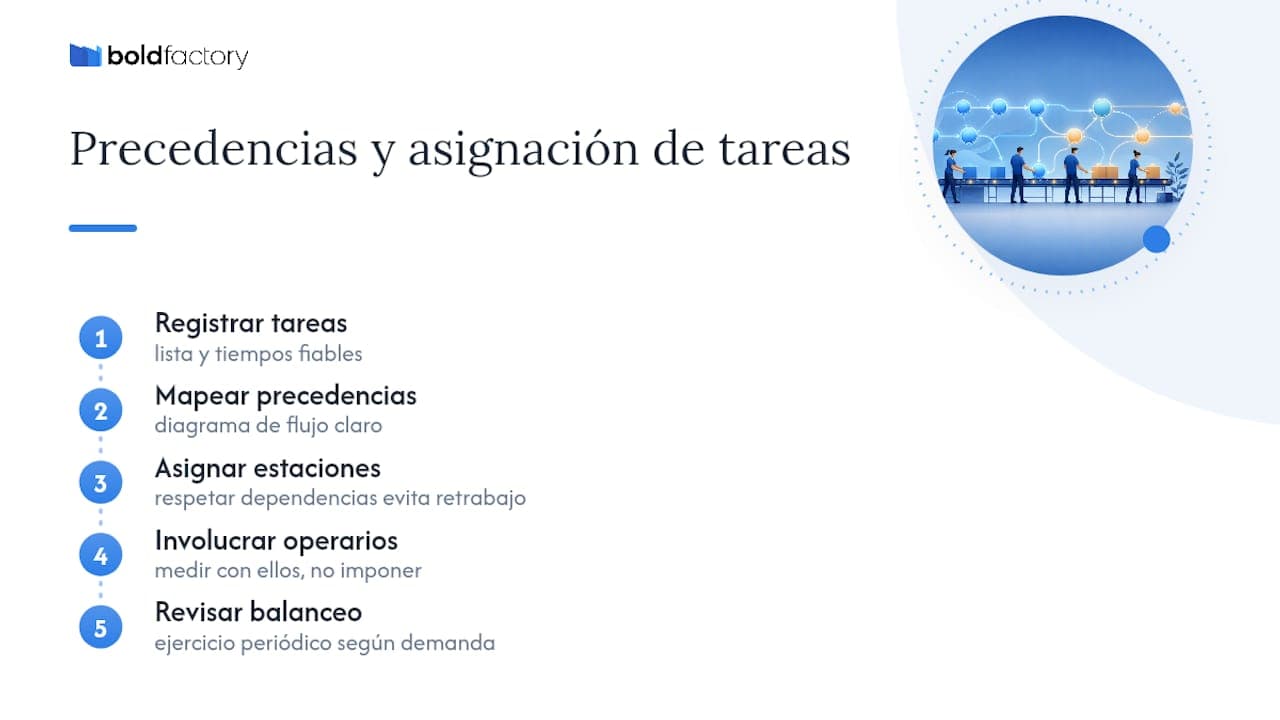
Finally, many lines are balanced once and the calculation is not revisited for years. Takt time changes with demand, and a line balanced for 240 units per day is no longer balanced as soon as demand rises to 300. Reviewing line balance should be a periodic exercise, not a one-off project.
The impact of line balancing on operating costs
Line balancing reduces costs without changing the workforce or installed equipment, because it addresses time that has already been paid for but is currently lost to waiting. Every minute a station sits idle waiting for the previous one is labor time the company has already paid for but is not using.
By increasing the OEE performance factor, a line produces more units in the same shift with the same staff, which spreads the fixed labor cost over more units manufactured. In the numerical example in the previous section, moving from 6 to 5 stations for the same output frees up one full-time position, which can be reassigned to another line or another shift, or simply used to reduce overtime.
Line balancing also reduces the capital tied up in work-in-process inventory. When stations are unbalanced, material accumulates in front of the bottleneck, and this intermediate inventory is money tied up that generates no revenue until it becomes a finished product. A well-balanced line maintains a more even flow, with fewer units waiting between stations.
The combined effect is that the improvement does not require investment, only hours of analysis and the discipline to measure before reassigning tasks. Compared with expanding installed capacity, it is the lowest-cost lever available to a production manager.
Considerations by industry or production type
Line balancing does not work the same way in a machining plant as it does on a textile or packaging line. In discrete manufacturing with metal parts or machining, task times tend to be more stable because they depend on programmed machine cycles. This makes takt time easier to calculate but leaves less room to reassign manual work between stations.
On furniture or textile lines, human variability carries more weight: two operators may take different amounts of time to perform the same stitching task or assemble the same piece of furniture. It's therefore a good idea to measure several people before setting the standard time for each task, as explained in the practical steps section.
In packaging and filling, where speeds tend to be high and manual intervention is limited, balancing focuses more on synchronizing machines than on distributing tasks among people, and the bottleneck is almost always mechanical rather than human.
When a plant manufactures several product references on the same line (multi-model), the calculation becomes more complex because each product contributes a different task time to the same station. The solution is to calculate composite times weighted by the demand share of each product reference before assigning any task to a station, rather than balancing for a single model.
A MOM platform speeds up every balancing iteration
What separates a line balance that works from one that remains a nice-looking document is the discipline of measuring before and after. Most failures don't come from the formula, but from unreliable input data or skipping simulation when variability is high. We recommend treating line balancing as a cycle, not a project: measure, simulate, apply, measure again. The tools that shorten this cycle by capturing actual times on the plant floor instead of estimates are the ones that truly move the needle for a production manager.
Applying everything above with paper and a spreadsheet works for a first exercise, but every time demand changes, you have to time tasks by hand again and redo the calculations. Bold Factory solves precisely this administrative bottleneck: it automatically captures the cycle times of each station directly from production control, so the takt time and balancing efficiency calculations update on their own, without a stopwatch or Excel.
The platform lets you record times and progress from a tablet or mobile phone. By integrating production planning with actual plant-floor data, the system can recalculate the new takt time whenever demand changes without anyone having to rebuild the precedence diagram from scratch.