Pilot in Days: Integrate MES and ERP with ISA-95 and Improve OEE in Your SME

2026-07-14

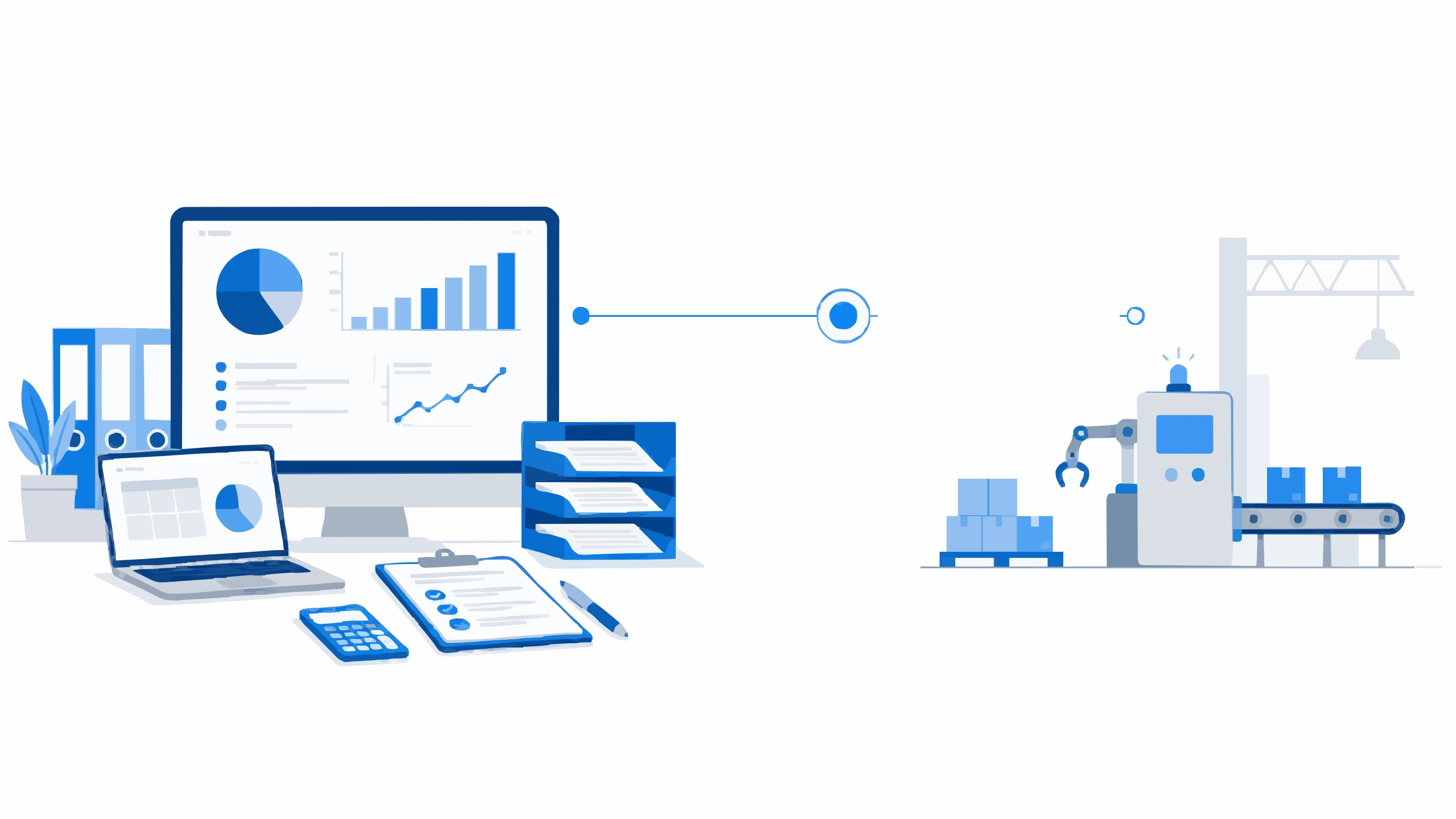
The ERP plans the company: finance, purchasing, inventory, orders. The MES executes and controls the plant: which machine produces what, when, and with what quality. You need an MES when real-time visibility and shop-floor control become critical to your business. The practical recommendation is simple: use the ERP as the source of orders and add an MES when the plant becomes the bottleneck, integrating both according to the ISA-95 standard.
In summary:
An MES is needed on the plant floor when real-time visibility and machine control become critical to reducing microstops and improving performance.
Effective integration between MES and ERP is based on the ISA-95 standard, allowing both systems to share information without duplicating data or creating manual errors.
The greatest advantage of an MES lies in the automatic, real-time capture of production data, which makes it possible to improve OEE, reduce rejects, and optimize inventory.
Platforms such as Bold Factory make rapid implementation easier for SMEs, offering unified management with simple communication with the ERP and the use of artificial intelligence for repetitive tasks.
The decision to invest in an MES should be based on indicators such as inventory discrepancies, traceability requirements, or recurring operational losses before scaling up across the entire plant.
Table of contents
-
What an ERP is: scope, common modules, and limitations on the plant floor
-
Key differences and questions to ask yourself before investing
-
Practical MES↔ERP integration: what goes down, what comes up, and the role of ISA-95
-
When your company needs an MES: signs, size, and ROI expectations
-
Measurable benefits after integrating MES and ERP, and which metrics to track
What an MES is: typical functions, users, and connectivity
A manufacturing execution system (MES) captures what happens on the plant floor in real time, not what was planned to happen. It translates production orders into specific instructions for each machine and operator, and returns accurate data about what was actually manufactured.
Typical MES functions include:
-
Real-time data capture from machines, sensors, and operators.
-
OEE (overall equipment effectiveness) calculation to detect performance losses.
-
Control and sequencing of production orders on the plant floor.
-
Traceability of batches, materials, and processes.
-
Quality and incident management during production.
-
Electronic batch records (EBR) for regulated processes.
It is used by operators and supervisors, with a time horizon ranging from seconds to full shifts. Its data sources include PLCs, SCADA systems, barcode readers, sensors, and manual operator input—something a standard ERP rarely captures at that level of detail, as GE Vernova explains.
What an ERP is: scope, common modules, and limitations on the plant floor
An ERP centralizes information from across the company to plan resources and make business decisions. It manages money, suppliers, and forecasts, but it is not designed to run a machine in real time.
Its most common modules are:
-
Finance and accounting.
-
Purchasing and supplier management.
-
Inventory control at an aggregate level.
-
Sales and order management.
-
Material requirements planning (MRP).
The ERP's time horizon is weeks or months, and it is used by finance and planning teams, not line operators. Its main limitation appears in its level of granularity: an ERP may know how many units were manufactured during a shift, but not why a machine had a microstop at 10:47 or which exact batch passed through each station. NetSuite points out that this lack of real-time data is precisely the gap an MES is designed to close.
Key differences and questions to ask yourself before investing
The comparison between MES and ERP is not about which is better, but about which problem each one solves. The ERP works with aggregated data and long cycles; the MES works with individual events and cycles measured in seconds.
| Dimension | ERP | MES |
|---|---|---|
| Scope | Entire company | Plant and production line |
| Data speed | Days, weeks | Seconds, minutes |
| Granularity | Orders, aggregated batches | Machine, operation, part |
| Typical owner | Finance, planning | Production, quality |
Before deciding what to add to your operation, ask yourself three specific questions: Are you looking for accounting accuracy or to improve your lines' OEE? Do your customers or audits require batch traceability back to the source of each raw material? Do the inventory counts reported by the ERP match what is actually on the plant floor, or do they vary from line to line?
The most common mistake is trying to force the ERP to store plant-floor data without an intermediate layer to structure it. The result is generic fields, manual updates, and traceability that breaks during the first serious audit.
Practical MES↔ERP integration: what goes down, what comes up, and the role of ISA-95
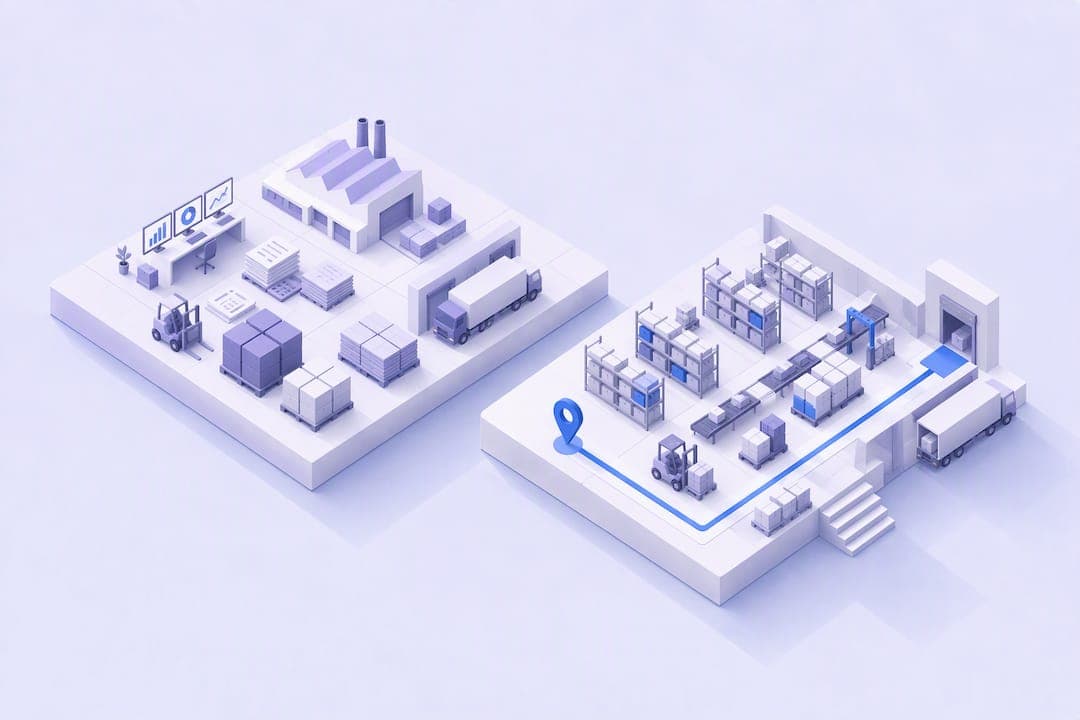
Integration works best when each system does only what it knows how to do, and both communicate through clear interfaces. The ISA-95 standard formalizes this separation between the enterprise level (Level 4, where the ERP resides) and the operations level (Level 3, where the MES resides), avoiding duplicate information and defining what data crosses the boundary between them.
The typical flow follows this sequence:
-
The ERP releases production orders, bills of materials (BOMs), and manufacturing routings to the MES.
-
The MES prioritizes and sequences those orders according to the actual availability of machines and personnel.
-
The plant executes, and the MES captures actual consumption, cycle times, quality confirmations, and traceability data.
-
The MES returns this consumption and these confirmations to the ERP, which adjusts inventory and actual costs.
This division of responsibilities is exactly what GE Vernova describes when explaining how the ERP releases orders and the MES returns actual execution data.
Professional tip: define unique identifiers for items and batches before connecting the two systems. Without a common key, inventory reconciliation becomes a permanent manual task instead of an automated process.
Synchronization frequency matters as much as interface design: synchronizing every shift works for many SMEs, but critical quality processes often need almost immediate updates.
When your company needs an MES: signs, size, and ROI expectations
Not every plant needs an MES from day one. There are specific signs that indicate the ERP is no longer enough to manage production:
-
Recurring discrepancies between what the ERP says was produced and what is actually in the warehouse.
-
Customer audits requiring complete genealogy of batches and raw materials.
-
A real need to measure OEE to justify investments in machinery or shifts.
-
Frequent microstops that nobody records because there is no system to capture them automatically.
The plants that benefit most from an MES are those with more than one production line or processes where quality is critical, such as precision machining, manufacturing regulated components, or packaging with the traceability required by the customer. According to Allied Solutions Global, line-level pilots often show visible improvements in OEE and reductions in rework during the first quarter after implementation, before scaling to other lines or plants.
Measurable benefits after integrating MES and ERP, and which metrics to track
OEE (overall equipment effectiveness) combines availability, performance, and quality into a single number that shows how much of your installed capacity is truly being used. An MES captures it automatically from machine events, something rarely available in a conventional ERP, according to NetSuite.
In numbers: plants that integrate real-time data capture usually identify the causes of performance losses (microstops, changeovers, rejects) sooner because the MES records each event as it happens, rather than relying on manual reports at the end of the shift.
The practical effects show up in three areas: a lower rejection rate by detecting deviations sooner, greater inventory accuracy by reconciling actual consumption with the ERP, and shorter cycle times by identifying real bottlenecks. To justify the investment, translate these data into euros: downtime minutes avoided per week, fewer rejected units, manual counting hours eliminated...
Start with a pilot, not an entire project
Implement in phases: choose one line, measure OEE before and after, and use the data to decide whether to scale up. Never activate an MES without clean master data or a reconciliation plan with the ERP, or you will spend weeks correcting inventory instead of improving production.
Bold Factory is an alternative to custom development when you need production control integrated with your ERP, without months of project work or contractual lock-ins. It brings MES, planning and purchasing, warehouse management, and maintenance together in a single platform designed for discrete manufacturing shops, with an API connection to the ERP for exchanging production orders and data on consumption, times, and OEE.
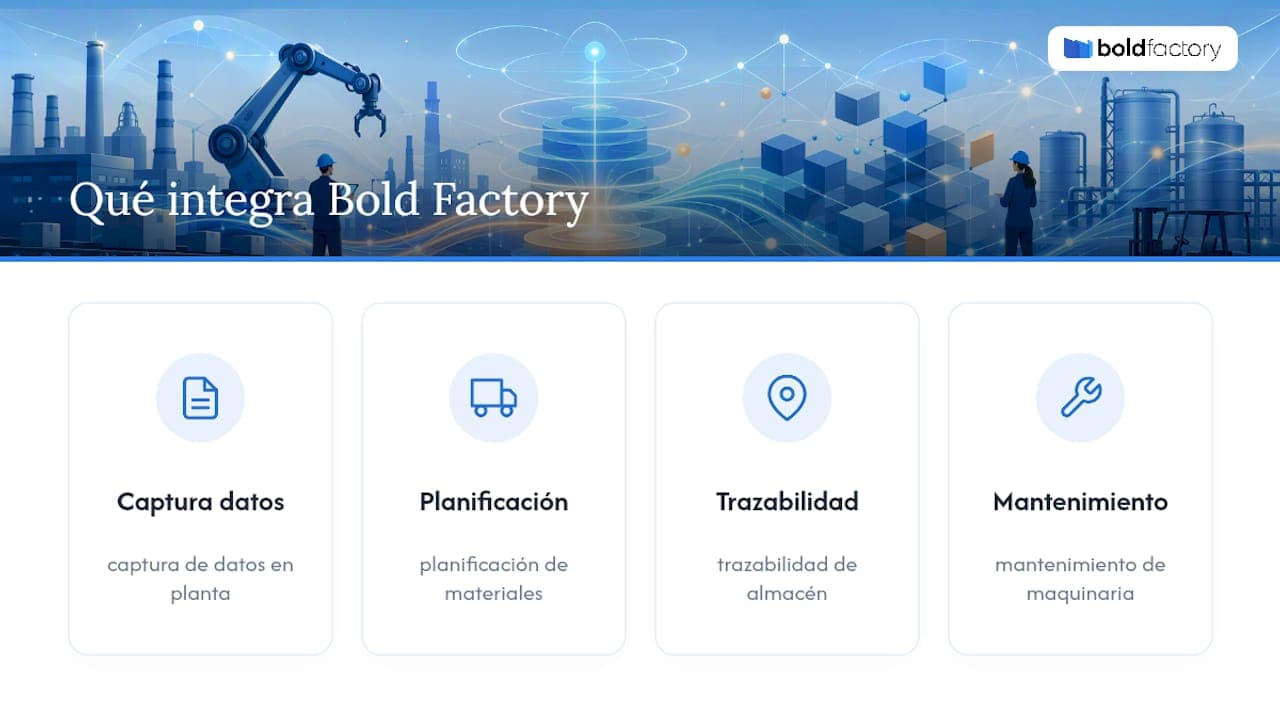
The platform integrates plant-floor data capture, materials planning, warehouse traceability, and machinery maintenance in a single system with an intuitive mobile interface, and uses AI agents for repetitive tasks through natural-language instructions, helping the production manager.
Implementation time is usually short, with an accessible interface for operators on mobile and AI agents to automate repetitive tasks through natural-language instructions, avoiding lengthy projects or contractual lock-ins.
If you manage a metalworking, machining, furniture, textile, or packaging factory and want to see how this integration would work in your plant, you can request a demo of the industrial production control software and find out in just a few days whether the pilot improves your OEE.
Sources
To design your own integration, consult the ISA-95 standard, the technical resources from MESA, and comparative analyses such as SynaptixPlatform on selection criteria.