UX as a Driver of Adoption and Efficiency in the Digital Factory

2026-01-08
Industrial digitalization rarely fails because of a lack of technology. It fails because of a lack of real adoption. There’s little point in implementing a system packed with features if the people who are supposed to use it see it as a burden, don’t understand it, or don’t trust it. In manufacturing SMEs, where resources and training time are limited, UX is the deciding factor in turning software into an everyday tool rather than a failed project.
Onboarding and adoption in factories
At Bold, the onboarding process for new users is designed to make the barrier to entry as low as possible. Don’t get me wrong: initial resistance exists with any B2B software. Leaving familiar processes behind, learning a new interface, or making time for training often meets with resistance. But in industry, that resistance is even greater, because many operators aren’t used to digital tools.
The idea that “writing it down on paper is faster” persists here, and managers worry that training sessions will interrupt production. That’s why onboarding can’t be treated as a series of static manuals, but rather as an active, guided, and ongoing process.
- Contextual help: the system provides explanations only when needed, without overwhelming users with irrelevant information.
- Getting-started checklists: these let each user complete basic tasks (create an order, launch a production order, record consumption) and quickly build confidence.
- Integrated walkthroughs: interactive guides that appear within the application, showing users where to click and what each step means.
These aids prevent information overload and help get the system into real-world use within hours.
Another distinguishing feature is the use of real factory data from the outset:
- Operators learn to record operations using products they recognize.
- Supervisors see machines and workstations they actually manage on the dashboard.
- Managers analyze reports with figures they’re familiar with.
This immediate connection to reality builds motivation and trust, because the value of the system is clear from day one.
The result is a learning curve reduced to a minimum. An operator can record consumption or incidents after their first shift, a supervisor can monitor the factory in real time without needing additional courses, and a manager can generate basic reports with just a couple of clicks. This speed is essential in factories where training time competes directly with production time.
Ultimately, onboarding at Bold isn’t a formality, but a design strategy focused on adoption. By reducing resistance to change, guiding users through their first steps, and showing tangible results from the very first minute, digitalization stops being a promise and becomes everyday factory practice.
UX as a driver of efficiency and returns
In B2B software, good UX is often measured by fewer support tickets, less training time, or higher retention rates. In factories, however, the impact is deeper: usability becomes a direct driver of operational efficiency and financial returns.
Bold’s user-centered design doesn’t just make everyday work easier; it also improves data quality and, in turn, decision-making. When the interface is clear, recording errors decrease and information becomes reliable, making it possible to plan accurately and control costs. A solid database is the starting point for any improvement.
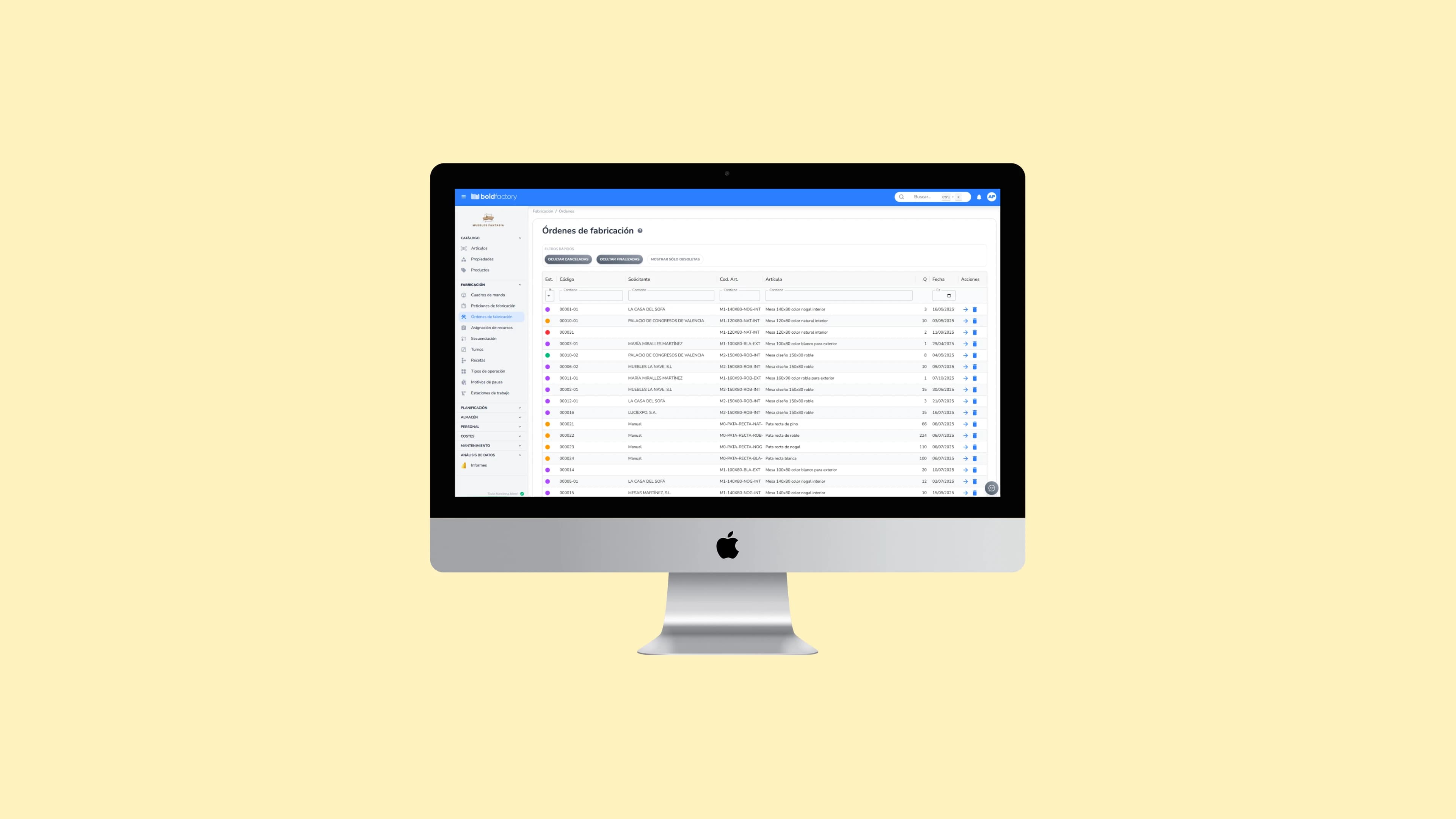
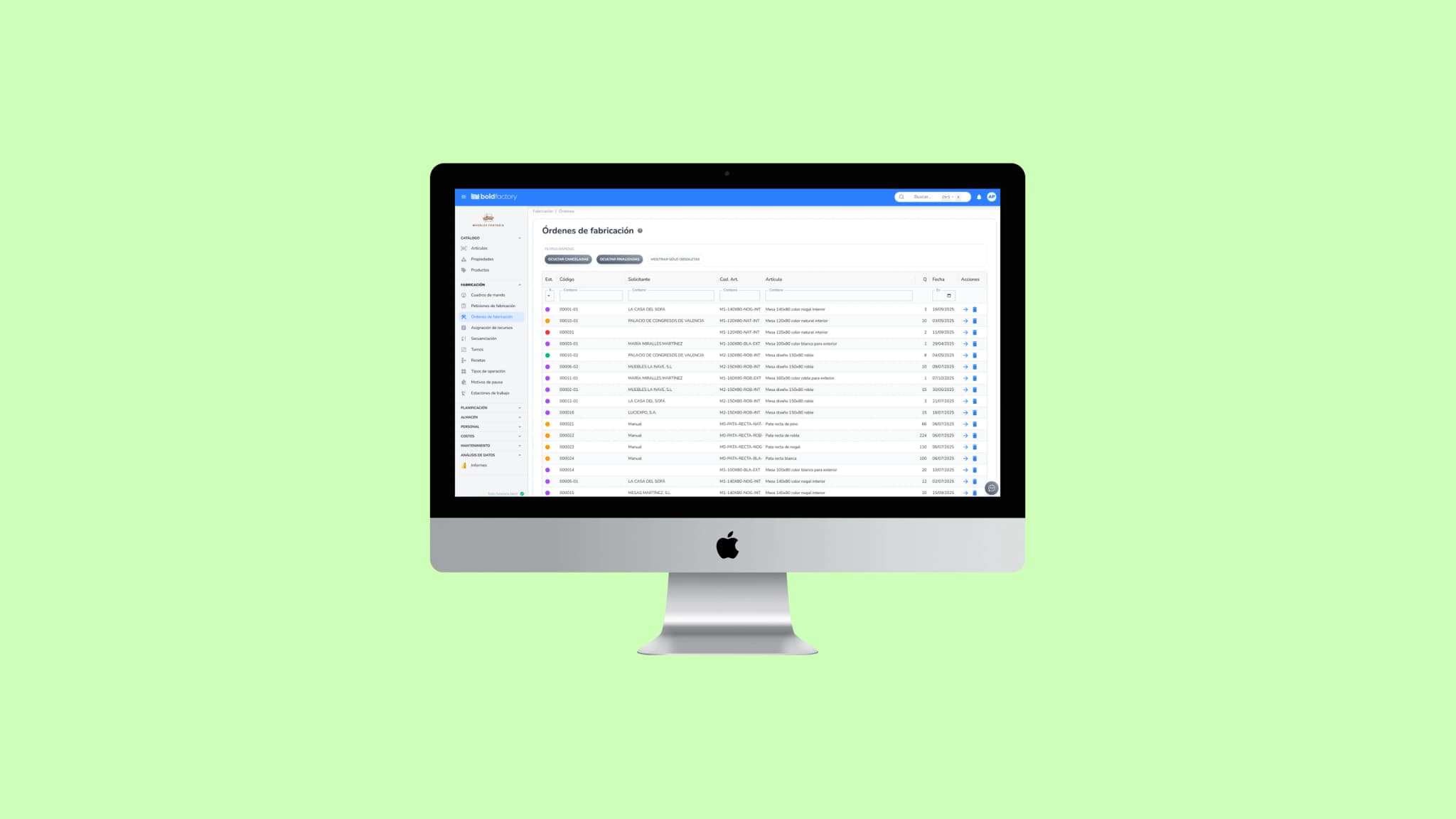
A well-designed dashboard doesn’t just display figures: it immediately highlights stoppages and delays, sends alerts when an order stalls, and makes it possible to connect maintenance failures with production or delivery delays. This way, problems are detected before they escalate and downtime is reduced.
In addition, a usable system helps users learn from the history of incidents. At Bold, incidents are recorded in a structured way, making it possible to identify patterns, take preventive measures, and avoid recurrence. The result is a more stable operation, with fewer interruptions and greater confidence in deliveries.
All of this has a direct impact on the KPIs (key indicators) that matter most to any SME: on-time deliveries, greater resource productivity, lower costs, and a more agile response to the market. In this sense, UX stops being an aesthetic consideration and becomes a strategic factor in competitiveness.
UX trends for B2B SaaS and how Bold applies them
UX is evolving rapidly. Artificial intelligence, language models, open integrations, and new forms of interaction are redefining the relationship between people and software. In factories, these innovations aren’t a luxury: they’re real opportunities to reduce friction, accelerate adoption, and increase efficiency.
At Bold, these trends are applied with a very clear focus: making digitalization simple and practical for any SME, regardless of its size or technological maturity.
1. Artificial intelligence and LLMs as copilots
Users no longer have to learn menus or memorize navigation paths: they can interact with the application conversationally. Thanks to language models, complex tasks become simple, direct questions such as:
Which orders are delayed?
Start manufacturing order 367 on the new machine.
At Bold, this takes the form of Boldy, our integrated chat assistant. Today, it answers questions and provides guidance on using the application, but the roadmap goes further: Boldy will be able to carry out actions directly when asked. From generating a productivity report to rescheduling production orders, the goal is for Boldy to move from being a guide to becoming an active digital operator within the factory.
In addition to this conversational interaction, AI-powered automation is already being applied to tasks with a direct impact on the shop floor, such as automatic replenishment: the system detects when projected stock will fall below the reorder point and generates purchase or manufacturing requirements without manual intervention.
2. Frictionless integration through open APIs
Another classic B2B challenge is integration. Rather than forcing SMEs to change their systems, Bold offers open APIs that let customers connect the platform to ERPs, CRMs, or tools specific to each customer. This eliminates duplication, reduces manual errors, and creates a flexible ecosystem rather than a closed software system.
3. New ways to interact: AR and voice
The future of industrial UX isn’t just about screens. Technologies such as augmented reality (AR) and voice control can transform the way operators work. An instruction projected directly onto a machine, or the ability to record an incident without taking your hands away from the task, reduces interruptions and improves safety on the shop floor.
Although these trends are still seen as experimental, they have immediate transformative potential in an industrial context: reducing interruptions and improving safety on the shop floor.
Conclusion
User experience is no longer an aesthetic detail, but the factor that determines whether a B2B SaaS solution is adopted or abandoned. For manufacturing SMEs, where every second counts, usable software is the difference between failed digitalization and an efficient factory.
Bold is built on this premise: simplifying industrial digitalization with an MOM platform designed around the experience of everyone from the operator to the manager.
👉 Request a demo and discover how Bold adapts to your processes.