Digital Kanban for Industrial SMEs: What It Is and How to Try It

2026-04-28
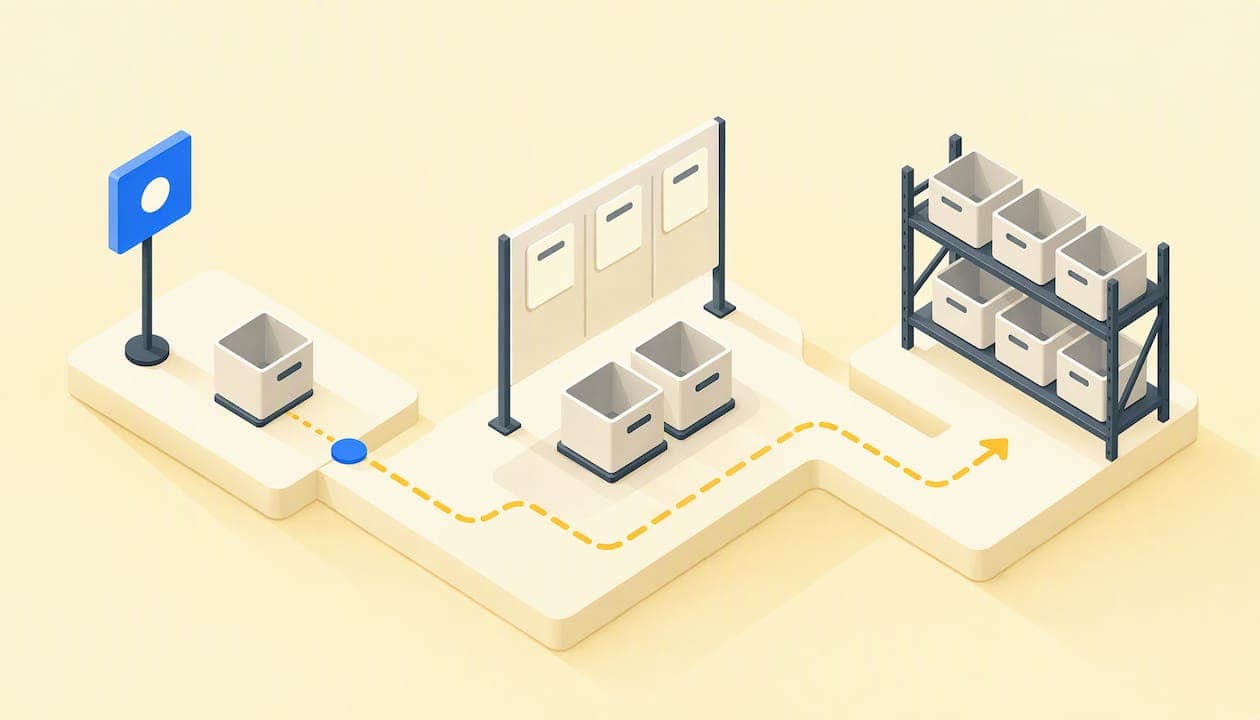
Digital kanban is an electronic signaling system that replaces physical cards with automated alerts integrated into the MES or ERP. Its immediate benefit is reducing material shortages through synchronized PULL control between the plant and purchasing. It is worth implementing when a line experiences recurring stockouts of standard parts or accumulates excessive safety stock for no clear reason. In that situation, a limited pilot is usually enough to demonstrate the impact before deciding whether to roll it out across the entire factory.
In summary:
Digital kanban is recommended only for lines with recurring shortages or excessive inventory for no clear reason, starting with limited pilots.
The technology uses electronic signals integrated into the system to record each replenishment, making it easier to analyze patterns and adjust stock using precise data.
It is essential to clean up master data and define clear metrics before starting the pilot, as well as train operators in the daily review routine.
Technical integration requires precise mapping, consistent transactions, and an API connection to the ERP, which is crucial for avoiding automatic replenishment errors.
Pilot success is measured using indicators such as reduced shortages, response time, inventory turnover, and warehouse space freed up.
Table of contents
-
What digital kanban is and what it offers over physical kanban
-
Technical integration and hardware options: what to choose on the shop floor
-
Which KPIs to measure and how to calculate return on investment
-
How Bold Factory speeds up a digital kanban pilot in your factory
What digital kanban is and what it offers over physical kanban
E-kanban turns a consumption signal (scanning a code, pressing a smart button, or reading a sensor) into an electronic order that goes directly to the warehouse, MES, or purchasing module. There is no longer any need for an operator to walk to a card mailbox or for someone to collect the cards by shift: the system triggers replenishment at the exact moment of consumption.
The difference from paper is not just speed. When the signal is integrated into the system, each replenishment cycle is recorded, and that historical record makes it possible to detect consumption patterns (weekly peaks, bottlenecks on certain shifts) that a physical board would never reveal, making it easier to adjust safety stock using real data instead of intuition. E-kanban also eliminates the so-called “silence gap”: the time between when a container is emptied and when someone finds out.
The practical advantages over paper kanban can be summed up in three points:
-
Full traceability for every replenishment, including date, quantity, and person responsible.
-
Consumption history that makes it possible to recalculate buffers without taking a manual inventory.
-
Container quantity adjustments in minutes, without reprinting physical cards.
Practical checklist for implementing a digital kanban pilot
A well-scoped pilot avoids the most common mistake among SMEs: trying to digitize the entire plant all at once. It is best to follow a specific sequence.
-
Map the actual consumption points and choose candidate parts, prioritizing standardized components (C-parts) with high turnover and low unit value.
-
Clean up the master data before touching the hardware: supplier lead times, the exact quantity per container, and the physical location of each replenishment point.
-
Set up the pilot with a limited scope: two or three lines, minimal hardware (buttons or e-paper labels), and a fixed number of digital cards per part number.
-
Define metrics and duration, usually between 8 and 12 weeks, with clear thresholds for deciding whether to scale up.
-
Train operators in the daily routine: who reviews exceptions and who responds if a replenishment does not arrive on time.
Professional tip: do not start the pilot without first correcting the quantities per container. Digitizing a poorly calculated replenishment rule only makes the error repeat faster, with less human oversight to stop it.
Technical integration and hardware options: what to choose on the shop floor
Not all signaling technologies serve the same purpose. E-paper labels update consumption information in real time and offer years of battery life, making them ideal for shelving where electrical infrastructure is limited. Smart buttons are the cheapest and most straightforward option for assembly lines: the operator presses one and the order is sent instantly. RFID and fill-level sensors, on the other hand, are better suited to silos or tanks where measuring physical volume is more reliable than counting units one by one.
E-paper technology combined with API integration provides immediate visibility without losing the visual quality that makes kanban useful on the shop floor.
The critical part is not the sensor; it is the integration. Any system needs:
-
Precise mapping between physical locations and system locations.
-
Consistent stock transactions between what happens on the shop floor and what the ERP records.
-
Connectors or APIs to the MES and ERP that trigger replenishment without manual intervention.
In SAP S/4HANA, for example, scanning an empty container can trigger a transfer or an automatic purchase order. If the physical movement and the system movement do not match, backflush errors arise, requiring a clear exception procedure—not just the operator’s goodwill.
Which KPIs to measure and how to calculate return on investment
Four indicators are enough to assess a digital kanban pilot: the percentage of stockouts, the response time between the signal and actual replenishment, inventory turnover, and the square meters of warehouse space freed up. A fifth indicator, backflush incidents, shows whether synchronization between the shop floor and the system is failing.
The data that drives the decision: a documented industrial pilot in the GEDIA case reported significant inventory reductions alongside a notable improvement in material availability.
To calculate the savings, simply multiply the inventory reduction in euros by the cost of tied-up capital, then add the avoided cost of each production line stoppage caused by a missing part. E-kanban itself captures this data automatically during the pilot, with no need for a parallel manual count.
Common mistakes and what the organization needs
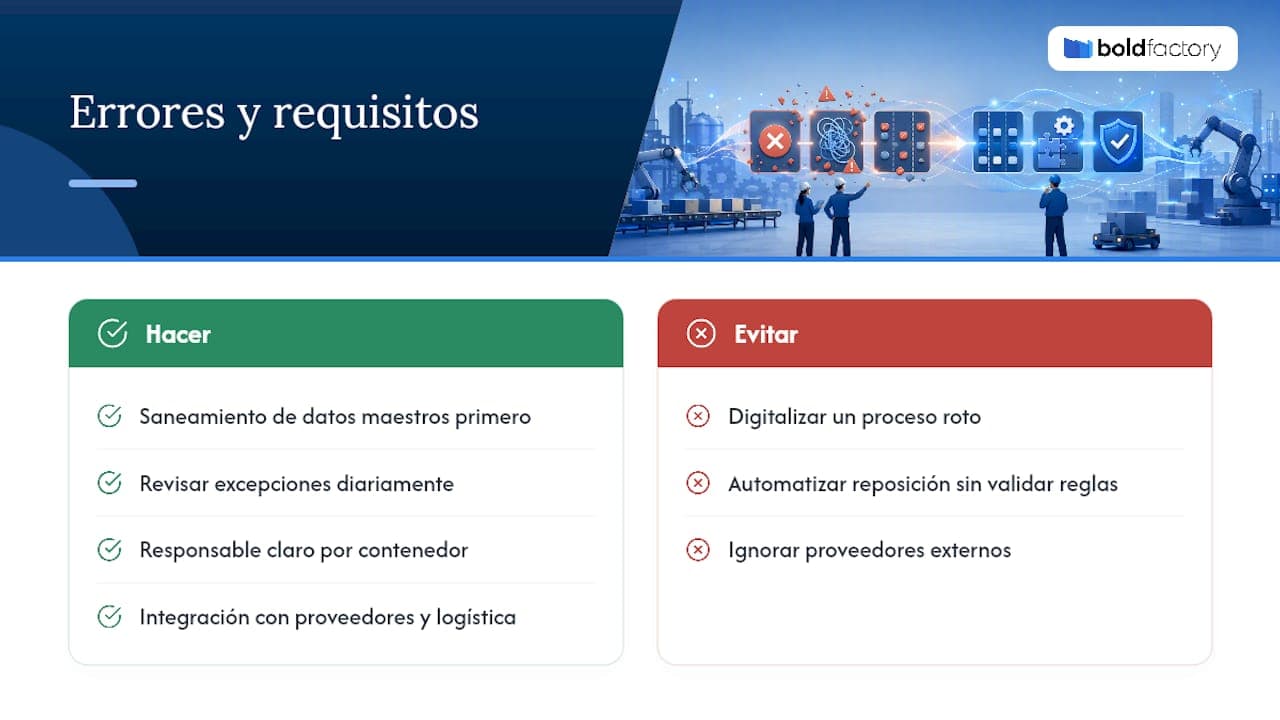
The most common failure is not technological: it is digitizing a process that was already broken. Automating a poorly calculated replenishment rule only speeds up the chaos; it does not fix it. Master data cleanup must always come before the hardware.
The second non-negotiable requirement is PULL discipline. Someone must review exceptions every day, and each container must have a clearly assigned owner, or the system becomes an alarm that nobody responds to. If external suppliers are part of the Kanban flow (coaters, subcontracted machinists), they need effective integration with suppliers and contract manufacturing logistics: without them, automatic replenishment stops at the factory boundary and the problem is simply shifted outside.
Case study: results from a real industrial pilot
The GEDIA case in Spain illustrates the pattern well. The plant introduced e-Kanban control, even integrating an external supplier into the replenishment flow—something unusual in initial deployments. The lesson for an SME is straightforward: start with a limited pilot, but do not leave critical suppliers out from day one.
What to ask for in a demo before deciding
Ask for fast integration (days, not months), actual use by an operator on a tablet, and a concrete example from your industry. Be wary of anyone promising “no preparation”: if they do not ask about your master data, they have not understood your operation.
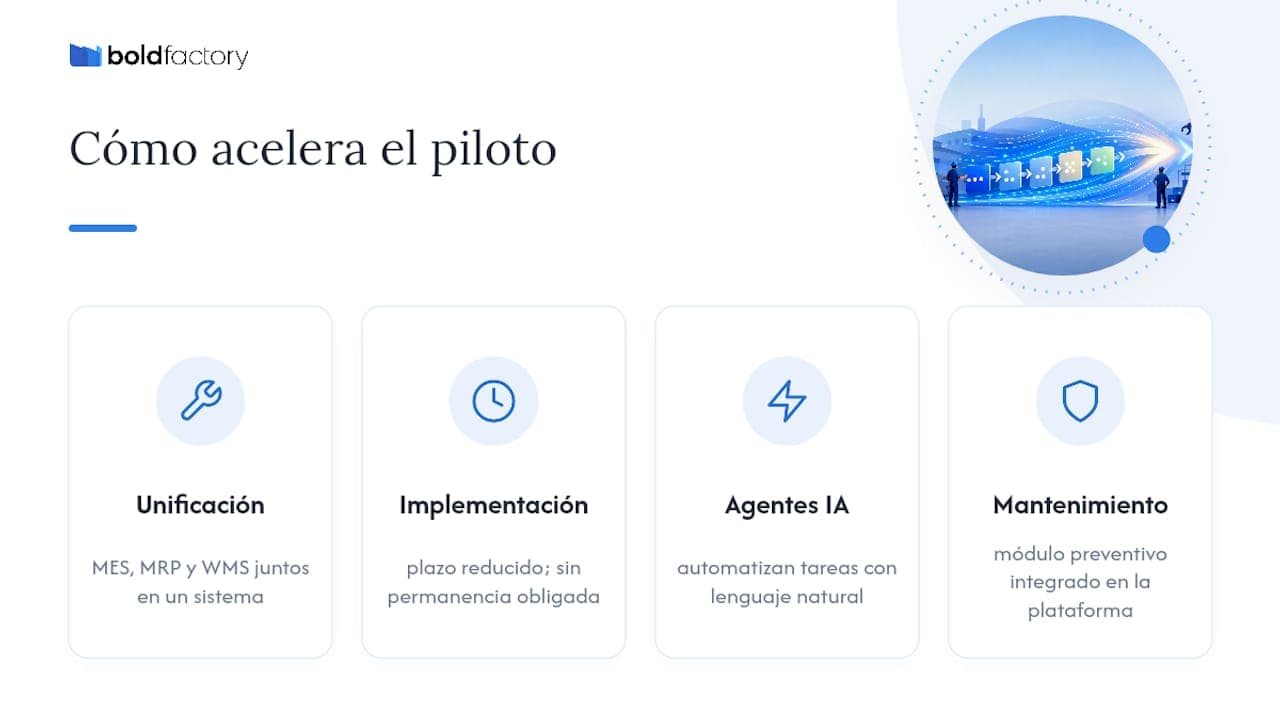
Bold Factory reduces the time between deciding on a digital kanban pilot and seeing it running on the shop floor, because it brings together in one system what normally requires three separate projects: production (MES), planning and purchasing (MRP), and warehousing (WMS). This unification is precisely what prevents the mismatch between physical movement and the system that ruins so many automatic replenishment pilots.
The platform can be implemented in a short time and without a mandatory commitment, features that may set it apart from some custom developments used in similar projects. The platform includes AI agents that automate repetitive tasks through natural-language instructions, and its interface is designed to make it easy to use on mobile devices. If you want to complement the workflow with preventive maintenance for the machinery involved, the maintenance management module is integrated into the same environment.
If your plant has already identified candidate lines, the logical next step is to request a demo of Bold Factory’s MES system, with objectives and success metrics defined in advance, exactly as outlined in the pilot checklist.
Sources
To explore the technical logic of e-kanban and its integration in more depth, it is worth reviewing the Kanban flow in SAP S/4HANA, the analysis of real-time replenishment, and the GEDIA industrial case study.
-
Technical document on the advantages of digitally recording Kanban cycles
-
Just-in-time material supply: Pull List & Kanban (SAP Learning)
Frequently asked questions
What is the difference between digital kanban and physical kanban?
Physical kanban uses paper cards that an operator moves manually; digital kanban sends the same consumption signal electronically, integrated into the MES or ERP, without manual intervention to transmit it.
How long does a digital kanban pilot take?
A period of several weeks is usually enough to validate metrics for shortages, response time, and inventory turnover before deciding whether to scale it to the entire plant.
Which parts should be digitized first?
Standardized components with high turnover and low unit value (C-parts), because they deliver visible benefits quickly and minimize pilot risk.
Does digital kanban replace the ERP or MES?
No. Digital kanban is the consumption signaling layer that integrates with the MES for production and with the MRP for purchasing; platforms such as Bold Factory already include it as part of the same system.
What happens if the master data is wrong before digitization?
Automation amplifies the error instead of correcting it, so lead times, quantities per container, and locations must always be cleaned up before any hardware is installed.